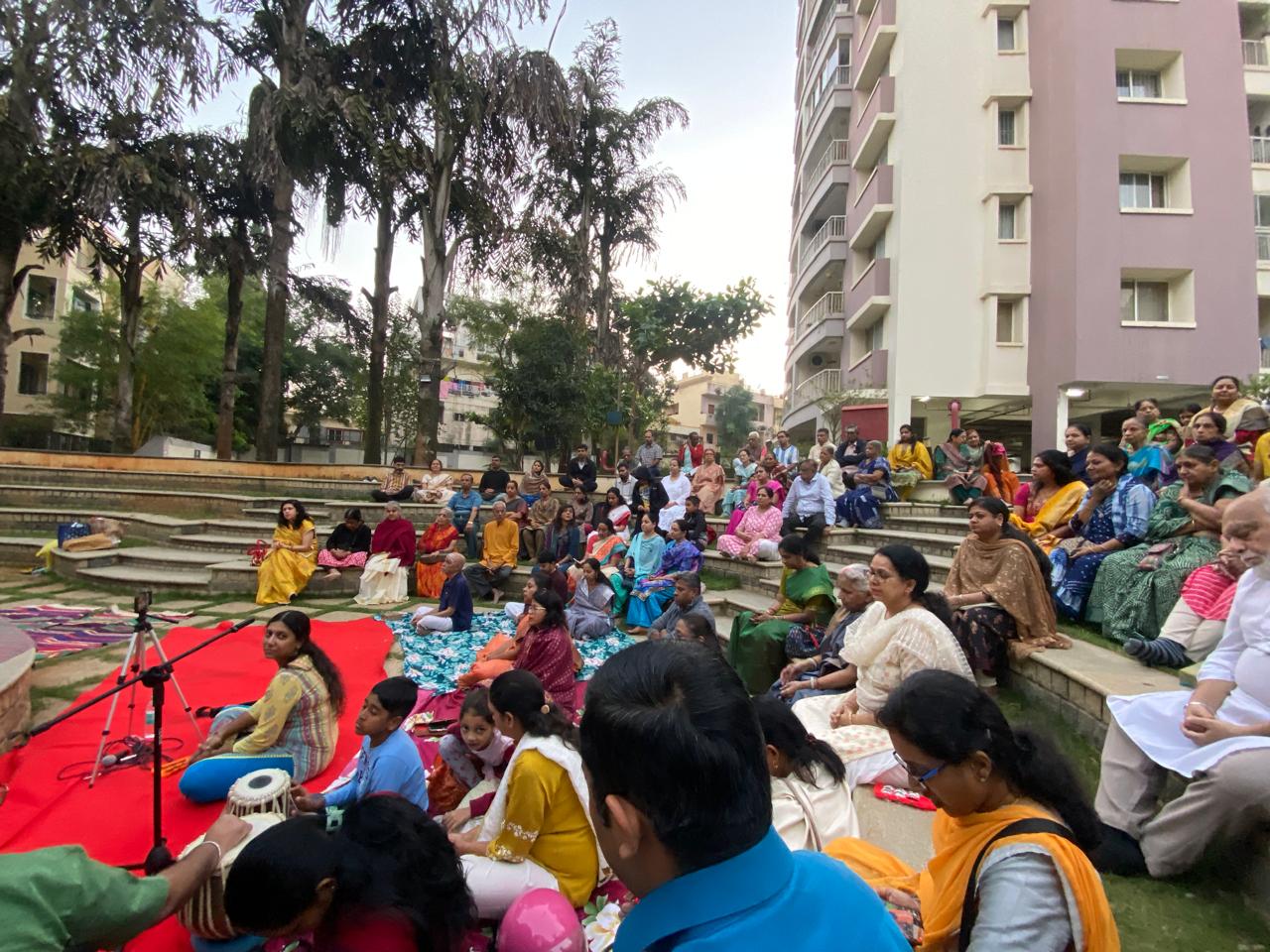
We decided to celebrate three and a half decades of togetherness with a comprehensive and spiritually elevating pilgrimage, which we thought is a beautiful way to honour our journey which would not have been possible without blessings of Divine. We remain eternally grateful to Pujya Gurudev Sri Sri Ravi Shankar ji, Founder of The Art of Living whose blessings and love has guided us all along.
Thirty-five years is a lifetime of shared glances, whispered prayers, and the quiet resilience of a love that has matured into a sanctuary. To celebrate this milestone with Aparna, we didn’t just plan a trip; we embarked on a soul-stirring journey of Divine Permission, seeking the grace that has held our hands together since our first step as a couple. Our pilgrimage began in the humble, water-blessed town of Kanipakkam. Standing before Swayambhu Shri Varasiddhi Vinayaka Swamy in Kanipakkam, I felt a profound sense of beginning. Just as the Bhagwan here is said to be Swayambhu, self-manifested and ever-growing, I realized our marriage has been much the same. We started with so little, yet under His watchful eye, our bond has expanded, outgrowing the silver armour of our youth to become something far more substantial.


With the silent strength of Kanipakkam Shri Manikanteshwara Swamy and Kanipakkam Shri Varadaraja Swamy grounding our pilgrimage in the foundational strength of the Trinity, ensuring that as we looked back on thirty-five years, we did so with hearts cleansed of obstacles and spirits aligned for the ascent. We felt the obstacles of the ego melt away, replaced by a sacred permission to move closer to the divine heart.


As we traveled to Srinivasa Mangapuram, the air seemed to soften, carrying the fragrance of a timeless union. There is a specific tenderness in the Shri Kalyana Venkateshwara Temple; it is the place where the Bhagwan paused His celestial duties to simply be a husband, honoring the rites of marriage with Padmavathi Devi. It was here, in the very place where the Bhagwan and Padmavathi Devi stayed as newlyweds, that we felt the weight of our own vows. Walking through these halls felt like a quiet conversation with time, a reminder that the early days of a marriage are the seeds of a lifelong sanctuary. Looking at Aparna in that light, I was overcome with the realization that our thirty-five years were not just a sequence of days, but a long, beautiful stay in the ashram of life.


With the sense of peace that Darshan of Shri Kalyana Venkateshwara, softening our hearts for the raw, elemental and intense energy of Shri Kalahasteeshwara Temple. In the presence of the Vayu Lingam, amidst the stone and shadow, watching the lamp of the Vayu Lingam flicker with an unseen breath that defied the stillness of the air, we offered our gratitude for the breath of life that has sustained our union, acknowledging the three creatures—the spider, snake, and elephant—who proved that devotion requires no status, only a surrendered heart.


I could not help but feel a surge of gratitude for the very air we’ve shared. In thirty-five years, there are moments when the wind of life blows hard, yet like that lamp, the flame of our companionship has never gone out. It was a moment of deep, human recognition, that we are sustained by a grace we cannot see, but can always feel.
The emotional heart of our pilgrimage peaked during the Kalyanotsavam at Tiruchanoor. Celebrating the Divine Mother’s wedding on the eve of our own anniversary felt like a profound grace. As we watched the sacred rituals of Shri Padmavathi Ammavaru, our thirty-five years together flashed before us—a journey sustained entirely by her compassionate gaze. She is the ultimate mediator who prepares the seeker to meet the King. Witnessing her union reaffirmed that our bond is but a soft echo of that eternal harmony. I found myself thanking the embodiment of Karuna for being the silent guardian of our home throughout the decades. Tradition holds that one must seek the Mother’s intercession before approaching the Bhagwan; sitting there, I felt her blessing our shared history and graying years, smoothening the path for the Venkateshwara Darshan to come.


This feeling of being carried brought us to the foothills of Tirumala, Alipiri. Kneeling at the Padhala Mandapam and pressing our foreheads to the Venkateshwara Paduka, we were no longer the successful professionals or the heads of a family; we were simply two pilgrims, humbled by carrying the Srivari Padukas around the Alayam 3 times. Walking through the Lakshmi Narasimha Temple and performing the Sapta Gau Pradakshina, the gentle breath of the cows and the ancient stones seemed to wash away the weariness of the decades, leaving us light and ready for the summit.


We ascended to Tirumala not as tourists, but as guests of the Bhagwan. We first bowed to Shri Varaha Swamy, the ancient protector of the hills, thanking him for the land we have occupied in this world and for the permission to finally enter the inner circle of the Bhagwan’s presence. The final walk through the specialized shrines of Tirumala felt like reviewing the facets of a diamond. We sought wisdom at Shri Hayagreeva’s feet, protection from Ahobilam Shri Lakshmi Narasimha, and felt the sweet, playful joy of our youth again at the Shri Radha Krishna Swamy Temple. Seeing Shri Bedi Anjaneya standing guard, eternally bound by love and duty, reminded me of the strength required to protect a home for thirty-five years.


We were blessed to witness the beginning of Salakatla Vasanthotsavam is a centuries-old, three-day spring festival held at the Tirumala Sri Venkateswara Temple from March 30 to April 1. It celebrates the arrival of spring through purification rituals, sacred ceremonies, and a ceremonial procession of the deities through the Mada Streets.


About Sri Srinivasa Divya Anugraha Homam
On our 35th Anniversary, in the hustle bustle of the daily lives, we sat before the sacred fire of the Shri Srinivasa Divya Anugraha Homam. As the offerings were made to the flames, I closed my eyes and saw a montage of our lives, the early struggles, the raising of amazing children – Divya and Vishnu, the quiet evenings, and the loud celebrations when Apple of our eye and a major source of joy in our lives today, Grandson Anay. This Anugraha or divine favour felt like a warm mantle being wrapped around our shoulders. It was the final clearance, the ultimate yes from the heavens.

Shri Srinivasa Divya Anugraha Homam is a beautiful new chapter in the spiritual journey of Tirupati pilgrims. As explained by the Archaka, for a long time, many devotees felt that performing a special Seva at the feet of Bhagwan Venkateswara was a difficult task, often involving long waits or complex bookings, especially the Nitya Homas in Ananda Nilayam (Tirumala abode of Bhagwan). TTD has simplified things by introducing this Homam at Saptha Go-Pradakshina Mandapam in Alipiri. By shifting this powerful ritual to the base of the hills, they have made it possible for the common man to sit before the sacred fire and offer their prayers directly before they even begin their climb to the top, literally the Ananda Nilayam.
When you enter the Mandapam, the atmosphere is immediately different from the heavy rush of the main temple lines. There is a sense of calm as you see rows of devotees sitting with their families, guided by Vykhanasa priests who chant the holy names of the Bhagwan. Though I don’t remember the names of the priests in the rituals, we were extremely blessed to hear from one the priest (Photograph shown below) with a tinge of humour explaining significance of each and every aspect of this homam. His chanting and explanations was ultimate topping for participants in this homan.

The ritual is centered around Agni, the fire god, who is believed to be the messenger carrying our deepest sankalpas or wishes to Srinivasa Himself. As the ghee and sacred herbs are offered into the flames, the sound of the chants fills the air, creating a vibration that stays with you long after the ceremony ends. It feels like a personal conversation with the Divine, away from the pushing and pulling of the general crowds.
What makes this experience special for an Indian family is the inclusion of the Go-Shala nearby. In our culture, the cow is a symbol of immense purity, and performing a ritual in a place dedicated to Sapta Gau Mata (all Indian Breeds) adds double blessing to the day.


You don’t just leave with a piece of silk cloth or some prasadam; you leave with a heart that feels lighter and a mind that is focused on the Bhagwan. It is a perfect way to start your pilgrimage, reminding every devotee that in the eyes of Balaji, everyone is invited to receive His grace.
The ticket is reasonably priced at Rupees One Thousand Six (₹1600/-), and it permits two people (not necessarily couples), making it an affordable way for a couple to seek divine protection and includes Special Entry Darshan for 2 at 3pm, the same day. Please note that you have to necessarily attend and participate in the Homam and get your tickets scanned and stampled to be eligible for Special Entry Darshan against this Seva. It generally opens at 10:00am on 25th of every month for the subsequent month.
Finally, we stood in the dim, incense-filled sanctum of Bhagwan Venkateshwara. In that electrifying silence, as the camphor lit up the Bhagwan’s face, thirty-five years of life culminated in a single, tearful gaze. There was nothing left to ask for. Looking at Aparna, I realized that the greatest Sthala Purana ever written was the story the Bhagwan wrote for us, a story of two people who set out to find a temple and ended up finding the Divine in each other. Standing at His feet, our hearts simply whispered a thousand times – Hare Srinivasa, Venkataramama Govinda Govinda. Bonus was that extra minute or so we were able to be in His presence to a stoppage of the queue. Every Grateful for the grace showered upon us.
HARE SRINIVAS! OM NAMO VENKATESHAYA
Here is a brief (One-liners) Sthala Purana and significance of the sacred places that we visited:
The Kanipakkam Trinity
Swayambhu Shri Varasiddhi Vinayaka Swamy
The Legend: Centuries ago, three brothers (blind, deaf, and mute) were digging a well. Their shovel hit a stone, and blood started oozing into the water. Upon touching the water, the brothers were instantly cured of their disabilities.
Significance: The idol is Swayambhu (self-manifested) and sits inside a well. Miraculously, the idol is said to be growing in size over the years and continues to grow till the end of Kali Yuga; the silver Kavacham offered years ago no longer fits the deity.
Swayambhu Shri Manikanteshwara Swamy
The Legend: Built during the Chola dynasty, this temple is linked to the penance of a devotee who sought Shiva’s grace.
Significance: It is rare to find a Shiva temple so close to a Ganesha temple. It represents the Panchamukha (five-faced) aspect of Shiva in a subtle form, emphasizing the father-son bond in the divine hierarchy.
Shri Varadaraja Swamy Temple
Significance: Completing the Trinity at Kanipakkam, this temple is dedicated to Bhagwan Vishnu. It serves as a reminder that the protector (Vishnu) and the obstacle-remover (Ganesha) reside together, offering holistic blessings to devotees.
Sacred Environs of Tirupati & Kalahasthi
Shri Kalyana Venkateshwara, Srinivasa Mangapuram
The Legend: After marrying Padmavathi Devi, Bhagwan Venkateshwara stayed here at the ashram of Sage Agastya for six months because, according to ancient rites, newlyweds shouldn’t climb the hills immediately.
Significance: It is considered a powerful alternative for those who cannot climb Tirumala. It is especially significant for couples seeking a blissful married life.
Shri Kalahasteeshwara Temple, Kalahasthi
The Legend: This is the Vayu Lingam, one of the five Pancha Bhoota Sthalas (representing Air). The name comes from three animals: Kala (Spider), Hasti (Elephant), and Sree (Snake), who all attained salvation here through their unique devotion.
Significance: The lamp in the inner sanctum flickers constantly, even though there are no windows or drafts, proving the presence of the Bhagwan as Vayu (Wind).
Shri Padmavathi Ammavaru Temple, Tiruchanoor
The Legend: Goddess Lakshmi manifested here in a golden lotus pond (Pushkarini) after her deep penance.
Significance: Protocol dictates visiting the Goddess first before her Bhagwan in Tirumala. She is the mediator who recommends the devotees’ prayers to Bhagwan Venkateshwara.
The Footsteps of the Bhagwan: Alipiri
Alipiri Padhala Mandapam & Paduka Temple
The Legend: This marks the spot where the Bhagwan placed his first step as he moved from the sky to the earth.
Significance: Devotees touch their heads to the Paduka (holy footwear) to seek permission to begin the climb. It represents humility at the base of the sacred Seven Hills.
Shri Lakshmi Narasimha & Sapta Gau Mandir. Alipiri
Significance: The Narasimha temple provides protection for the journey ahead.
Sapta Gau Pradakshina Mandir is unique for Go-Pradakshina, which is said to wash away the sins of many lifetimes.
The Abode of the Seven Hills: Tirumala
Shri Varaha Swamy Temple
The Legend: Bhagwan Varaha (the Boar incarnation) was the original owner of the Tirumala Hills. When Bhagwan Venkateshwara arrived, he requested a small piece of land.
Significance: Venkateshwara promised that the first darshan and the first offering would always go to Varaha Swamy. A pilgrimage to Tirumala is considered incomplete without this visit.
Shri Venkateshwara Swami Temple
The Legend: Known as Kaliyuga Vaikuntam, the Bhagwan manifested here to protect humanity from the trials of the current age.
Significance: The idol is believed to be live, with real hair and a temperature that stays at 37°C.
Shri Bedi Anjaneya Swamy
The Legend: As a child, Hanuman wanted to leave the hills. His mother, Anjana Devi, tied his hands with Bedi (shackles) and ordered him to stay until she returned. He remains there, facing the main temple, as the eternal protector.
Specialized Shrines (Hayagreeva, Ahobilam Narasimha, Radha Krishna) on the Mada Street
Hayagreeva: The God of knowledge; essential for those seeking wisdom.
Ahobilam Lakshmi Narasimha: Located near the temple, it connects Tirumala to the powerful Narasimha energy of the Ahobilam.
Radha Krishna: A serene spot reflecting the Madhurya Bhava or the sweetness of divine love, fitting for an anniversary celebration.
PS: I have used photos from my December 2025 Pilgrimage in Kanipakkam and Srininvasa Mangapuram