Sanatana Dharma, often referred to as the eternal way or eternal order, indeed stands out for its non-prescriptive and inclusive nature. Unlike many organized religions that have rigid doctrines or mandatory practices, Sanatana Dharma emphasizes:
- Personal spiritual exploration rather than compulsory rituals or dogmas
- Diversity of paths—Bhakti (devotion), Jnana (knowledge), Karma (action), and Raja (meditation)—all considered valid.
- No central authority or single scripture, allowing for a wide range and freedom of interpretations and practices.
- Cultural Pluralism & Respect for individual choice, making it adaptable across cultures and eras.
This flexibility is what has allowed it to evolve organically over millennia while remaining deeply rooted in timeless principles like Dharma (righteous living), Satya (truth), and Ahimsa (non-violence).
Sanatana Way and Skill Development

Integrating Sanatana Dharma’s cultural ethos into skill development can offer a deeply enriching and values-based approach to learning. Its non-mandatory, inclusive, and philosophical nature can be woven into modern skill-building programs:
- Value-Based Learning Framework
Sanatana Dharma emphasizes Dharma (duty/ethics), which can be translated into:
• Workplace ethics
• Responsibility and integrity
• Respect for diversity and collaboration
This can be embedded into soft skills training, leadership development, and vocational education.
- Multiple Paths to growth and bliss
Just as Sanatana Dharma offers many paths to spiritual growth (Bhakti, Jnana, Karma, Raja), skill development can:
• Encourage customized learning paths (hands-on, theoretical, experiential)
• Support self-paced and mentor-guided models
• Recognize different intelligences and talents
- Inner Development as Core Competency
Skills are not just external. Drawing from yogic and meditative traditions:
• Include mindfulness, focus, and emotional regulation in training
• Promote self-awareness and resilience
• Use storytelling from epics to teach decision-making and leadership
- Cultural Literacy and Contextual Learning
Sanatana Dharma is deeply rooted in local traditions and languages:
• Use regional examples and metaphors in training
• Encourage learning in mother tongue where possible
• Celebrate local craftsmanship and traditional knowledge systems
- Non-Coercive, Lifelong Learning
The tradition respects individual choice and lifelong inquiry:
• Design non-mandatory, modular courses
• Promote learning as a journey, not a race
• Encourage reflection and dialogue over rote learning
It may also be the worth revisiting Gurukul System of Education in Modern times. There could be many flaws and fallacies but definitely a lot more of it is good especially, the aspect that emphasizes holistic development through close teacher-student relationships, experiential learning, and values-based education. Some key positive elements that will hold our modern Skill Development system in good stead

- Residential Learning:
- Students (shishyas) lived with their teacher (guru) in the guru’s home or ashram.
- This fostered a deep bond and allowed for continuous learning beyond formal lessons.
- They not just learn lessons from their teachers, but imbibe their persona
- Holistic Curriculum:
- Included subjects like Vedas, philosophy, mathematics, astronomy, warfare, music, and medicine.
- Emphasized physical, mental, and spiritual development.
- Value-Based Education:
- Focused on discipline, humility, respect, and self-reliance.
- Students learned through observation, practice, and moral guidance.
- Personalized Instruction:
- Education was tailored to the student’s aptitude and interests.
- Gurus mentored students individually, ensuring deep understanding.
- Integration with Nature:
- Learning often took place in natural surroundings, promoting environmental awareness and simplicity.
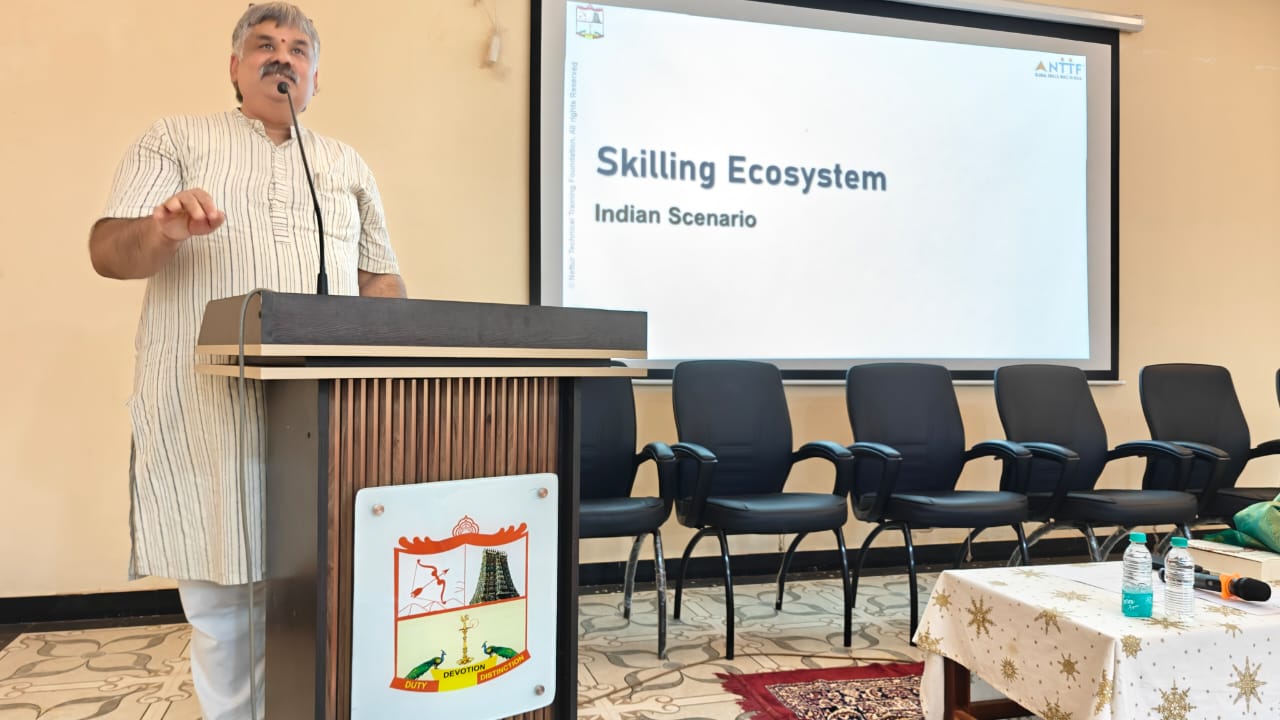
One of the organisations that has evolved but maintained a great degree of these methods and process is Nettur Technical Training Foundation (NTTF), a 66 year old Technical Skill Development Institution. Their philosophy (unstated but practiced by default) – Teach Trainees how to learn, not lessons by rote has made the Institution an unique one of its kind.
Cannot help but mention this – Much thanks to Late Dr Reguraj, who was an institution by himself and the one known popularly as the Guru of Skill Development in India who guided this organisation for 57 long years. Though starting as an employee in 1967 as Marketing Engineer for the Tools and Dies that was produced, he became synonymous with NTTF and his contribution in establishing a value based, hands-on training system transforming 16-18 year old youth into world beaters was immense and it is not just NTTF, but the entire nation that will remain indebted to.
Many other traversed this journey with him with matchable passion towards the Mission of Transforming Youth by Technical Skilling – to name some (with whom I had the fortune of being associated along with Dr Reguraj) Shri Rajagopalan, Shri Venugopal, Shri Arul Selvan, Shri Anil Kumar and many others – mainly the Trainers and other support staff who lived, breathed and worked with the missionary zeal