Rudram & Satsang – When Mind Meets Mantras

There is a specific kind of electricity that fills the air when the Pandits from the Art of Living Gurukul begin to chant. Having been part of hundreds of Art of Living Rudra Puja & Satsangs, Trust me when I say this, It isn’t just sound; it is a tectonic shift in the room’s vibration. Conducted generally in the presence of a Swamiji/Sadhvi of Art of Living, the Rudra Puja is less of a ritual and more of a cosmic cleansing. Participating in this sacred ceremony, followed by a soulful Satsang led by our team (the cherry on top), proved to be an experience of sublime elevation that words struggle to fully capture.

With Swami Virupaksha ji of Art of Living

The heart of the Puja lies in the Sri Rudram, a Vedic hymn with two distinct movements that mirror the rhythm of life itself. In the phase of Namakam, the repetitive salutations recognize the Divine in everything—from the beautiful to the fierce—serving as a profound exercise in non-duality. This is seamlessly followed by Chamakam, where the chant shifts to a list of prayers for human needs, acknowledging that spiritual liberation requires a body and world in harmony.

With Sadhvi Nityabodha ji of Art of Living

As the resonance of the mantras peaks, the Abhisheka begins. The most mesmerizing element is the Dhaara, a continuous, unbroken stream of water and milk poured over the Shiva Linga. This flow represents the movement of consciousness, reminding us that our awareness should remain centered and steady amidst the chaos of daily life. Offerings of honey for sweetness, curd for prosperity, and sandalwood for mental clarity are layered into the ceremony, each adding a biological and spiritual resonance to the atmosphere.

Swami Paramanand of Art of Living performing Panchamrita Abhisheka

The Puja follows a precise energetic map, starting with the Sankalpa, where we drop our intentions into the field of consciousness. Through the Mahanyasam, the Pandits effectively turn their bodies into vessels for the Divine vibration. The entire process culminates in the Arati, the final offering where the external light serves as a powerful reminder of the light within.

Alankara Post Rudram
Alankara
Aarti
Vaibhav ji Performing Aarti

Beyond the spiritual masterpiece of the ritual, the impact on the human nervous system is scientifically profound. The mathematical precision of the Sanskrit syllables acts as a sonic scrub for the mind. These specific Vedic accents create a resonance in the cranial cavity that synchronizes the brain hemispheres, leading to a state where you are awake but in a relaxed, meditative, or restful condition. It is a state of flow where daily mental chatter—the Vruttis—is shattered, replaced by a deep, centered stillness.

It reaches a crescendo as we transitioned from the ancient rigor of the Gurukul chants into the Satsang. If the Puja was the deep-cleaning of a vessel, the Satsang was filling that vessel with nectar. The silence earned during the meditation exploded into music, locking in the elevated state we had cultivated. We didn’t just sing; we integrated the peace we had found.

Post Rudra Puja Satsang

This journey from the depths of Vedic silence to the peaks of collective celebration left us in a state of sublime elevation—a peak of consciousness that stays with you long after the last bell has rung.

With Pandits Subbaraya ji and Ganapati ji trained in Art of Living Gurukul – Their amazingly coordinated and perfect Chants makes our day
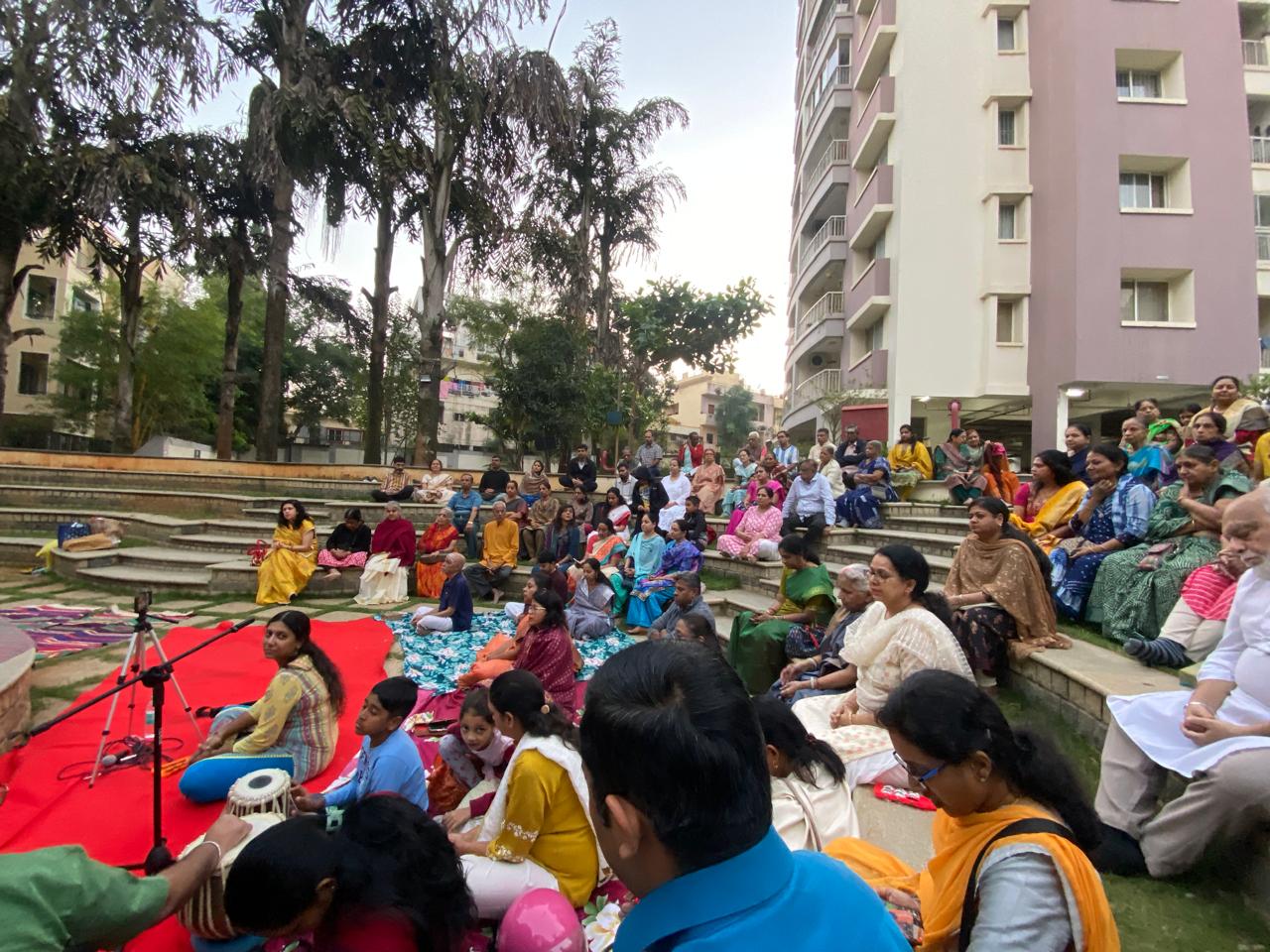
Satsangis in a Rudra Puja and Satsang

Dice, Deficiency, Diet & Divinity – Annapoorna Jayanti

O! Maa Annapoorneshwari! renderer of the support of compassion, the bestower of eternal happiness, the donor of gifts and protection, the ocean of beauty, the destroyer of all sins and purifier, the great goddess, the purifier of the family of Himavan, and the great deity of Kasi, grant us alms.

Maataannapoorneshwari

Bharat is a land that celebrates everything and everyone in the creation. Our Puranas ensured the significance of being grateful for everything that we possess and not possess. The celestial drama surrounding the importance of sustenance & nourishment culminates in the joyous observance of Annapoorna Jayanti, celebrated each year on the full moon day of the Hindu month of Margashirsha. Agrahayana or Margashirsha is the ninth month of the Hindu lunar calendar and the name of the month is derived from the position of the Moon near the Mrigashīrsha nakshatra (star) on the full moon day. This day honors the embodiment of nourishment, Goddess Annapoorna, a compassionate manifestation of Parvati. Her very name, derived from ‘Anna’ (food) and ‘Poorna’ (full or complete), defines her role as the divine provider.

The story begins with a playful, yet consequential, game of dice between Lord Shiva and Goddess Parvati. Fueled by excitement, their friendly wager escalated until Shiva, repeatedly losing, eventually gambled away every possession, even his symbolic trident and the serpent that adorned him. Humiliated and destitute, Shiva sought the counsel of Lord Vishnu. Following Vishnu’s advice, Shiva returned to the game and, to Parvati’s astonishment, won everything back.

Shiva-Parvati Playing Dice

Suspicion turned into accusation. Parvati, disbelieving her husband’s sudden reversal of fortune, called him a cheat. The ensuing argument prompted Vishnu to reveal that the course of the game was a matter of divine will, an illusion (maya), orchestrating their moves. Shiva seized upon this revelation, dismissing all worldly possessions, including the very food that sustains life, as mere maya. This assertion deeply angered Parvati. To her, equating food with illusion was to dismiss her divine presence. To demonstrate the fundamental error in his cosmic view, the Goddess vanished from the world, adopting her form as Annapoorna.

Her disappearance brought about an immediate and catastrophic change. Nature itself came to a standstill: the seasons ceased, the land grew barren, and a devastating famine swept across the universe. Gods, demons, and humans alike suffered crippling hunger, their desperate prayers echoing through the void.

Seeing her own children suffer, compassion welled up in the heart of Parvati and she came to the earth, in Varanasi (Kashi), and set up a kitchen where she served all those who came to her for nourishment. Seeing this, Shiva took the form of a mendicant and went to her asking for alms. Parvati recognised Shiva and was happy to see her Lord. Lord Shiva finally grasped the depth of his error—that the physical body and the spirit it housed required nourishment, and that without Shakti (the feminine power, Parvati), he was incomplete. Humbled, he appeared before Annapoorna with a skull for a begging bowl and accepted alms from her hands.

Art of Living‘s Gurudev Sri Sri Ravi Shankar ji says, “The dancer and the dance cannot be separated, so also the creator and his creation”. Shiva lovingly told Parvati, “This world and you are verily a part of me. The world is as illusory as the dance, neither real nor unreal. One does not try to understand a dance—you simply rejoice in it”. Anna refers to ‘food’, poorna is ‘fullness’. When you eat food, you can immediately experience contentment and fullness at the gross level. Similarly, anna daana, meaning offering of food, brings contentment in the other person who receives the offering. These glimpses of fullness and contentment can be expressed through other actions as well. Whenever you taste that contentment, it takes you to a higher state of consciousness. An unfulfilled person cannot reach the higher states.

It was on the auspicious full moon day of Margashirsha that the Goddess returned to bestow her life-giving presence upon the world. Thus, Annapoorna Jayanti is observed on this day to eternally honor the deity who ensures humanity is never deprived of food.

As the divine steward of nourishment, Mother Annapoorna is traditionally depicted holding a golden ladle and a jeweled bowl overflowing with rice, seated on a majestic throne. This image is a perpetual reminder of her bountiful grace and the sacredness of sustenance.

On this special day, devotees observe rituals that emphasize purity and gratitude. The kitchen, the heart of the home’s sustenance, is meticulously cleaned and sanctified with Ganga water. Special worship is offered to the domestic stove, and devotees honor both Shiva and Annapoorna, knowing that their combined blessings ensure the perpetual flow of food and water in the household. Cooking without onion or garlic and performing acts like Annaabhishekam (offering rice to the sustainer of life) are revered ways to connect with the divine mother’s abundant energy.

Bow down to Mother Annapoorna, you the Eternally Complete (with the gift of Food and Blessings), You Who are the Beloved of Shankara, O Mother Parvati, Please grant me the Alms of Your Grace, to awaken within me Spiritual Knowledge and Freedom from all Worldly Desires.

Rituals & Vidhana

  • Devotees may observe a full or partial Upavasa (Fasting).
  • Many follow a simple diet that includes fruits, milk and light meals.
  • Upavasa is observed with a calm mind and positive thoughts.
  • Upavasa is broken after evening prayers.
  • Upavasa on this day is believed to purify the mind and bring spiritual clarity.

Puja Vidhana

  • Clean the Puja Area
  • Install the moorti or photograph of Goddess Annapoorna on a wooden Peetha.
  • Light a Lamp with Ghee or Sesame Oil
  • Offer Arghya (water) in a copper or silver vessel.
  • Apply turmeric, kumkum and sandalwood paste on Devi’s Moorti.
  • OfferFresh flowers, rice, wheat and fruits as Naivedya
  • Prepare Prasada – simple vegetarian food such as rice, dal, vegetables or sweet dishes.
  • Chant Annapurna Ashtakam, Annapurna Stotra.
  • Perform Aarti
  • Distribute Prasada
Adishaktyatmaka Shree Annapoorneshwari Amma Temple, Horanadu, Karnataka

Thiruvattar Shri Adi Keshava Perumal Temple : A Temple that Shaped a Kingdom.

On one of my trips to Thiruvananthapuram, my colleague Shri Sudheesh Thampi after the official duties and some temples already covered in Thiruvananthapuram city, suggested we drive down to some unique temples across the Kerala border. He was so sure that I would thank him later, and Boy! what a pilgrimage it turned out to be. It was peak monsoon in Kerala and non-stop rain added to the fervour (and flavour). First stop was, 3rd of the Shivalaya Sivalaya Ottam – Thirparappu Arulmigu Mahadevar Temple (Shri Jatadharan) in Kulashekaram town (compiling the research and will be my next article)

Thirparappu Shri Mahadevar Temple (Shri Jatadharan)
More details in my future Article

This Maxi-post is about the next one that we visited and that which left me awestruck and the spirtual hangover lasted for a few days after my return – Thiruvattaru Shri Adi Keshava Perumal Temple.

PC: WWW

The Shri Adikesava Perumal Temple is a highly venerated Hindu shrine situated in Thiruvattar in the Kalkulam Taluk of the Kanyakumari district, Tamil Nadu. It holds the distinction of being one of the 108 Divya Desams dedicated to Bhagwan Vishnu.

The temple is uniquely situated, surrounded by three rivers: the Kothai (or Kotha), the Pahrali (or Parali), and the Thamirabarani. The name Thiruvattar is derived from the curved flow (vattaru) of the Paraliyar river around the temple, and the region was historically known as ‘Valaneer Vattaru’ by the poet Malkudi Kilar in the ancient anthology Purananuru. There is another school of thought on the origin of the name that says three rivers named earlier encircle this temples as recorded in Nammalvar’s 11 pasurams in praise of Adi Kesava Swamy in the 6th Thiruvai mozhi. By sheer luck and blessings we had the fortune of listening to these pasurams from Scholar from Srirangam Thiru Varadan Mama. We have recorded his entire talk in Tamizh, recorded by yours truly (Pardon the quality of recording).

Nammalvar’s 11 pasurams in praise of Adi Kesava Swamy in the 6th Thiruvai mozhi
An Exposition by Srirangam Thiru Varadan Mama

Antiquity, Nomenclature, and Architectural Style

The temple is known by ancient names such as Adi Ananthapuram and Dakshina Vaikundam. It is also historically referred to as the ‘Srirangam of the Chera Kingdom’. While its exact founding date is uncertain, Tamil hymns suggest its antiquity dates back to the 7th or 8th centuries C.E., with some accounts placing the inner sanctum construction over 4,000 years ago.

AS can be seen in the above Photograph, the temple showcases a blend of Dravidian and authentic Kerala-style architecture, closely resembling the Shri Ananta Padmanabhaswamy Temple in Thiruvananthapuram. The Thiruvattar temple is considered older and is said to have served as the model for the Thiruvananthapuram temple. Significantly, the presiding deity of Adikesava is revered as the Elder Brother of Sri Ananta Padmanabha Swamy, and their idols are placed facing each other (Adi Kesava facing west and Padmanabhaswamy facing east).

The Deity and Architectural Features

The presiding deity, Bhagwan Vishnu in the form of Adi Kesava Perumal (also known as Adi Ananthapadmanbhan), is in the Yoga Nidra Postures – the Bhujaga Shayana (reclining posture) on Adi Sesha. The Moorti measures 22 feet in length and is made of Kadu Sarkara Yogam, a mixture of mustard, jaggery, and lime powder is bigger than Shri Anantha Padmanabha Swami. He is seen with his consort Ambal Maragathavalli Nachiar. A unique feature is that Bhagwan’s form must be viewed through three separate Dwarams (Openings). A Shiva linga is also situated near Bhagwan inside the garbha gudi (santucm sanctorum), and the unusually Deity’s feet point north while his head points south (speciality of this temple). This direction is in exact opposite direction of how Shri Ananta Padmanabha Swamy reclines. It is said that the latter lied in this direction to see his elder brother, Adi Keshava. The temple is surrounded by a thirty-feet-high fort wall.

Key architectural marvels include:

  • Ottakkal Mandapam (Single-Stone Hall): A hall built from a single stone slab, approximately 18 feet wide and 3 feet thick/high, installed by King Veera Ravi Varma Kulasekhara in 1603 CE
  • It is built in such a manner that the sun’s rays fall directly on the deity on the 3rd and 9th day of Puratasi and Panguni. During Painguni utsavam, Lord’s utsava-murti comes on a golden Garuda and have a dip in the river thus enacting the incident of purifying hitherto sinful rivers, Kothai and Parali.
  • Nalambalam: The circumambulatory passage features 224 ornately carved granite pillars.
  • Udaya Marthanda Mandapam: This hall in front of the sanctum is decorated with exquisite wooden carvings, notably depicting the marriage procession of Bhagwan Ganesha.
  • Inscriptions: Close to 50 inscriptions in Tamil and Sanskrit (Vattezhuthu and Nagari) are found, including those related to Kulothunga Chola I and Chera royalty. One of the inscription also includes a mentions that temple was established in Treta Yuga.

Purana and Legends

Brahma performed a yajna without Maa Saraswati and as a result of Saraswati’s anger, brother sister sibling asuras Kesan and Kesi emerged out of agni of the Yagna. The devas approached Bhagwan Vishnu and pleaded with Him to free them from this torment. Bhagan Vishnu in the form of Adi Kesava fought with Kesan. Lord threw Kesan who fell on top of Mahendragiri and Bhagwan blew His Shankha (Conch). Adi Sesha, the serpent King wound himself around Kesan thus disabling the asura to move after which Bhagwan Vishnu laid himself on Adi Sesha thus putting His weight on the asura. When the asura tried to free himself from Adi Sesha’s coils, Bhagwan made 12 Siva-lingams to stand as guard all around the asura and Him. These Shivalingams are in Thirumala, Thikkurussi, Thrupparappu, Thirunandhikkara, Ponmana, Pannippakam, Kalkkulam, Melankodu, Thiruvidaikkodu, Thiruvithamkode, Thiruppanrikkode and Thirunattalam. After Kesan was defeated, Kesi and her friend Kothai took the form of rivers to encircle and submerge Bhagwan. Bhoomi Devi (Mother Earth) saved the deity by raising the temple terrain, which is why the shrine is situated at a height of about 55 feet from the ground level. Bhagwan Adi Kesava then purified the two rivers by taking a sacred dip. The sages Parashurama and Vashista are also said to have performed penance at this holy site.

A miraculous event occurred in the late 17th century when a Mughal Sardar’s forces invaded. The local Raja Kerala Varma prayed to Adi Kesava, singing the Paada Sankeerthanam. A swarm of wasps rushed out of the temple, attacking the army, and killing the Sardar, leading to a decisive victory for Kerala Varma.

Historical and Devotional Significance

The temple was once a part of the erstwhile kingdom of Travancore. The Travancore Royal Family held the temple in high esteem:

  • Marthanda Varma (1729-1758 CE): The first ruler of Travancore, alongside his minister Ramayyan Dalawa, gave high importance to the temple. Before the Battle of Colachel (1741), the Maharaja prayed here, dedicating his sword to the deity.
  • Thiru Allah Pooja: In 1740, the Nawab of Arcot’s forces looted the golden Utsava-murti. Upon the subsequent illness of the Nawab’s wife, a dream instructed the priest to return the idol. After its restoration and the wife’s recovery, the Nawab endowed an annual 21-day ritual called the Thiru Allah Pooja, which is performed even today. During the Seeveli (evening ceremonial procession of the deity, the abharanas donated by Nawab is used as alankara for the deity.
  • Alwar saint Nammalwar: Glorified the temple through 11 pasurams in 6th Thiruvai mozhi.
  • Maharishi Vedvyasa: mentions this temple and Adikeshava in Padma Purana written 2500 years ago
  • Shri Chaitanya Mahaprabhu: the founder of the Gaudiya Vaishnava sect, visited in 1510 A.D. and discovered the 5th chapter of the Brahma-samhita within the temple premises, which he subsequently transcribed. In the temple there is a spot, the very place that Shri Chaitanya was seated for transcribing Brahma-samhita.

Rituals and Festivals

The temple’s rituals and practices follow the Kerala-style (Taantrika Vidhi). Many ceremonies are required to be performed here before they are conducted at the Shri Padmanabhaswamy Temple in Thirvananthapuram.

Major festivals, which often coincide with those in Thiruvananthapuram, include:

  • Vaikunda Ekadasi (Swarga Vathil Ekadasi).
  • The 12-day festival in the month of Thai (Perunthamirthu, Kalapa Poojai).
  • The 10-day Painguni Utsavam, during which the processional idol is taken on a golden Garuda for a ritualistic bath in the river, re-enacting the forgiveness of the rivers.

Prasadam

Offerings at the temple include Paal Payasam (Milk Kheer), Aval, and Appam.

Dress Code:

Devotees must adhere to a strict dress code: men must wear a dhoti or pyjama with an upper cloth, or formal pants and shirts; women must wear a sari or a half sari or churidhar with an upper cloth.

Directions to Reach

https://maps.app.goo.gl/mrsU1NCMfP2Qh17m9

Contact
+91 9442577047

Some Pictures that we clicked wherever it was allowed:

Ever grateful to Sudheesh Thampi whose idea it was to make this pilgrimage
Blessed and Blissed Author (yours truly)