Rudram & Satsang – When Mind Meets Mantras

There is a specific kind of electricity that fills the air when the Pandits from the Art of Living Gurukul begin to chant. Having been part of hundreds of Art of Living Rudra Puja & Satsangs, Trust me when I say this, It isn’t just sound; it is a tectonic shift in the room’s vibration. Conducted generally in the presence of a Swamiji/Sadhvi of Art of Living, the Rudra Puja is less of a ritual and more of a cosmic cleansing. Participating in this sacred ceremony, followed by a soulful Satsang led by our team (the cherry on top), proved to be an experience of sublime elevation that words struggle to fully capture.

With Swami Virupaksha ji of Art of Living

The heart of the Puja lies in the Sri Rudram, a Vedic hymn with two distinct movements that mirror the rhythm of life itself. In the phase of Namakam, the repetitive salutations recognize the Divine in everything—from the beautiful to the fierce—serving as a profound exercise in non-duality. This is seamlessly followed by Chamakam, where the chant shifts to a list of prayers for human needs, acknowledging that spiritual liberation requires a body and world in harmony.

With Sadhvi Nityabodha ji of Art of Living

As the resonance of the mantras peaks, the Abhisheka begins. The most mesmerizing element is the Dhaara, a continuous, unbroken stream of water and milk poured over the Shiva Linga. This flow represents the movement of consciousness, reminding us that our awareness should remain centered and steady amidst the chaos of daily life. Offerings of honey for sweetness, curd for prosperity, and sandalwood for mental clarity are layered into the ceremony, each adding a biological and spiritual resonance to the atmosphere.

Swami Paramanand of Art of Living performing Panchamrita Abhisheka

The Puja follows a precise energetic map, starting with the Sankalpa, where we drop our intentions into the field of consciousness. Through the Mahanyasam, the Pandits effectively turn their bodies into vessels for the Divine vibration. The entire process culminates in the Arati, the final offering where the external light serves as a powerful reminder of the light within.

Alankara Post Rudram
Alankara
Aarti
Vaibhav ji Performing Aarti

Beyond the spiritual masterpiece of the ritual, the impact on the human nervous system is scientifically profound. The mathematical precision of the Sanskrit syllables acts as a sonic scrub for the mind. These specific Vedic accents create a resonance in the cranial cavity that synchronizes the brain hemispheres, leading to a state where you are awake but in a relaxed, meditative, or restful condition. It is a state of flow where daily mental chatter—the Vruttis—is shattered, replaced by a deep, centered stillness.

It reaches a crescendo as we transitioned from the ancient rigor of the Gurukul chants into the Satsang. If the Puja was the deep-cleaning of a vessel, the Satsang was filling that vessel with nectar. The silence earned during the meditation exploded into music, locking in the elevated state we had cultivated. We didn’t just sing; we integrated the peace we had found.

Post Rudra Puja Satsang

This journey from the depths of Vedic silence to the peaks of collective celebration left us in a state of sublime elevation—a peak of consciousness that stays with you long after the last bell has rung.

With Pandits Subbaraya ji and Ganapati ji trained in Art of Living Gurukul – Their amazingly coordinated and perfect Chants makes our day
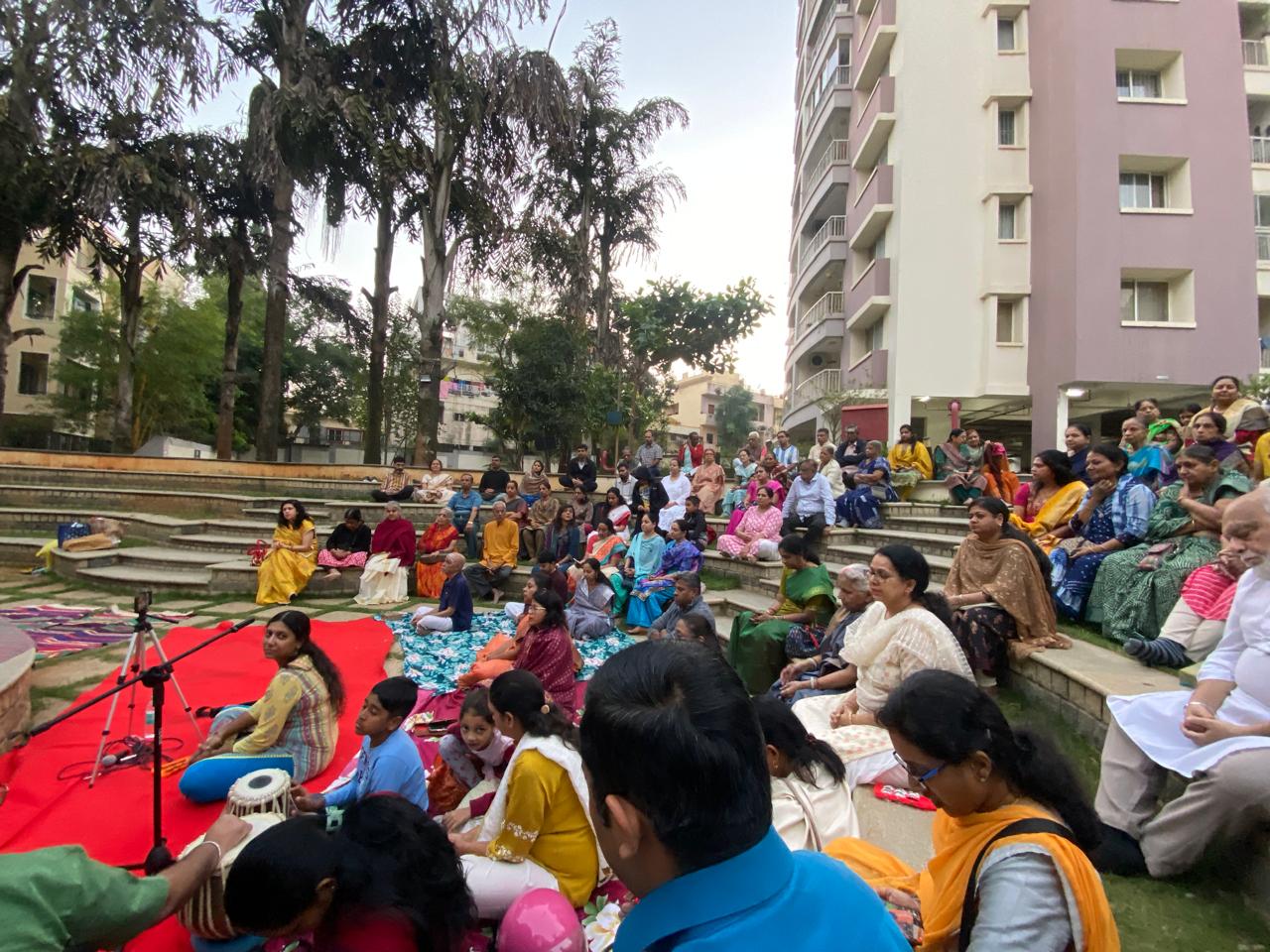
Satsangis in a Rudra Puja and Satsang

Dice, Deficiency, Diet & Divinity – Annapoorna Jayanti

O! Maa Annapoorneshwari! renderer of the support of compassion, the bestower of eternal happiness, the donor of gifts and protection, the ocean of beauty, the destroyer of all sins and purifier, the great goddess, the purifier of the family of Himavan, and the great deity of Kasi, grant us alms.

Maataannapoorneshwari

Bharat is a land that celebrates everything and everyone in the creation. Our Puranas ensured the significance of being grateful for everything that we possess and not possess. The celestial drama surrounding the importance of sustenance & nourishment culminates in the joyous observance of Annapoorna Jayanti, celebrated each year on the full moon day of the Hindu month of Margashirsha. Agrahayana or Margashirsha is the ninth month of the Hindu lunar calendar and the name of the month is derived from the position of the Moon near the Mrigashīrsha nakshatra (star) on the full moon day. This day honors the embodiment of nourishment, Goddess Annapoorna, a compassionate manifestation of Parvati. Her very name, derived from ‘Anna’ (food) and ‘Poorna’ (full or complete), defines her role as the divine provider.

The story begins with a playful, yet consequential, game of dice between Lord Shiva and Goddess Parvati. Fueled by excitement, their friendly wager escalated until Shiva, repeatedly losing, eventually gambled away every possession, even his symbolic trident and the serpent that adorned him. Humiliated and destitute, Shiva sought the counsel of Lord Vishnu. Following Vishnu’s advice, Shiva returned to the game and, to Parvati’s astonishment, won everything back.

Shiva-Parvati Playing Dice

Suspicion turned into accusation. Parvati, disbelieving her husband’s sudden reversal of fortune, called him a cheat. The ensuing argument prompted Vishnu to reveal that the course of the game was a matter of divine will, an illusion (maya), orchestrating their moves. Shiva seized upon this revelation, dismissing all worldly possessions, including the very food that sustains life, as mere maya. This assertion deeply angered Parvati. To her, equating food with illusion was to dismiss her divine presence. To demonstrate the fundamental error in his cosmic view, the Goddess vanished from the world, adopting her form as Annapoorna.

Her disappearance brought about an immediate and catastrophic change. Nature itself came to a standstill: the seasons ceased, the land grew barren, and a devastating famine swept across the universe. Gods, demons, and humans alike suffered crippling hunger, their desperate prayers echoing through the void.

Seeing her own children suffer, compassion welled up in the heart of Parvati and she came to the earth, in Varanasi (Kashi), and set up a kitchen where she served all those who came to her for nourishment. Seeing this, Shiva took the form of a mendicant and went to her asking for alms. Parvati recognised Shiva and was happy to see her Lord. Lord Shiva finally grasped the depth of his error—that the physical body and the spirit it housed required nourishment, and that without Shakti (the feminine power, Parvati), he was incomplete. Humbled, he appeared before Annapoorna with a skull for a begging bowl and accepted alms from her hands.

Art of Living‘s Gurudev Sri Sri Ravi Shankar ji says, “The dancer and the dance cannot be separated, so also the creator and his creation”. Shiva lovingly told Parvati, “This world and you are verily a part of me. The world is as illusory as the dance, neither real nor unreal. One does not try to understand a dance—you simply rejoice in it”. Anna refers to ‘food’, poorna is ‘fullness’. When you eat food, you can immediately experience contentment and fullness at the gross level. Similarly, anna daana, meaning offering of food, brings contentment in the other person who receives the offering. These glimpses of fullness and contentment can be expressed through other actions as well. Whenever you taste that contentment, it takes you to a higher state of consciousness. An unfulfilled person cannot reach the higher states.

It was on the auspicious full moon day of Margashirsha that the Goddess returned to bestow her life-giving presence upon the world. Thus, Annapoorna Jayanti is observed on this day to eternally honor the deity who ensures humanity is never deprived of food.

As the divine steward of nourishment, Mother Annapoorna is traditionally depicted holding a golden ladle and a jeweled bowl overflowing with rice, seated on a majestic throne. This image is a perpetual reminder of her bountiful grace and the sacredness of sustenance.

On this special day, devotees observe rituals that emphasize purity and gratitude. The kitchen, the heart of the home’s sustenance, is meticulously cleaned and sanctified with Ganga water. Special worship is offered to the domestic stove, and devotees honor both Shiva and Annapoorna, knowing that their combined blessings ensure the perpetual flow of food and water in the household. Cooking without onion or garlic and performing acts like Annaabhishekam (offering rice to the sustainer of life) are revered ways to connect with the divine mother’s abundant energy.

Bow down to Mother Annapoorna, you the Eternally Complete (with the gift of Food and Blessings), You Who are the Beloved of Shankara, O Mother Parvati, Please grant me the Alms of Your Grace, to awaken within me Spiritual Knowledge and Freedom from all Worldly Desires.

Rituals & Vidhana

  • Devotees may observe a full or partial Upavasa (Fasting).
  • Many follow a simple diet that includes fruits, milk and light meals.
  • Upavasa is observed with a calm mind and positive thoughts.
  • Upavasa is broken after evening prayers.
  • Upavasa on this day is believed to purify the mind and bring spiritual clarity.

Puja Vidhana

  • Clean the Puja Area
  • Install the moorti or photograph of Goddess Annapoorna on a wooden Peetha.
  • Light a Lamp with Ghee or Sesame Oil
  • Offer Arghya (water) in a copper or silver vessel.
  • Apply turmeric, kumkum and sandalwood paste on Devi’s Moorti.
  • OfferFresh flowers, rice, wheat and fruits as Naivedya
  • Prepare Prasada – simple vegetarian food such as rice, dal, vegetables or sweet dishes.
  • Chant Annapurna Ashtakam, Annapurna Stotra.
  • Perform Aarti
  • Distribute Prasada
Adishaktyatmaka Shree Annapoorneshwari Amma Temple, Horanadu, Karnataka

The World Culture Festival

By Neelam Dowlani

WCF-01The World Culture Festival is expected to have a presence of over 3.5 million people, to gather from across the world at New Delhi, from 11-13 March 2016. A majestic stage of 7 acres will be set, which is 304,920 square feet for those of you who are trying so hard to visualise the vastness. The colourful diverse stage will assemble an array of politicians, dignitaries, spiritual leaders, musicians, artists and other important contributors of the world.

Now the question that arises; how is this possible?  It is only possible when a renowned spiritual leader such as Sri Sri Ravi Shankar decides to host such an event.  As he did in 2008 to celebrate Art of Living‘s 25th Anniversary, hosting a crowd of 2.5 million people at Bangalore, in Jakkur airfield.

SJC-01

A peaceful gathering of over 3.5 million people; the voice of peace to speak loud and clear.  We no longer can be the lukewarm peaceful citizens of the world. We now need to be passionate, loud and clear about the necessity for peace.

If it’s not for us, then it’s for our children. Do we want our children to live in fear of terror? Or do we want our children to have a future of security, trust, friendship, belongingness.  The World Culture Festival represents the future we want.  If such a grand gathering for peace can take place on this scale then we are making ourselves heard.  Our children have not just hope but a reality in front of them of the future that we dream of as a possibility in front of them.

WCF-03

There is such a great joy in being a part of a celebration that is so magnificent, and larger than life. It is a dream that has turned into a reality.

Travelling the world, experiencing different cultures expands the mind.  So is eating different foods, flavours, learning others ways that vary so vastly. The World Culture will be a display of this diversity. The festival will show that it is not tolerance but acceptance with joy of all religions, cultures and traditions and their unconditional embrace that brings in infinite harmony and peace in this world.

WCF-04

This event will undermine the voice of terror and bring enormous strength to the powerful voice of peace.   It is not that the world is full of bad people, in fact quite the contrary. It is the good people who don’t get together to make their voice heard. This voice of peace will reach people not just visually, but will also create a wave of harmony which would reach the remote corners of the world. These waves of peace are required in trying times like now where wars are being fought like games and games like war.

Today the Internet, social media and globalisation have made the world smaller than ever. We now know real time what is happening across the world.  Where there is suffering and loss of lives in the world. Do we not feel their pain or experience sadness over the happenings?  We are all connected through human values, regardless of colour, creed and religion. We need to make it loud clear that the world is one world family connected through the human essence.  We are connected by breath and breath is universal.

And breath is the essence of Yoga.  Let us all come together for this breath taking event  in the land where Yoga began.

For information of those who tuned in late:

The World Culture Festival 2016 is a celebration of The Art of Living’s 35 years of service to humanity. The festival will bring together people from different cultures, nations and faiths as a one world family in a resounding message of peace.

Get more details here