As I shared the information on the Social media (Facebook and Twitter) that we are headed to our 61st Gurupuja and Satsang of 2013 this evening, I received a few queries (I assume they were genuine ones) primarily centered around 2 questions:
What is in it for you?
What is in it for others/Society?
Though we never thought about this on lines of question above, I was pleasantly surprised to find that each one of my co-passengers in this blissful journey, pretty much had same reasons for the above questions when I spoke to. This blog is a summary of Why we do what we do 🙂
What is Satsang?
Googling for technical definitions of Satsangs will give you many descriptions: And I found this one pretty close to what has been our experience. Satsang is a Sanskrit word that means “gathering together for the truth” or, more simply, “being with the truth.” Truth is what is real, what exists. So all there is, is Truth.
A few quotes on Satsang from the Founder of The Art of Living Foundation, His Holiness Pujya Gurudev Sri Sri Ravi Shankar ji who is the inspiration and the guide for this journey of ours:
“Satsang, the company of the Truth, is the resting place for the mind and the spirit.
Give quality time to the divine, it will be rewarded. Give Satsang and meditation your highest priority.”
“Why do people need homes? Can they live like animals in the forest without shelter? Even intelligent animals make their homes. Man needs protection from changing nature. So, he builds a shelter for physical comforts. In the same way, for spiritual and mental comfort – Satsang is the shelter.”
“Satsang is the nest in which you can rest.”
If we were to define experientially, On the outside, Satsang is the worldly version of an e-group, an opportunity & platform for us with some common interest to gather, enjoy, share and care.
Considering what a Satsang has done for each one of us, this is a very simplistic (and too limited definition). It is those moments when we just get together, sing, dance, meditate, share knowledge “SPONTANEOUSLY” Yes, the key here is “spontaneous”. We have never had a template (except the Sampradayic/traditional sequence, though not prescribed has become a feature), we never plan or design a Satsang. It just Happens, the theme or mood gets set spontaneously based on needs of “that moment” A fellow Satsangi added, this clarity and overtness happens due to dissolution of Ego.
It is an expression of the inner joy that we experience, our way to share and show that we care. To summarize, we often refer to such Evenings (we do have Satsangs during the day too) as an evening of Gaana, Dhyana, Gyaana and “Khaana” – a time when it touches our heart and douches our mind, fills our heart and stills our mind.
This also answers “What is in it for us” Everything” 🙂 is a single word answer. We do it for our own joy and growth. On the material level, an opportunity for whole lot of us to hone our talents, improve confidence – we have been in Satsangs with participants from 30 (at homes) to 2800+ (Brahma Chaitanya Mandira in Chintamani on Vaikunta Ekadashi day), enhance our state of mind when we are able to give those moments of smile and joy to others, better our public speaking skills, network with like minded individuals and groups and the usual perquisites of Gossip (no vile ones though) and of course, the Food 🙂
It is pertinent to also touch upon a question that someone asked – Isn’t this a Hero Worship or Vyakti Puja?Even for a moment assuming that this argument was true, our answer was “So what? Why not, if it enhances our state of mind, does it matter?” It anyway is an essential part of our culture, revering and honoring those who have added value to our lives. Our Satsangs or Gurupuja is not about worshipping the photo or any individual, it is an expression of Gratitude and acknowledging their role in our spiritual quest from a state of fullness.
A few words on the significance of Gurupuja (almost always an essential part of our Satsangs these days) maybe pertinent here. Guru Puja is a thanksgiving ceremony remembering all the ancient rishis, seers, sages in the Holy tradition of Masters, who have brought this knowledge of self. Puja means that which comes from the fullness and the five elements, which are used & one of the highest expressions of devotion and gratitude to the Master. Chanting the Guru Puja unites our minds with the Holy tradition of Spiritual Masters.
Let me also add another important thing here. In more than a decade & a half that I have known and got inspired by this Master Sri Sri Ravi Shankar ji, there has been no attempt on His part to create thought-clones of Himself. He keeps emphasizing that everyone is equally endowed with the capacity to discriminate the Truth and the true teacher, or Sadguru, is within us. Guru Puja thus is more, a recognition of the Guru Tatva or Essence of Master that is within us than a chant in praise of anyone else. In any case, Praising is a quality that we should nurture because that broadens our thinking – we always praise that which we aspire to become (or which we value)
What is in it for Others? Nothing that we really plan for. We do it for our joy, our growth and our well-being. Anything else as the goal of our Satsang would be a lie 🙂
While there, I would like to also mention that many things in life is infectious. Benefits of Satsangs like our Joy, Growth and General Well-Being (both physically and mentally), we believe is infectious too. It rubs off on those around us. A time when everyone turns inwards and realize the temporary nature of our temporal pursuits. A time to realize that real Joy is within us, A time to disconnect our Joy from the Events. Do we need any other benefits that we can be to others and society through this route!
Incidentally,we do also address “Annadata Sukhibhava, Godaaana/Goraksha, Organic Farming, Education, Cleanliness/Hygiene, Women empowerment and Self help Groups, Rural-Urban partnership (on equal terms) and so on. But then these are mundane stuff compared to the Unerasable “Smile” that we put on peoples’ face.
Translation of the Tribute piece written in Malayala Manorama on August 22nd 2013 by HH Pujya Gurudev Sri Sri Ravi Shankar of The Art of Living. Responsibility is completely mine, for any errors in this translation from Malayalam to English. Kindly notify me for corrections. This tribute piece was written on the occasion of Birth Anniversary of the Guru (August 20th)
Sri Narayana Guru took birth in the 19th Century for the sake of development and progress of Human race. He was a great proponent of Humanism. He was responsible for the extra-ordinary awakening in the Kerala of those days, both by his action and deed. This Great Maharshi, was responsible for bringing Advaitadarshana as means of salvation to the entire Human race, which otherwise was exclusive preserve of Scholarly debates
His effort was towards unifying and equalizing the entire human race across the world by exposing the futility and meaninglessness of differences and differences caused by Caste, family and religion. He expounded that everyone is a part of same Divine & composition of humans across the world both physically and mentally is the same. This great Guru who described Characteristics of Indivual Human as “punarnnu perum ellamo” (All that are born of sexual union of humans are same species), “Oru yoni oru aakaaram Oru bhedavum illa ithil” (One yoni – womb, one form, there is no differences between them), Manushyanam Manushyathvam (humaneness is the quality of a human being) – says primary needs of all human beings are the same. Everyone desires Food, Clothing, Health, Water & Shelter. He also made people aware of the fact that – the recognition & position earned by someone is also desired by others is good for a better world & Unending and selfish desires & acts sows the seeds of disharmony in the community.
Guru exhorted Keralites to reject discriminating people based on limited comprehension of Caste, which gave rise to differences and conflicts. His words and life was devoted to obliterate non-Dharmic thoughts and deeds of fellow human beings. He preached that “it is not other human beings who make one impure but one’s own thoughts, words and acts”. His dreamt of a humans who made understanding, love and compassion a basis of their lives
He rejected the belief that those who adapted Panchashuddhi (5 types of Cleanliness) & Panchasheela (5 practices) are the protector of generations. Instead he directed people to make unselfish nature a way of life.
While the birds and animals with its limited needs co-exist harmoniously with nature, He warned that it is dangerous when humans who destroy nature and earth to satisfy their greed.
Personal traits like purity in words, thoughts, senses, country, home etc along with community benefiting traits like Non-violence, Truth, Asteya (Non-Stealing), Fidelity, Prohibition (intoxicants) – were his dreams for realization of a Modern Kerala. Guru’s preaching that a Pure Divine thought on part of individual and family is inevitable, gave rise to a new culture of temple ritual system. Consecration of Lord Shiva temple in Aruvippuram in 1888 was a beginning of a big Revolution. It was a proclamation that God and Supreme Knowledge is birthright of everyone irrespective of caste and religion. Guru in fact set in motion a powerful & impactful mass movement through this temple. These temples established all over became a place for a devotee to seek knowledge, skills and solace and had Educational, Library, garden and some vocational training centres associated with it.
Guru’s message Freedom via Education was an invitation for an flood of scientific thinking. Guru made people aware that rebuilding Kerala – which was then beset with ignorance, misdeeds, superstitions & poverty – was possible through education alone. His goals for Education was for creation of a Modern Kerala. Guru who encouraged an educational system with equal prominence to Malayalam, Sanskrit and English, Study of Shastras, Vocational/Technical study, Women education also set aside funds for those willing to study abroad and also set up evening schools.
According to Gurudev, final goal of every religion was the same. and those who did not realize were like the blind men who touched elephant and imagined things. Religious bigots will see nothing in other religions and also sees a separation. Guru insisted on a creation of culture of acceptance and respecting other faith to prevent religious animosity & conflict.
In those days, every word and deed were controlled based on the religion and caste they belonged to. The tenets, adaopted by other cultural and development organizations, he preached awakened & arose everyone towards strengthening of community & cultural bonding.
It was giving a shape to culture of Humanatrianism, co-existence and peace in Kerala. Every cultural and political organizatins included the teachings in their work. Kerala which benefited enormously walking the path advocated by Guru became an example for the whole world. Malayalis thus became capable of settling anywhere in the world. Malayalis rejected the caste system. Kerala became an abode religious harmony. People thus were able to reap benefits of this favorable situation .
But, this change could not be sustained by Keralites. This enviable material prosperity, especially those of middle class gave rise to commodification. Without their knowledge the culture of humanism got ejected out. Malayali community who are ever ready to accept any change, without any second thoughts or analysis adapted this commercial culture. Today we see a community that has slipped away from the path prescribed clearly by Sree Narayana Guru
This culture of excessive greed & uncontrollable commercialization changed a Malayali to an unthinking, highest polluter. Unstable family, violence against women and children, extremism, alcoholism, disrespect towards Nature & corruption and such characteristics that are against human values, reminds us of the importance of adhering to Guru’s vision.
The teachings and path of Guru, which is relevant beyond any generation is the mantra of hope. We have to be prepared to imbibe it mentally and convert it into our life-style. It is not a world devoid of natural diversity, terror or insecurity, we should leave a world more beautiful than what we enjoyed, to our future generations. Humankind should ensure that valuable gifts like smile, amicability, compassion, broadmindedness etc that nature has bestowed on us is never forsaken. We need variety, material comfort and progress. At the same time, let us not forget to be human or humanism.
ॐ नमः शिवाय भीमाशंकराय। सह्याद्रिवासिने डाकिनीविनाशनाय॥
Bheemana Amavasye is the Amavasya or New Moon Day of Ashada month in the Hindu calendar, marking the final day of the month. Believers hold that on this sacred day Bhagwan Shiva was deeply moved by the devotion of Devi Parvati and accepted Her as His wife. The festival is widely celebrated as Bhimana Amavasya in Karnataka and many other states. It is also known as Pati Sanjeevini Vrata or Jyothi Bhimeshwara Vrata. People observe this festival for the well being and prosperity of all male members in a family.
The festival is dedicated to Bhagwan Shiva and Devi Parvati. Unmarried women pray for the good health and well being of their brothers, father, and all male relatives. Married women observe this vrata for the long life of their husbands. Married women carry out this ritual for nine consecutive years after marriage. In the ninth year, they gift a pair of sacred lamps to their brothers or a Brahmin.
Preparations and Puja Setup
Traditionally, women make two sacred lamps using Red Clay, believed to represent Kalikamba, or Thambittu wheat flour paste. One lamp symbolizes Bhagwan Shiva and the other represents Devi Parvati, who is worshiped as the Supreme Mother and the source of every other Devi. Devotees install these lamps on a bed of grains, typically Rice, facing east.
Traditional Red Clay Lamps replaced with Silver ones
Puja begins by tying a Turmeric Root to the right lamp of the Deity picture, which is the lamp on our left as we face it, signifying Devi Parvati. The altar installation also incorporates representations of Surya Dev, Chandra Dev, and a sacred water pot called Kumbha.
Women light the lamps and offer a nine stranded thread called Gejje Vastra along with Sandal paste or Gandha, which is an essential offering for this puja. The sacred Tambula offering includes nine Betel leaves, nine Betel Nuts or Bettada Adike, and a fresh coconut.
Gowri Dhara
Women also place Gowri Dara or Rakshe, which is a thread smeared with Turmeric paste, alongside the Puja Samagri. Married women use a nine stranded thread with nine knots, while unmarried women use a five stranded thread with five knots. During Granthi Puja, women perform a specific puja for each strand with offerings, and female family members later tie these sacred threads around their wrists.
Please note that variations exist in these practices depending on regional traditions and family customs.
Puja and Rituals
After the mandatory Ashtottara Puja of Bhagwan Ganesh to remove all obstacles, devotees worship Bhagwan Shiva and Devi Parvati. Uma Maheshwara Ashtottara Puja is performed with devotion, and the Gowri Dara is tied around the wrists. At this stage the main part of the Puja is complete, and everyone pays respect to the lady performing the rituals.
All set. The main part of Puja done. Respects to this Lady
Daughter gets her Rakshe tied. Along with Blessings that None else can give her
Naivedya offerings include Karjura or Dates, Cosambari, and usual seasonal fruits. Families prepare traditional Kadubu filled with coins, staple food grains, and dry fruits, which is called Bandhara or Treasure Chest to symbolize abundance. Post puja, this Bandhara is placed on either side of the house threshold or Hosilu. Male family members crush these sweet cakes using their elbows, signifying an abundant flow of material and spiritual wealth into the home. Afterwards, the wife performs an Arati to her husband praying for his health and long life.
I get an Arti today 🙂
Traditional Festive Feast
After the rituals comes the much awaited part of the festival, which is the grand feast. Typical items served at home include Chitranna or Lemon Rice, Cosambari, Groundnut Chutney Pudi, Midi Uppinakayi or Tender Mango Pickles, Appala or Pappad, Majjige Menasinakayi or Fried Curded Chilly, Hoorna Saaru or Rasam, and sweet Kaayi Holige or Obbattu.
Traditional Fare, (except Pappad & Fried Curded Chillies) which is usually not made on this festival
The Batting Begins 🙂
Legend of Susheela and Dead Prince
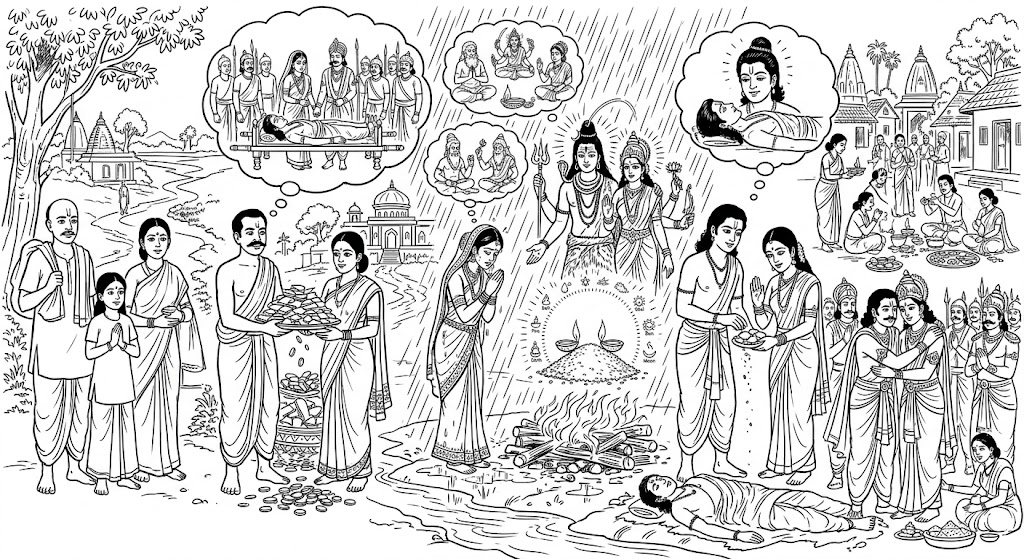
A pious Brahmin couple living in Saurashtra decided to undertake a pilgrimage to Kashi, as praying to Mahadeva there was considered a crucial lifetime duty. In those days, traveling to Kashi was a perilous journey, and people were never sure if they would return safely. Therefore, they decided not to take their young daughter Susheela along. They placed Susheela under the care of their married son and asked him to get her married and well settled in case they did not return from Kashi.
Years rolled by with no news or sign of the parents returning. The son and his wife were greedy to possess the family property and did not want to spend any money on getting Susheela married. In those times, it was a moral obligation and societal norm that the son inheriting property must shoulder the responsibility of marrying off his sisters.
During this period, Saurashtra was ruled by an able and righteous king named Vajrabahu. He had a son named Prince Jayasheela, who suddenly died due to a strange illness. King Vajrabahu was deeply worried about who would fulfill the ritualistic requirements of Tilodaka for his forefathers. The palace astrologer discovered a remedy and suggested marrying the dead prince off before cremation to keep the Pitrus satisfied.
King Vajrabahu made a royal proclamation across his kingdom that whoever agreed to marry the deceased prince would receive vast rewards including gold coins, a palatial home, agricultural land, and enough food grains to last three generations.
The greedy brother and his wife had no concern for Susheela and convinced her to accept the offer, arguing that she would become a Princess even if widowed right after marriage. They also emphasized that it would help the family financially and raise their status in society. Though Susheela resisted and pleaded desperately with her brother, he forced her to agree and took her to the King. The marriage was solemnized between the helpless Susheela and the dead Prince Jayasheela. The brother collected all royal rewards from the King and left.
Divine Appearance on the Bhagirathi Riverbank
Immediately after the wedding, King Vajrabahu, the newly wed Susheela, the army, and all courtiers took the prince body to the banks of River Bhagirathi for cremation. Susheela, decked in full bridal glory with Haridra Kumkuma or Turmeric and Vermillion, was asked to perform Agni sparsha and light the funeral pyre. Praying fervently to Maa Parvati and Bhagwan Parameshwara, she set fire to the pyre.
Providentially, torrential rain began to fall as soon as the pyre was lit. It rained incessantly and turned pitch dark with no signs of the storm subsiding. King Vajrabahu asked Susheela to return to the palace since she was now the princess, but Susheela refused, stating her place was with her husband, and she stayed back beside the body.
The King and the rest of the gathering left the young bride all by herself and returned to the palace. Susheela sat grieving beside her husband body in the dark forest. As fear set in, she began praying to Shiva Parvati, cursing her fate and thinking this tragedy would not have happened if her parents were present.
Susheela beseeched with tears, asking O Parameshwara, You have blessed Markandeya with immortality, restored life to Agni Manmatha, and blessed Shwetavahana and Brighu Putra Chyavana Rishi with long life. What sin have I committed to undergo this terrible situation. Please show some compassion towards me.
Bhagwan Shiva, who is always on the side of His devotees, appeared before her along with Maa Parvati. Susheela immediately sought the blessings of Sowbhagya, Sumangali, and Wealth.
Bhagwan Shiva Directives on Jyotirbhimeshwara Vrata
Bhagwan Shiva then told her that They would teach her a vrata to observe diligently with utmost sincerity. On the Amavasya Tithi of Ashada month, one must take a ritualistic bath, clean the Puja sthala, and install Uma Maheshwara on a Peetha or pedestal. On a heap of rice, one should install two Ghee Lamps to worship Him. Bhagwan Shiva explained that in such a lamp He resides as Ashtamurti.
As described in the Shiva Purana, Ashtamurti represents eight distinct attributes of Bhagwan Shiva. Sharva represents Earth holding the entire universe of mobile and immobile beings. Bhava represents Water which is the lifeline of the world. Rudra represents Fire symbolizing perfection and destroying all imperfections. Ugra represents Air holding the outer and inner universe and throbbing by itself. Bhima represents Ether pervading everything and affording space to all, whose decomposition results in groups of elements. Pashupati represents Soul supporting individual souls and breaking the bondage that encircles them. Ishana represents Sun brightening the entire universe and moving in the heavens. Mahadeva represents Moon whose nectar like rays strengthen and fatten the universe to satiety.
Bhagwan Shiva continued explaining that He exists in the lamp in its unbiased purest form. He added that alongside this lamp, another lamp must be kept with a Turmeric Stick attached to represent His consort, Shakti or Parvati. Because His favorite moon exists as part of Ashtamurti, His luminous form is also known as Bhimeshwara.
Bhagwan Shiva instructed her to assume the lamp as Himself and worship with utmost sincerity for nine years, offering Kadubu rice cakes, Sandalwood, and flowers, along with doing charity for Brahmins. He promised that after nine years her husband would certainly return to life and she would become Sowbhagyavati.
Miracle and Awakening of the Prince
Susheela had to manage with whatever was available around her in the wilderness. Instead of real rice cakes, she made Kadubu out of mud, created lamps from clay, used Banyan leaves as Betel leaves, and Banyan fruits as Betel nuts. She gathered wild grass to use as flowers and sincerely began her vrata vows.
While she was performing worship, a young couple arrived and expressed curiosity about her actions. Susheela explained her plight and misfortune. Since she was alone, there was no male member present to break the mud Kadubu. The young man offered to break the mud cake for her, and as he broke it he blessed her saying Dheegha Sumangali Bhava, meaning may you be a happily married woman for a long time and may your husband stay alive for your entire lifetime.
With a sad face Susheela smirked and asked how that was possible when her husband lay dead on the pyre. The young couple pointed toward the prince and told her that he was merely in deep sleep and asked her to wake him up. When Susheela looked at the prince, she was shocked to see him opening his eyes slowly as if waking from sleep. She could not believe her eyes, and when she turned around to thank the young couple, they had vanished.
Her puja bore fruit and the Prince was brought back to life. Susheela offered her heart felt gratitude to Uma and Maheshwara mentally and explained everything to her husband. Upon learning the news, King Vajrabahu was elated and rushed to the banks of Bhagirathi to see his son alive. He embraced the couple heartily and expressed immense gratitude to Uma Maheshwara. The King ensured that the glory of observing this vrata on Ashada Amavasya, known as Jyotirbhimeshwara Vrata or Bheemana Amavasye, was spread far and wide.
Continuing Traditions and Modern Observances
To this day, married and unmarried women worship Uma and Maheshwara on this day for the happiness, prosperity, and health of the men in their family. Married women also pray for a deep marital bond like that of Parvati and Shiva.
Another central tradition is preparing sweet Kadubu or Tambittu, made out of rice, peanuts, and chickpea flour with coins or jewels hidden inside. In the evening at the end of the vrata, male members break these cakes to retrieve the coins, a process known as breaking of Bhandara or treasure chest.
Bhandhara (Treasure Chest) – Tambittu with coins inside
May the blessings of Bhagwan Shiva be showered in abundance on everyone. This festival also launches month long Shravan Maasa Rudra Pujas and Satsangs conducted by the Art of Living Pundits, founded by His Holiness Pujya Gurudev Sri Sri Ravi Shankar, across various locations. A friend named Sindhu under the handle agnyaa on Twitter has also written blog posts detailing Bhimana Amavasya.
The traditional sacred chant associated with this day is
Mrityunjaya Rudraya Neelakanthaya Sambhave Amriteshaya Sharvaya Mahadevaya Te Namaha.
Significance of Tilodaka and Tarpana
The sacred invocation chanted during this ritual is Vasurudraditya swaroopanam asmat Pitru Pitamaha Prappitamaha aavahayami.
Forefathers are believed to reside in Pitru Loka for some time after their death until they take rebirth, reach Deva Loka, or attain Mukti. Pitru Loka is inhabited by three generations of ancestors, namely Vasu representing Father, Rudra representing Grandfather, and Aditya representing Great Grandfather.
Pitru Loka is situated on the other side of the moon, which gets exposed to the sun only on Amavasya or New Moon day. This day marks the official meal time for Pitrus. All offerings made through Tarpana by descendants serve as the only source of nourishment to feed the Pitrus. If ancestors are left displeased, their curse is believed to affect the family line by preventing future male progeny.