Bharat Maata – an essential part of any Sneha Seva Trust Event
On 2nd August 2026, Sneha Seva Trust organized Sankalpa Event as part of Samskara Kendra activities for about 200 newly sponsored 8th standard students selected for Jnanasiri Vidya Vethana, along with their parents and guardians. Event was wonderful success with everyone coming together to celebrate culture, devotion, and community values.
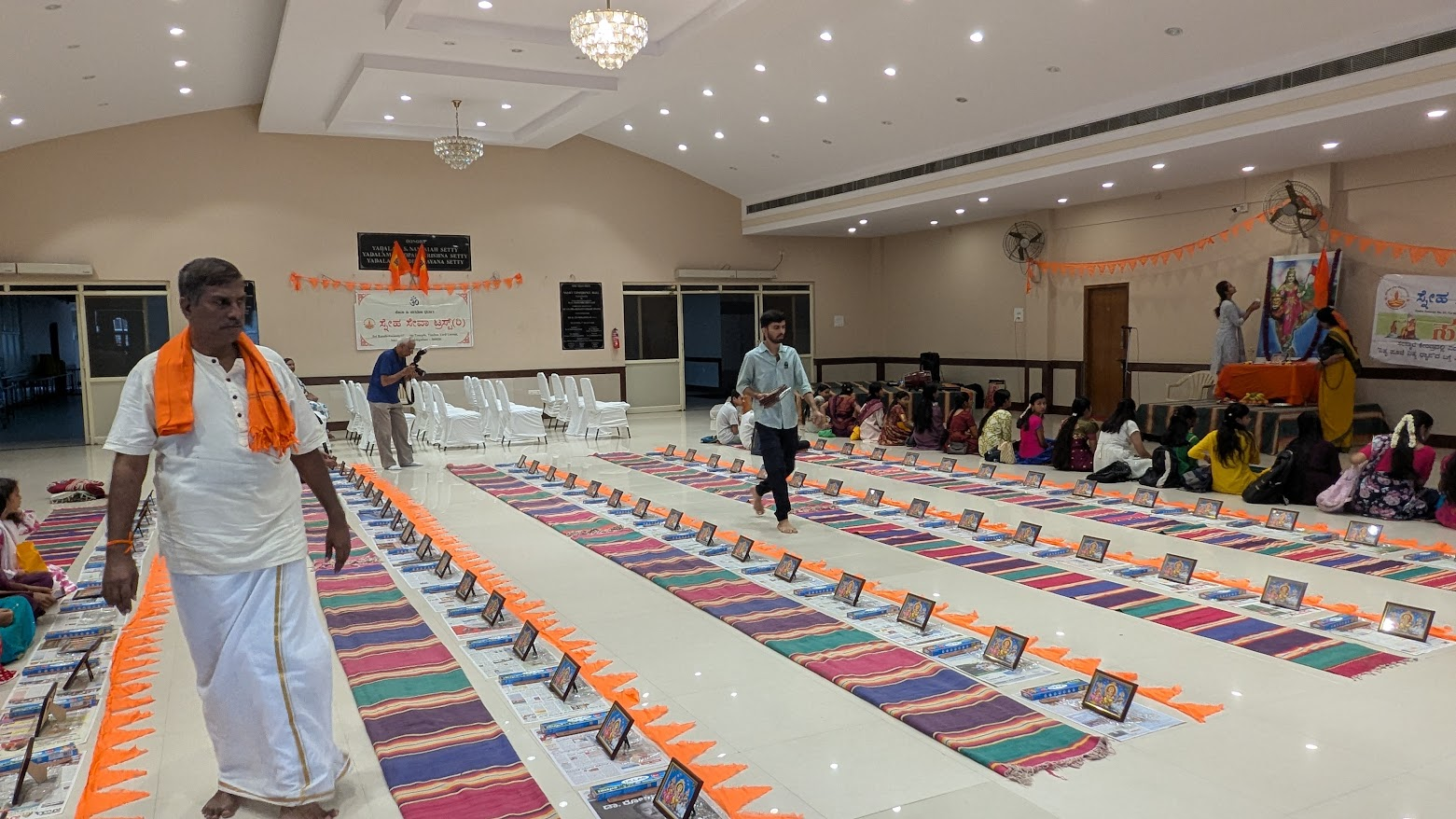
All Set for Nitya Puje Initiation & Practice
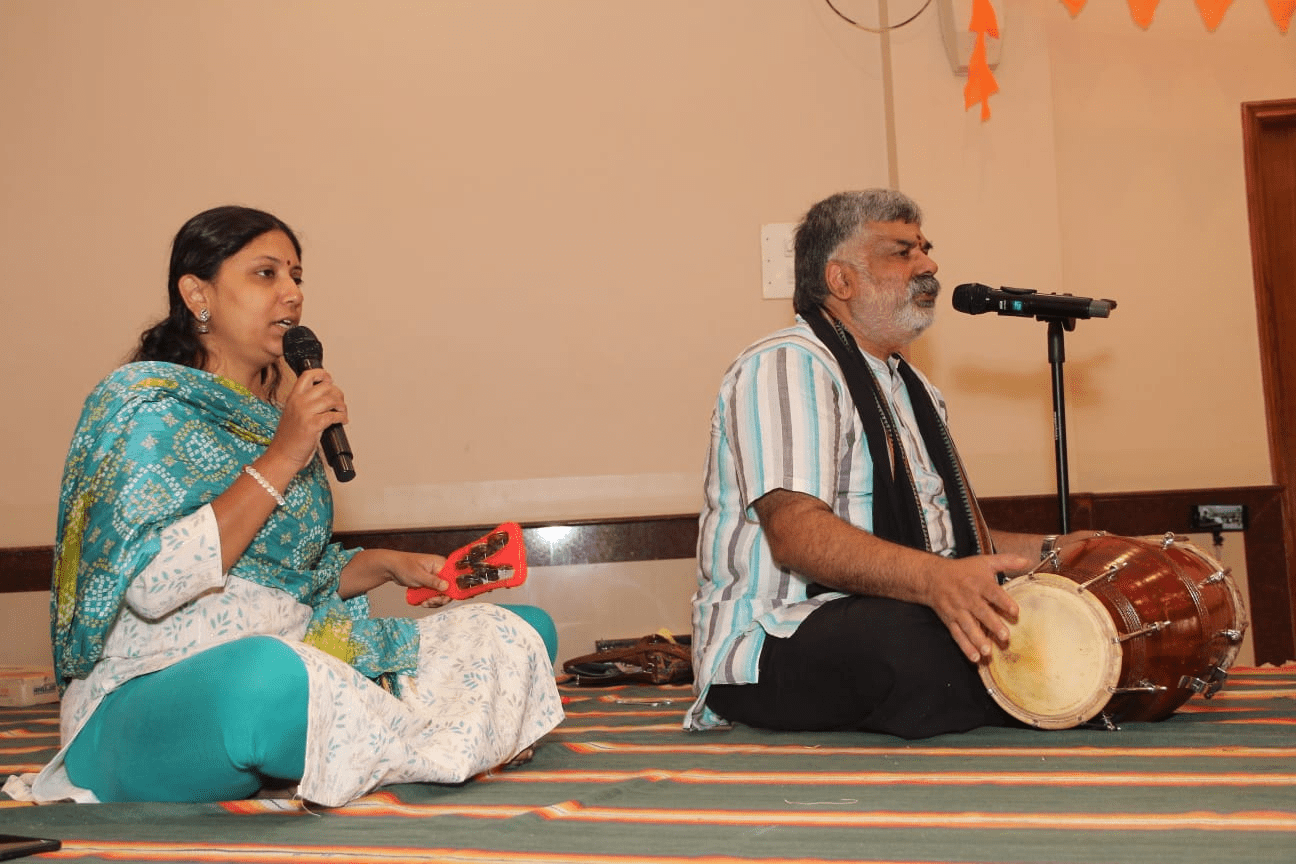
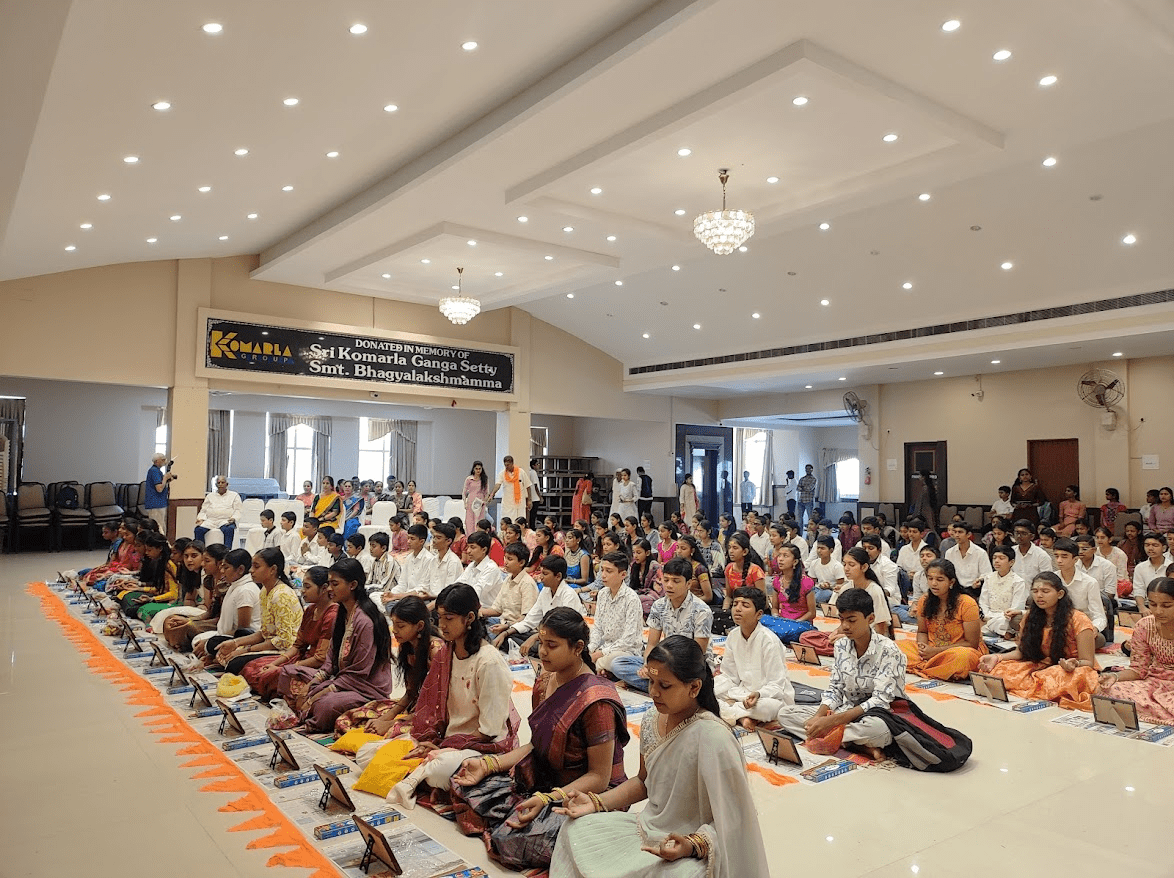
To start event on divine note, We, the disciples of Pujya Gurudev Sri Sri Ravi Shankar ji of Art of Living conducted a traditional Satsang & bhajan session. Kids participated in the session with immense enthusiasm, and we were thrilled to see 100% participation from all children and parents present. Entire hall reverberated with joy as everyone sang together with pure hearts and high energy. Importance of nama sankeertane , music and dance in our culture and how important it is for parents to practice sadhana.
Satsang & Bhajan Session
Demonstrated with a simple fun exercise how children listen more through their eyes than their ears, meaning we must demonstrate by our own behaviour and practice instead of just preaching, if you want children to emulate.
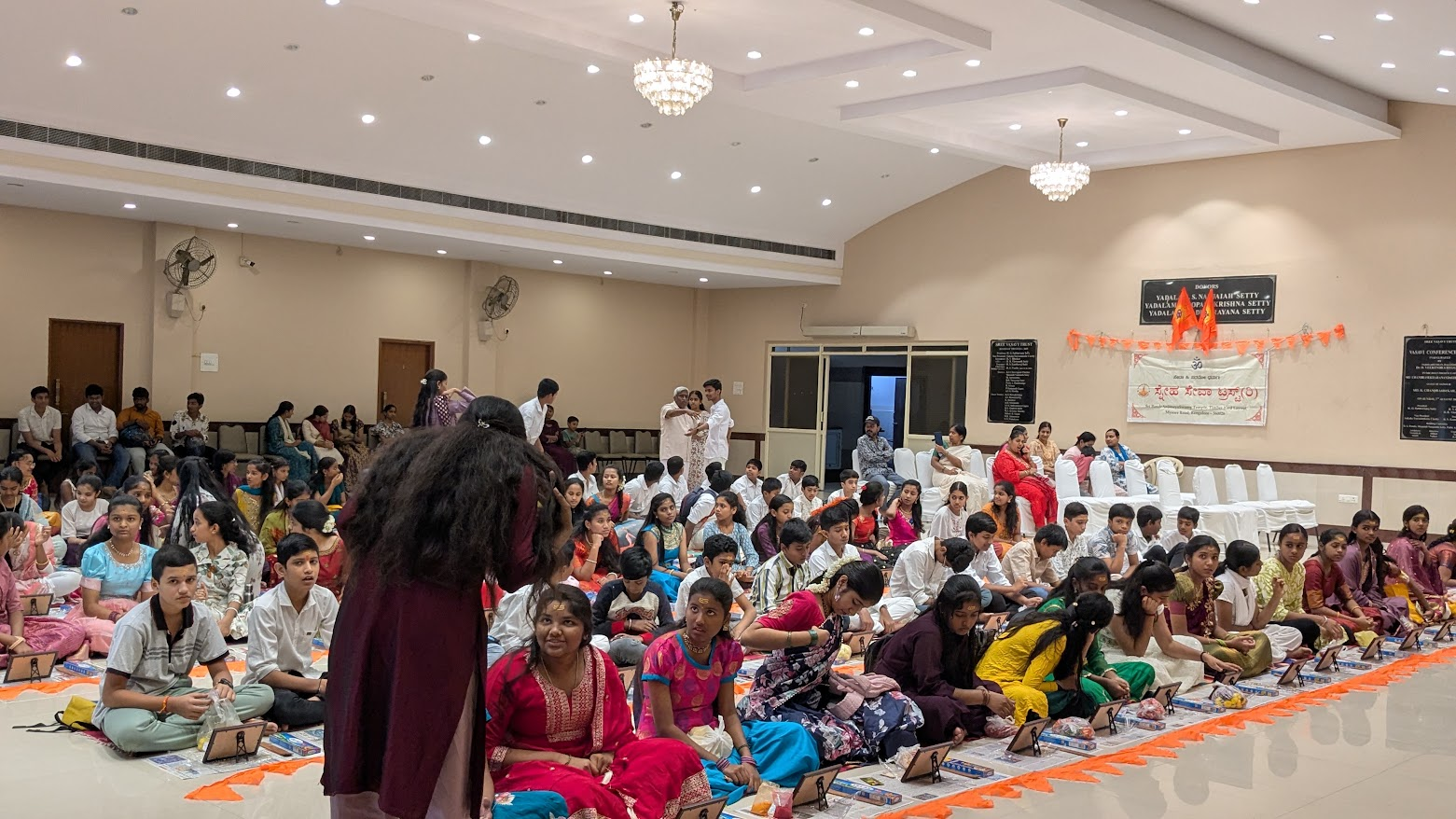
Participants being guided to the preparatory process
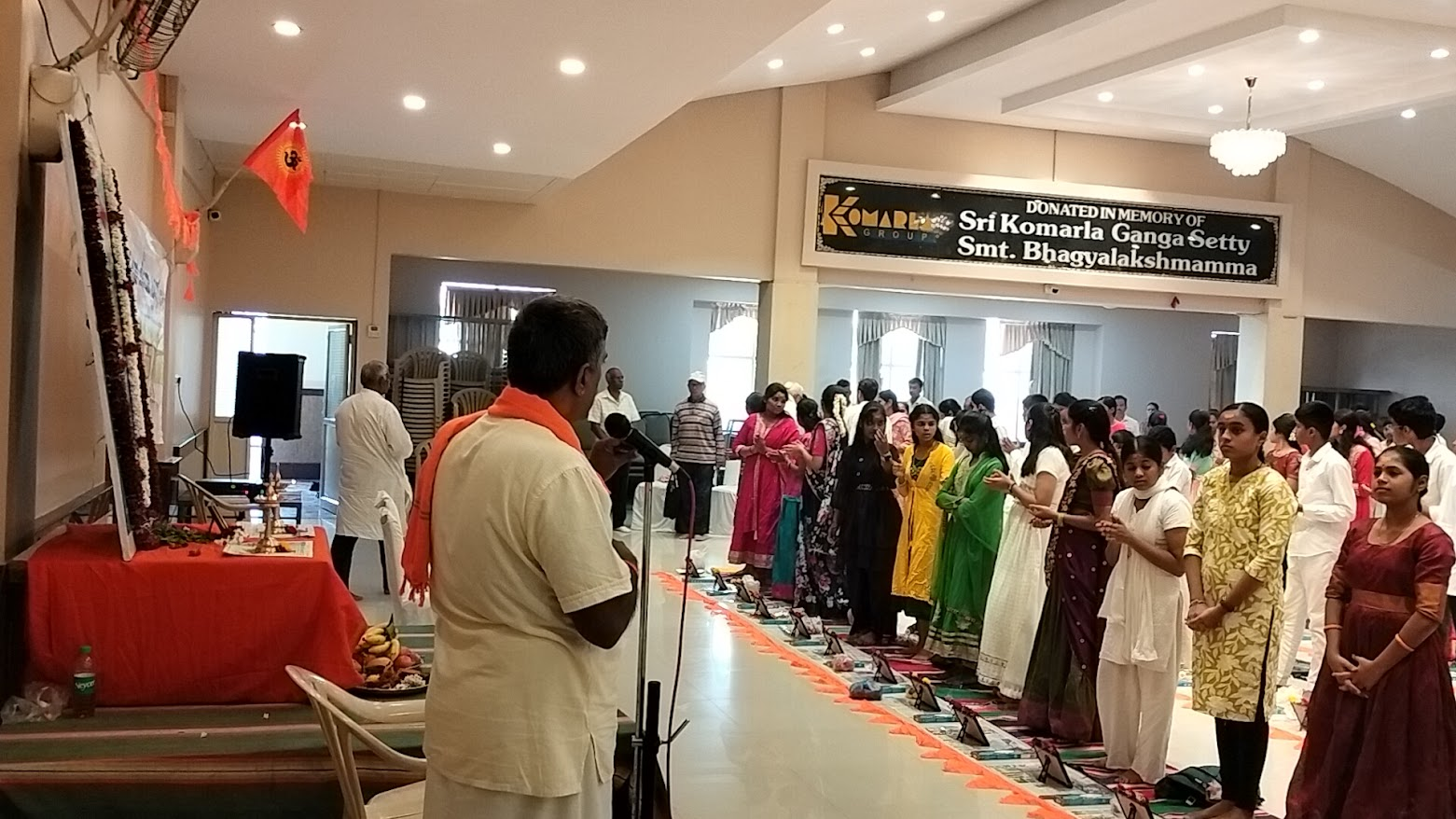
Chanting Time
Gratitude and Meditation Time
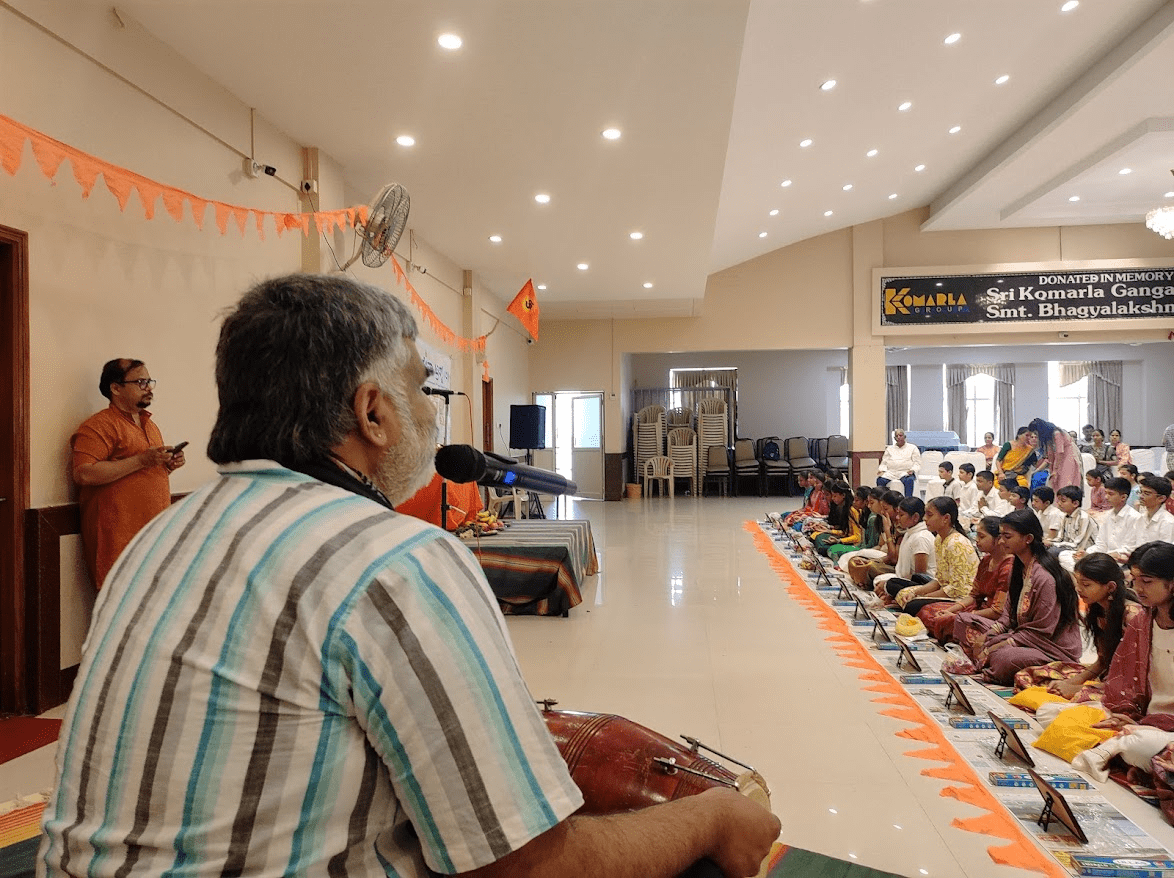
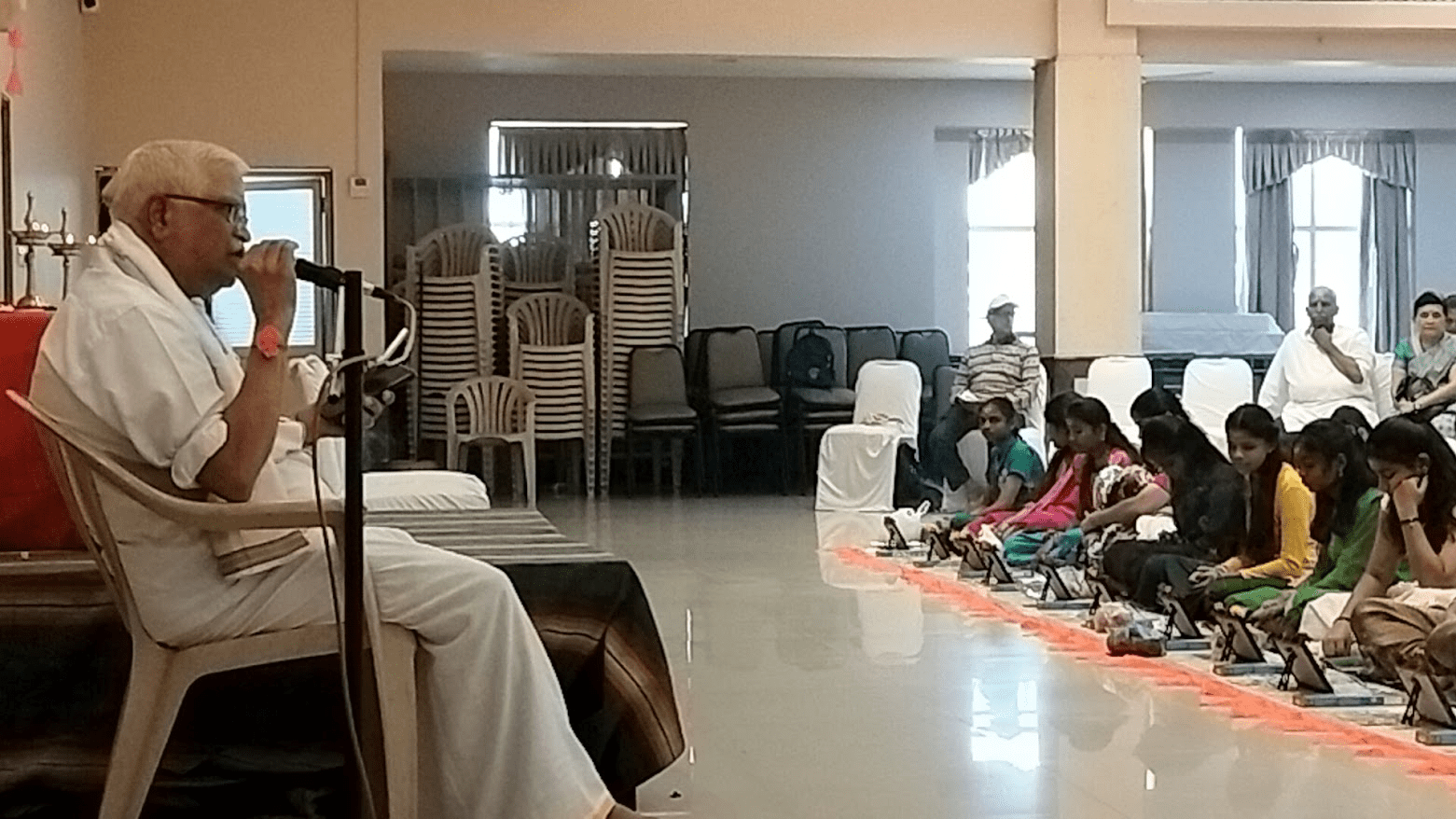
Following Satsang, ardent RSS Karyakarta and Swayamsevak Shri Lakshmi Narayan Sharma ji spoke to children and parents about importance of daily spiritual practice. He explained significance and process of performing daily pooja, and why reserving few minutes every day for pooja and dhyana in daily life is so valuable for growing mind. He taught students daily pooja procedure and four basic shlokas for everyday puja, giving them clear and easy daily routine to follow at home.
Shri Lakshmi Narayan Sharma ji
As part of session, Nitya Pooja and Dhyana concepts were explained in simple terms that every child can easily relate to. Nitya Pooja is just like saying good morning to God. Everyday you wake up, brush teeth, and say good morning to parents. Pooja is taking five minutes to say warm good morning, thank you, and offer small treat or flower to God who looks after world. Nitya Dhyana is power-up for mind. Just like charging phone gives energy to play games, taking two minutes to sit quietly and breathe gives brain maximum focus, memory, and peace for day.
Post Puja
Shri Lakshmi Narayan Sharma ji walked everyone through simple five minute Nitya Pooja for kids that keeps routine short, active, and sensory. First step is clean hands and smile, followed by lighting diya, offering flower or water, chanting simple mantra, and ending with gratitude pranam. In preparation step, kids wash hands and feet, then sit comfortably in designated quiet corner. Next step is welcome by lighting diya or agarbatti with adult help. It was explained that light removes darkness just like kindness removes sadness. For offering step, it was explained that kids pick real flower, tulsi leaf, small cup of water, or any fruit if available for naivedyam.
It was emphasized that God does not care how big gift is, only how much love you put into giving it. Thereafter all participants were initiated into 4 basic Shlokas – Vakratunda Mahakaya, Saraswati Namastubhyam, Guru Brahma Guru Vishnu and Namastestu Mahamaaye. Finally during aarti and gratitude, kids wave small bell or clap hands while singing short Arti song, if possible. With a quick pranam there were asked to pray God for good thoughts, health, and fun day.
During lunch time, group of curious students approached us to explain how exactly to do meditation in their daily routine. We sat together over food and guided them on simple ways to practice dhyana at home. We addressed common doubts that children usually have during meditation practice. When kids asked why they cannot just play instead of sitting for dhyana, we told them two minutes of Dhyana keeps mind healthy so they enjoy playing even more, just like brushing teeth keeps teeth healthy. When kids asked if God can see or hear them during quiet time, we explained that God is not person far away in sky but is like air or sunshine. You cannot see air, but you can feel it when you breathe, and God feels love whenever you think good thoughts. When kids asked what happens if they make mistake in steps or get distracted, we reassured them that God does not care if they drop flower or forget word. Just like mom loves hand drawn birthday card even if lines are not straight, God only cares about love and smile.
Parents/Guardians part of the program
Many parents participated in program and expressed immense happiness for being part of such divine event. After program, everyone enjoyed delicious meal together and returned home with firm sankalpa to perform Nitya Pooja every day. Sankalpa Event ended on highly positive note, leaving all new students and their parents inspired, empowered, and deeply connected with values of Sneha Seva Trust.
Organizational Profile: Sneha Seva Trust (Click to Visit their Website)
Background and History: Established in 1990 at the Timber Yard Layout in Bengaluru, the organization has served as a beacon of hope and transformation for communities in need. Formally registered in 2007, its journey began with a heartfelt mission to serve with compassion and empower individuals through education, healthcare, and skill development.
Educational and Community Initiatives: The organization provides free tuition classes for students from 2nd Standard to the SSLC level. However, its impact extends far beyond traditional academics. Through weekly Samskara classes, the trust imparts value-based education and essential life skills to children. Additionally, comprehensive counseling services are offered to both students and parents, alongside free medical camps organized to support the overall wellbeing of the community.
Jnanasiri Project: As part of the Jnanasiri Project, Sneha Seva Trust organizes a specialized program for students, encouraging them to take a formal pledge to practice daily worship and meditation (Nitya Pooje Nitya Dhyana).
Story of Little Arjun and Dusty Mirror
Once upon a time, there was a young boy named Arjun who loved to play in the mud, paint pictures, and race his friends. Arjun had a special tiny silver mirror in his room given to him by his grandmother. “This mirror is magic,” his grandmother had told him. “Whenever it is clean and clear, it reflects the warm, bright sunlight and fills your whole room with beautiful light.” Every morning, Arjun would wake up, wipe the mirror clean with a soft cloth, and shine a little flashlight onto it. The clean mirror would bounce a bright, glowing beam of light all over his room, making Arjun feel happy, energized, and ready for a great day. But then came a busy week. On Monday, Arjun said, “I don’t have time to clean my mirror today! I want to play right away.” By Wednesday, he forgot again. Day after day, tiny bits of dust, mud from his hands, and spots of paint settled on the glass. By Saturday morning, Arjun woke up feeling cranky and tired. He tried to shine his flashlight onto the mirror, but nothing happened. The glass was so thick with dust that no light could bounce off it. His room stayed dark and gloomy.
Arjun ran to his grandmother and said, “Ajji! The magic mirror is broken!” Ajji smiled gently, took a damp cloth, and handed it to Arjun. “The mirror isn’t broken, Arjun. It’s just covered in dust from all your playing. Take two minutes to wipe it clean.” Arjun sat down quietly. He took a deep breath, slowed down, and carefully wiped away every speck of dust. As soon as the glass was clear, the bright morning sunlight hit the mirror and Lo! His whole room lit up with brilliant, warm, golden light again. Arjun instantly felt peaceful and cheerful.
Lesson for the Kids
“Guess what? You have a magic mirror inside you—it’s your mind!
Every day, when we run around, get angry, or rush, a little bit of ‘dust’ settles on our mind. Pooja and Dhyana are just like wiping that mirror clean.
Taking two minutes every morning wipes away the dust, so your inner light can shine bright all day long!”
Shri Varadaraj ji, Secretary of Sneha Seva Trust and the heart and soul of this Event
Raghav worked as design engineer at heavy machinery firm in Mysuru for six years. He was reliable employee who spent his days solving complex mechanical problems. When his elderly parents in Mandya needed closer care, he decided to take up job in Bengaluru. With heavy heart, he walked into my cabin to hand over his resignation letter. In many Indian workplaces, resignation is often viewed as act of betrayal. Raghav feared he would face cold treatment during his notice period because of what had happened to others in the past under my management.
Adios, my dear friend, until we meet again
I had not always been understanding manager. In fact, I had learned my lessons the hard way through two painful incidents. A year ago, brilliant software integrator named Anand had resigned to join competitor. I took the resignation personally. I stopped inviting Anand to project meetings, spoke to him rudely, and delayed his experience certificate by months. Feeling humiliated, Anand left with deep resentment. Months later, my company needed to integrate a critical API that only Anand’s new employer controlled. When I reached out for help, Anand politely but firmly declined to cooperate, forcing my company to scrap the feature and lose valuable client.
Another incident involved talented junior engineer named Priya. When she resigned for higher studies, I cut her off completely and refused to write her recommendation letter. Two years later, Priya joined major government regulatory body as senior inspector. During routine factory audit, I found myself face-to-face with Priya. Though she remained professional, she did not offer any of the standard leeway or informal guidance that friendly inspectors usually provided. The company had to pay heavy fine for minor documentation errors which could have been easily resolved with friendly conversation.
These costly mistakes made me realize that departing employees are not enemies. I vowed to change my approach. So, when Raghav handed in his resignation, I looked at letter, smiled, and congratulated him. I understood that career growth and family commitments are natural parts of life. Instead of isolating Raghav, I made sure the transition was smooth and stress-free. Throughout the month, Raghav felt valued and respected. On his last day, the team gathered for small farewell with tea and hot Mysore pak. Raghav walked out of gates of the company with deep sense of gratitude and respect.
Three years later, my firm was bidding for massive project from German automotive giant. The contract was worth crores, but there was major hurdle. The German client required very specific quality certification that my team had never handled. I was struggling to find expert who could guide us through compliance process. One afternoon, my phone rang. It was Raghav. In his new role in Bengaluru, Raghav had become chief compliance officer for the very same German multinational.
Raghav had not forgotten warm farewell he received in Mysuru. He gladly spent his weekends guiding me and my team through the complicated audit requirements. With Raghav’s expert guidance, my company cleared audit and won the contract.
This experience cemented the invaluable lessons I had begun to learn. First, employee leaving organization is not end of relationship but beginning of new kind of association. Burning bridges out of ego or anger only harms business in long run, as I experienced firsthand with Anand and Priya. Second, departing employees are best brand ambassadors company can have in outer world. A dignified exit ensures they speak highly of organization, which attracts future talent and clients. Finally, corporate world is surprisingly small place. The person who is junior engineer today might become key decision-maker tomorrow. Treating every departing employee with respect and empathy is not just ethical choice, it is smart and strategic business practice that secures future opportunities.
Deepavali, is a popular Hindu festival that signifies and celebrates the victory of light over darkness, good over evil, and knowledge over ignorance. The lighting of Deepa (Lamps) represents the inner light that protects from spiritual darkness. Deepavali literally means a series (rows), garland of lamps. In the northern parts of India, the celebrations goes on for 5 days, beginning on the Trayodashi (13th day) of Krishna Paksha (Waning phase of the moon) during Ashwini (Ashwayuja) month of Hindu Calendar and it is celebrated as Dhanteras or Dhantrayodashi and ends on Dwiteeya (2nd Day) of Shukla Paksha (Waxing phase of the moon) during the month of Kartika month of Hindu Calendar with Bhai Dhooj. However in the South India, it begins on the Chaturdashi of Ashwayuja month and goes on for 3 days.
तमस्त्वज्ञानजं विद्धि मोहनं सर्वदेहिनाम् । प्रमादालस्यनिद्राभिस्तन्निबध्नाति भारत
O son of Bharata, know that the mode of darkness, born of ignorance, is the delusion of all embodied living entities. The results of this mode are madness, indolence and sleep, which bind the conditioned soul.
Objective of Deepavali is captured in this Sloka (Bhagavad Gita Chapter 14 Stanza 8) definition of darkness and its effect. When one is ignorant, he is insane and unable to discern or discriminate “what is” setting a process of degradation instead of progress. Ignorance causes Pramada (madness or delusion), Aalasya (Laziness or sloth) and Nidra (Unawareness). Bigger danger is Ignorance born out of ignorance causing one to end up in a vicious circle and pushing one into Nadir of Spirituality and keep them deep in the pits. Further our scripture also says, Vastu-yāthātmya-jñānāvarakaṁ viparyaya-jñāna-janakaṁ tamaḥ: under the spell of ignorance, one cannot understand a thing as it is.
Tamasoma Jyotirgamaya from Brahadaranyaka Upanishad captures what should every human aspire for – Lead us from darkness (Tamas) of ignorance to light (Jyoti) of knowledge which is exactly what Deepavali is all about. Beyong literal definition of Darkness, the spiritual meaning of Tamas or Darkness are many and all undesirable traits – Lethargy, Foolishness, Sorrow, Disease/Unhealthiness, Loss, Failures, Misery, Disappointment, Wickedness, False Ego etc. Darkness per se is not a definable phenomenon, It is a state where there is absence of Light. What is thus required to dispel darkness is presence of Light, which is the essence of Deepavali.
Dhanteras or Dhantrayodashi:
Dhanvantari in Sri Sri Ayurveda Hospital, Bengaluru
The celebrations begins on the Trayodashi (13th day) of Krishna Paksha (Waning phase of the moon) during Ashwini (Ashwayuja) month of Hindu Calendar. Commonly known as Dhanteras or Dhantrayodashi. During the Sagara Manthana (Churning of the Ocean) Dhanvantari, An avatar of Bhagwan Vishnu and considered the Divine Physician & God of Medicines, appears with Amrita Kalasha (Pot with Divine Nectar of Immortality) on Dhantrayodashi day and hence considered as birth of Dhanvantari and celebrated as Dhanvantari Jayanti by the Vaidyas of Hindu Medicines System. The worship ritual also includes Puja to Lakshmi and Kubera. Since Dhanvantari appears with a Kalash (pot) there is a ritual of buying Utensils for Dhanteras. It is believed that anything bought on this day multiplies 13 fold.
Dhanteras puja is generally performed during Pradosha Kaal. Along with worshipping Lord Dhanvantri, Deepdaan is also done. Along with this, one lamp is lit near the main gate, roof and tap of the house. It is lit outside the house also facing south. It is believed that by doing this there is no fear of untimely death.
In Karnataka this day is celebrated as Jalapoorna Trayodashi or Neeru Tumbuva Habba (Literal meaning – Water filling/collecting Festival). The day is dedicated to water purification and preparation for the sacred oil bath on Naraka Chaturdashi (the next day), symbolic of both physical and ritualistic cleansing. It is also considered a symbolic worship of the Maa Ganga, invoking her presence in the water stored for the ritual bath. It is observed by cleaning water vessels like urn (hande), pots, buckets, and bathing tubs. and then decorated with turmeric, kumkum, mango leaves, and flowers. In the earlier days water used to be collected from river, wells or other water bodies and the urn is filled. A Kalasha is installed and the entire set up is worshipped after invoking Maa Ganga. This water is then used for the ritual oil bath, next days on Naraka Chaturdashi and is believed to cleanse sins and bring prosperity.
AI Generated Image
Naraka Chaturdashi
2nd day of Deepavali for those who observe Dhanteras and the 1st day for the others, Naraka Chaturdashi is believed to be the day, Bhagwan Krishna slayed Narakasura. There is a deeper spiritual significance as explained by various Gurus during their discourses which I capture from my memory (Pardon me for any mistakes and please let me know to correct it).
Though the legend of Narakasura Vada though a simple episode with a message of victory of good over evil highlights importance of understanding & collaboration for perfect partnership in a relationship. The legend has it that it was Satyabhama who with her husband, Krishna, who killed the demon king Narkasura to which this day is associated with. Bhaumasura, his actual name was demon son of Vishnu in his Varaha Avatara and Bhoodevi. Since immortality is not the law of creation, Bhaumasura sought a boon from Brahma that he cannot be killed by anyone other than his mother. Once the boon was granted, he began a reign of Terror and created hell or Naraka for everyone around, hence the name Narakasura. He ruled over the empire of Pragjyotishpur, he went about capturing all kingdoms on earth and set his eyes on the Devaloka. He routs Indra and captures 16,000 princesses of all defeated kingdoms, and imprisons them atop Maniparvata, which was guarded by his general Mura, the 5-headed demon with his ten sons. The last straw was he snatching ear rings of Aditi, Mother of Devas upon which she approaches Satyabhama (Bhoodevi in her current form) to redeem the world from curse called Narakasura. Krishna with Satyabhama assures her that it would be done and Narakasura will be slayed soon. A fierce battle ensues where each kind of Astras (weapons) that Narakasura received as boon was countered by Krishna. Finally a trishoola (Trident) from Narakasura hits Krishna’s chest and he pretends to have fallen. Satyabhama was crestfallen and she shoots an arrow at Narakasura which pierces his chest and he falls down with agonising pain. Krishna who then rises, uses his Sudharshana Chakra to complete the task. Before his death, Narakasura asks Satybhama (his mother) for a boon that this day should be celebrated with lights by everyone which was granted.
Krishna pretending to be wounded while Satyabhama shoots arrow at Narakasura (PC: WWW)
After the battle, they free the princess, recover the ear rings and return to their palace all covered in blood, sweat and grime. Krishna and Satyabhama are then given a bath with Sandal and scented oil, which is practiced even today as a ritualistic bath during Deepavali festival. On Naraka Chaturdashi day, it is customary to have an Abhyanga Snana (Traditional Oil Bath). This is followed by Arati and then fun time bursting crackers and other fireworks.
On Deepavali day, traditionally we light numerous Deepas with one main Deepa. The main lamp (Supreme Jyoti) with which other individual lamps (jeevana jyotis) are lit is a Symbol of the Divine. The other lamps are jivanajyothis (individual lamps) which derive their light from the One Supreme Light. The other deeper significance of the Jyoti (flame) is its inherent nature. One, it dispels darkness and two, it always moves upwards. This is to represent wisdom that raises humans to higher states. Along with lighting the lamps, humans should strive to light the lamps within, calling for purity of body, mind, and speech (Trikarana Shuddhi).
Lakshmi Puja or Badi Diwali
The 3rd day of Deepavali for those who celebrate Dhanteras (2nd day for others) is on the Amavasya (New Moon) day of Krishna Paksha (Waning Phase of the moon) during the Hindu month of Ashwini (Ashwayuja). It is a day dedicated to worship of Maa Lakshmi. It is referred to as Badi Diwali (Main Diwali) and the most important day of Deepavali for many. It is also believed to be the day Bhagawan Shri Rama Parivara returns to Ayodhya after His victory over Ravana. Ayodhya without Effulgent Rama who goes on exile always felt it was an extended period of darkness and Amavasya being a new moon day rendered the world darker. In order to welcome victorious Rama and his Parivara to Ayodhya, whole town is lit up with series of Lamps (Deepa) which set the practice for Deepavali
It is believed that Lakshmi will visit every sincere devotees’ home and bless them with wealth and prosperity. Maa Lakshmi is worshipped in the evening in traditional manner. Typically, the following is performed of which Shodashopachara Puja is a part.
Homes are cleaned and decorated it with Deepas (lamps), flowers, and colourful rangoli. This sets up the place conducive for worship
A peetha (platform) is prepared for Sthapana of Kalasha (pot)
In the centre of the Peetha, handful of rice grains is spread and
Draw a Ashtadala Padma Rangoli and place the kalash on it.
Fill the kalash with water and add a coin, flowers, and akshate (rice grains) and dry fruits.
Arrange five mango leaves at the mouth of the kalash and place a Coconut. We also have Silver Lakshmi Mukha (face) placed on the coconut to give Kalash and Lakshmi Rupa (see photographs above).
If you have Sri Yantra or Maha Meru Yantra you can have it placed on the peetha and it is said to attract Maa Maha Laxmi.
Puja as always begins with Worship Ganesha: Place a silver or Turmeric murti of Ganesha on the right side of the kalash, along with offerings.
Light a lamp and offer haldi, kumkum, and flowers.
Invoking and Inviting Goddess Lakshmi by reciting the Maha Lakshmi mantras
Perform Abhisheka of the Smaller Silver Abhisheka Murti of Mahalakshmi with water
Perform panchamrita abhisheka,
Offer various incense and scented materials .
Finally worshipping Kubera, symbolised by the chest or enclosure where valuables like money or jewellery is stored.
Finally perform Mahamangalarati of Lakshmi and accept the Naivedya as Prasad and distribute to other participants
After the puja, it is celebration time and time for extensive fireworks and crackers are burst.
Bali Padyami or Bali Pratipada
The 4th day of the festival for those who celebrate Dhanteras (3rd and final day for those who don’t) is celebrated as Bali Padyami on the Pratama (Padya) or the 1st day of Shukla Paksha (Waxing phase of the moon) during Kartik Month of the Hindu Calendar . It is believed that this was the day when the Asura King, Mahabali (grandson of Bhakta Prahlada) & King of Asuras was stomped down to the Suthala (the highest level in the Patala-netherworld) by Vishnu in Vamana form. Mahabali was an ardent devotee of Vishnu, just like his grandfather Prahlada, and once Indra had killed him in a battle. His Guru Shukracharya revives him and other slayed demons with Mrutasanjeevini mantra. Mahabali also realised that war would be futile and his ambition would only cause destruction and unwarranted loss of lives and decides on alternate means. In his pursuit to occupy the position of Indra, he decides to perform 100 Ashwamedha Yaga and successfully completed 99 yagas. Devas were worried and they approach Vishnu to stop Mahabali from completing his 100th Ashwamedha Yagya.
Vishnu as Vamana extracting His 3rd Step offered by King Mahabali
Vishnu takes birth as Vamana (a dwarf brahmin boy), as son of Aditi (Mother of Indra). He visits the Mahabali’s Yagyashala while he was performing the 100th yajna. As was the practice, any guests are received by the King himself and offered Dakshina as part of Yagya rituals. Mahabali thus met and offered his respects to Vamana, and gives him gifts, horses, land, etc. But Vamana refused to take those. He said he was the ruler of the three worlds, the earth, skies and netherworld and wanted 3 steps of world as his Dakshina. Mahabali saw no danger in accepting this request. Vamana begins to grow in size and becomes so huge, in 2 steps was able to step all the worlds and there was nothing left for His 3rd step, whereupon Mahabali, the benevolent king offers his own head. While Mahabali goes in to purify before offering himself to Vishnu, Guru Shukracharya warns him and asks him to take back the offer. Mahabali refuses and says being a Bhakta of Vishnu, his life’s goals are achieved offering himself to Vishnu. Vishnu steps on his head and relegates him to Sutala and blesses him with a day when the humans celebrate his sacrifice and devotion to him. Bali Padyami is the day dedicated to honoring Mahabali. Vishnu in Vamana form also guards the sutala and protects His devotee Mahabali from any dangers.
Generally puja is offered to Tulsi on this day, and Holige (Puran Poli) is the Naivedya. Families get together and play Pagade (Pachikalu), a dice game
PC: Ancient Living
Note: Onam festival celebrated by Keralites is actually Vamana Jayanti, the day Vamana appeared on the earth and Bali Padyami the day when Mahabali is relegated to Sutala
The day is also celebrated as Govardhan Puja, since Bhagwan Krishna is believed to have lifted Govardhan hill to protect His devotees in Gokul from torrential rains and storm. Devotees in turn prepare mountain (symbolising Govardhana Hill) of Naivedya/Prasada as offering to Krishna for this act (Annakut)
Govardhan Puja being Performed by then Hon’ble CM of MP, Shri Shivraj Singh Chauhan
Bhai Dooj
The 5th day of Deepavali for those who began their celebrations with Dhanteras is celebrated as Bhai Dhooj or Bhai Bheej. Though it is a popular one in North India, it is slowly catching up in the South India too. It is observed on the Dwiteeya (2nd Day) of the Shukla Paksha (Waxing Phase of the moon) during Kartik Month of Hindu Calendar.
This is the day to reinforce and celebrate the eternal love between a sister and brother, an occasion where sisters pray to God for the longevity, well-being and prosperity of their beloved brother. Brothers visit their Sisters at their place and get a tilak applied on them (during Raksha Bandhan they get Rakhi tied) and pray for well being of their brothers against all the evils and bad fortune. It is the day Krishna met Subhadra after killing Narakasura. Subhadra was overjoyed by this unexpected visit of her brother’s and offers Him sweets and flowers. She also applied tilak on Krishna’s forehead and prays for his well-being which is what is practiced to this day by sisters.
PC: Doordarshan X handle
It is believed that Yama, God of death met his sister Yamuna on 2nd day of Kartik month and hence it is also called Yama Dwiteeya.
Conclusion
I would like to bring out an interesting narrative of spiritual significance of various aspects of Deepavali as I heard during my growing up years. Krishna is believed to be the ruler of five life force or pancha pranas)- prana (controls and regulates respiratory & heart functions), apana (ejection of waste from the body), samana(digestion & metabolism), udana(Balancing of movements of legs, arms and function of nerves etc), and vyana(controls all kinds of movements). Similarly, Krishna is the ruler of Five elements or Pancha Bhutas – Earth, Water, Fire, Air and Ether. Everything in the creation, including our body is composed of these 5 elements. This constitution thus affects only the body and not the Self or Atma. Nara-ka thus is something opposite to Atma. Narakasura thus is not an external demon but the one which is internal state – a state where we forget about Atma. Krishna slaying Narakasura signifies destruction of this ignorance where we forget Self (which is the cause of all problems in the world) and bringing us to the light of Supreme Knowledge.
Deepavali thus is a day to getting rid of all the bad qualities in us (the Narakaasura). 16,000 princess who He freed are the subdued good qualities within us which needs to be manifested outwardly. As long as the negative tendencies of demonic qualities exist, it is aking to be engulfed in darkness. Deepavali thus is an occasion to get rid of all such negative traits and thoughts and assume a new existence, just like we discard old clothes and wear new ones during the festival