Excerpts from my online address for International Consortium of Volunteer Organisations
Respected delegates and esteemed participants, warm greetings to you all.
I stand before you not as an expert on Administration nor as policy expert, but as humble seeker and blessed devotee of Pujya Gurudev Sri Sri Ravi Shankar ji. Whatever little I understand about human service comes from observing Him, whose life is ultimate testament to leadership by example. From Pujya Gurudev, I received foundational truth of my life: service is never burden we carry or favour we grant to society, but sacred privilege bestowed upon us.
My understanding of ground execution was tested in crucible of crisis. During relief operations with Art of Living, I saw how compassion transforms instantly into swift, organized action on ground. Later, while serving as Honarary Vice-Chairman of Citizen Task Force for COVID Management under Government of Karnataka, I coordinated with nearly 40,000 volunteers, where over 25,000 were active throughout the lock-down phases, risking their lives when virus was silent, unknown killer. I remain deeply grateful to Major Manivannan, IAS (currently Commissioner of Bengaluru Development Authority), a senior bureaucrat in Government of Karnataka, for trusting me with this responsibility. That experience revealed clear truth: formal state machinery can build infrastructure, but only deep spirit of voluntary action can heal society during massive human crises. When senior administrator asked why I was taking humongous personal risk when government officials were paid to do job, my heart gave only one response:
“If not me, who?
If not now, when?”
Paid duty moves within boundaries of mandate, but true citizen service springs from personal accountability toward community. I am sure each one of us are guided by the same principle
Yet, sustained service requires more than initial emotional surge. When public crises stretch across months like in case of COVID19 Management, enthusiasm naturally turns into physical and mental exhaustion. Key to building resilient volunteer movements lies in ancient Indian concept of dispassionate attachment. Shrimad Bhagavad Gita anchors this exact principle of action:
कर्मण्येवाधिकारस्ते मा फलेषु कदाचन |
मा कर्मफलहेतुर्भूर्मा ते सङ्गोऽस्त्वकर्मणि ||
karmaṇy-evādhikāras te mā phaleṣhu kadāchana
mā karma-phala-hetur bhūr mā te saṅgo ’stv akarmaṇi
“You have right to perform prescribed duty, but you are not entitled to fruits of action. Never consider yourself cause of results of your activities and never be attached to inaction.” (Bhagavad Gita 2.47)
When volunteers chase personal glory, recognition, or quick fairy-tale endings, frustration sets in immediately. Working without attachment to outcome protects teams from burnout and ensures temporary setbacks do not paralyze collective movement.
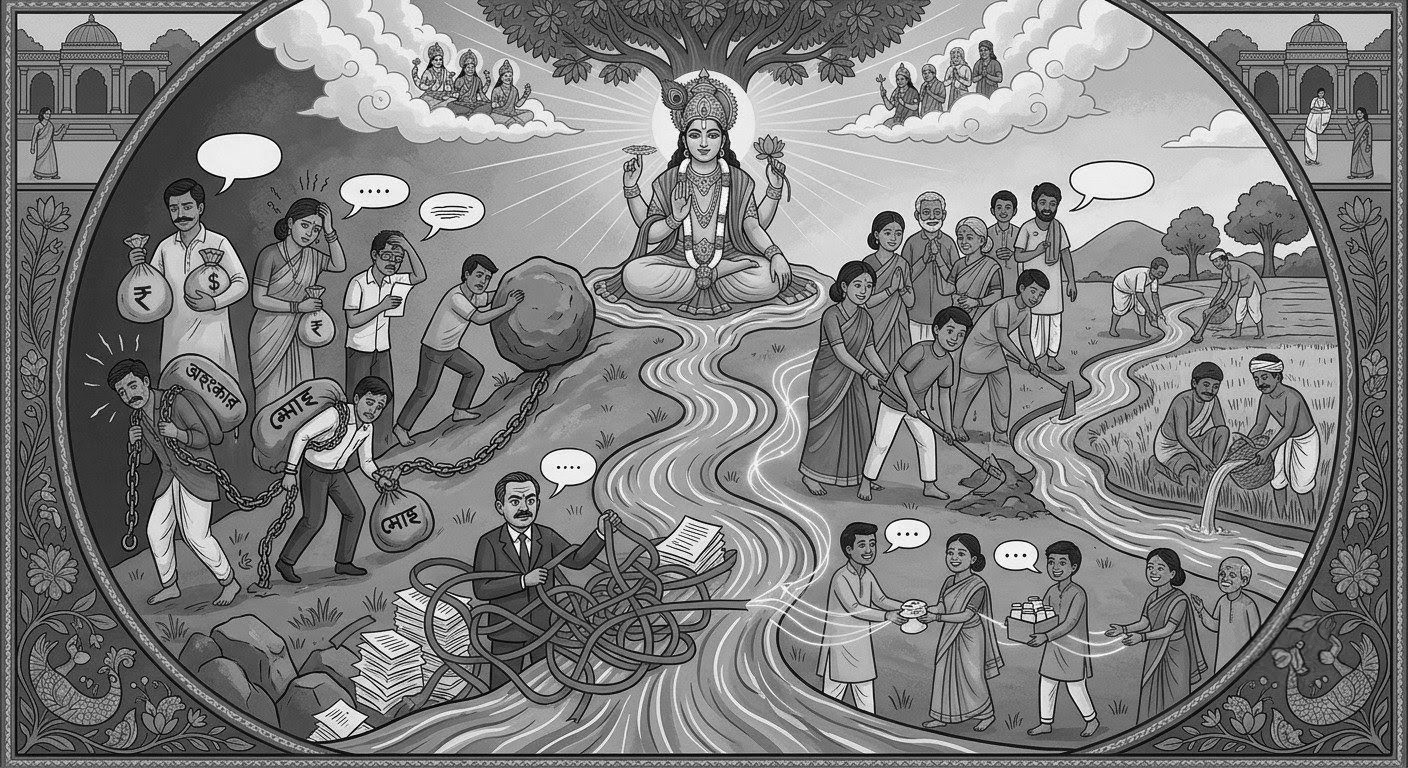
Public administration during emergencies often suffers from institutional friction, rigid hierarchies, and pursuit of absolute procedural perfection. Crises demand timely, practical solutions over delayed perfectionism. True leadership requires shifting from top-down control to facilitative mindset. Administrators must insulate ground teams from red tape, replace multi-layered authorization chains with rapid clearances, and eliminate bloated documentation. We must build documented systems, not systems for documentation. Thanks to the Government of the day for the free hand given to us to manage the situation, and Major Manivannan insulating us from the comprehensive and slow moving procedures. By deploying lightweight digital platforms for resource mapping and tapping open-source technology alongside pro-bono corporate expertise, zero-budget volunteer networks can scale rapidly without heavy overheads or delays.
This self-arising model, traditional wisdom calls Swayambhu, relies entirely on shared purpose rather than monetary incentives or capital-intensive structures. Amorphous citizen groups lack rigid designations, allowing individuals to step up based on competence and adapt instantly to changing field realities. To sustain such movements without exhausting key leaders, organizations must practice rotational leadership. Inability to delegate traps experienced leaders in routine tasks, creating operational bottlenecks. Bhagavan Shri Krishna highlights how detached duty releases operational stress:
तस्मादसक्तः सततं कार्यं कर्म समाचर|
असक्तो ह्याचरन्कर्म परमाप्नोति पूरुषः||
tasmād asaktaḥ satataṁ kāryaṁ karma samāchara
asakto hyācharan karma param āpnoti pūruṣhaḥ
“Therefore, without being attached to fruits of activities, one should act as matter of duty, for by working without attachment one attains Supreme.” (Bhagavad Gita 3.19)
Establishing robust decentralized frameworks and handing over authority ensures social institutions outlive individual leaders.
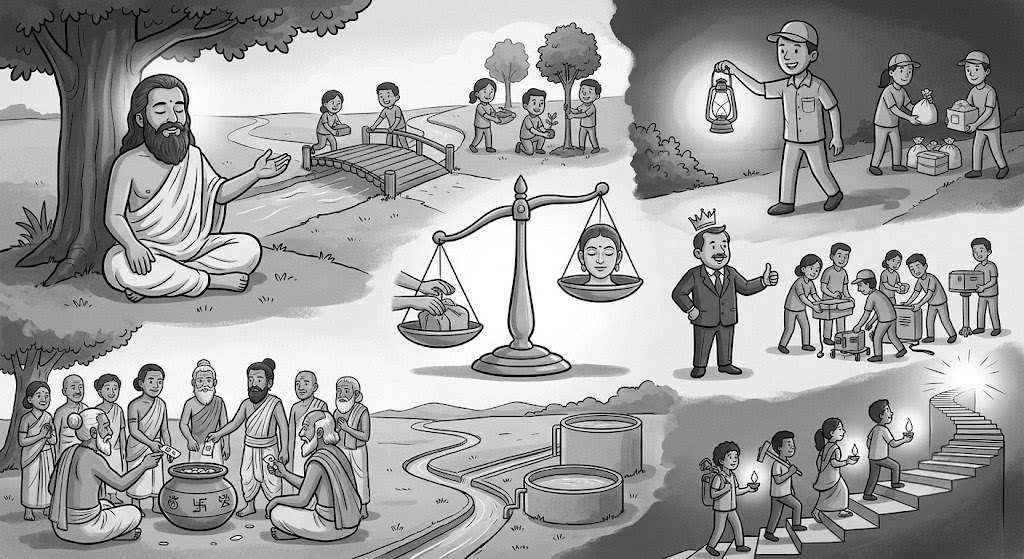
Decentralized self-governance is not foreign concept to Indian soil; it is our ancient heritage. For millennia, local communities managed civic infrastructure, water bodies, and justice independently of royal courts. 10th century Uthiramerur inscriptions from reign of Paranthaka-I detail how Tamilagam’s local assembly, Sabha, managed public works through executive committees elected via Kudavolai – Kudam (pot) + Olai (palm leaves) where a small non-interested boy draws the leaf with name of the nominee from the pot – an unique lottery system with strict eligibility criteria and instant disqualification for administrative misconduct or lack of financial transparency. Similarly, in Sixth Century BCE, Gana-Sangha dynasties like Licchavis of Vaishali governed through representative assemblies, taking democratic decisions using wooden voting slips called Salakas. Modern public policy can draw from these roots, creating nodal desks that seamlessly integrate citizen action into governance framework.
For over four decades, social initiatives guided by Pujya Gurudev Sri Sri Ravi Shankar ji have proven transformative power of selfless action across India. In River Rejuvenation project, Art of Living volunteers, hydrologists, and villagers have revived dozens of dying rivers across Karnataka, Maharashtra, Tamil Nadu, and Uttar Pradesh. By constructing thousands of recharge structures and injection wells, groundwater levels have been restored, bringing fertile land back to life for lakhs of farmers. From rural development and organic farming to free tribal education and disaster relief, these projects succeed because citizens view service not as transaction, but as spiritual duty.
Viewing volunteering as privilege transforms administrator and volunteer alike. Pujya Gurudev reminds us that supreme reality operates through us, and we are merely instruments in larger cosmic order. When we surrender personal ego and ownership of results, our actions remain pure and untainted, as Gita describes:
ब्रह्मण्याधाय कर्माणि सङ्गं त्यक्त्वा करोति यः|
लिप्यते न स पापेन पद्मपत्रमिवाम्भसा||
brahmaṇy-ādhāya karmāṇi saṅgaṁ tyaktvā karoti ya
ḥlipyate na sa pāpena padma-patram ivāmbhasā
“One who performs duty without attachment, surrendering results unto Supreme, is unaffected by material contamination, just as lotus leaf is untouched by water.” (Bhagavad Gita 5.10)
As every Art of Living follower understands, true service is not about capability; it is about availability. When we make ourselves available as clear instruments, dispassionate action becomes journey of self-discovery and lasting social transformation.
Thank you for patient listening and to the organizers for according this privilege of addressing this amazing bunch of Nishkama Karmayogi (Those Serving selflessly without any personal expectations)
On occasion of Deepavali, grand festival of lights, I extend my heartfelt wishes to you and your families. May your lives and path of volunteering be illuminated with light of wisdom, humility, and endless capacity to serve society.
Happy Volunteering!
PS: Script of this address will be availabe online within 24 hours on the following link
https://yensures.com/2026/11/07/essence-of-volunteering-an-indian-citizen-volunteer-perspective/
You may also refer to my earlier articles on the related subject on the following links