This story is inspired by a real incident last Friday, where a moment of quiet professional validation was abruptly interrupted by an awkward display of public insecurity. While the setting, industry, and individual identities have been completely changed to protect the privacy of those involved, the underlying behavior remains entirely authentic. The intent behind sharing this narrative is not to criticize or demean anyone, but rather to highlight a valuable workplace lesson on professional maturity, true competence, and the self-defeating nature of unprovoked insecurity.
Insecurity and incompetence are inseparable companions. A person who truly knows his craft remains composed, content to let his work do the talking. When real expertise is missing, however, every gathering feels like a threat to a fragile ego. Insecurity drives incompetent people to make noise at the most unexpected moments, desperately hoping to appear important. Sadly for them, this urge to steal the spotlight usually backfires, transforming simple ignorance into comedy for everyone else in the room.
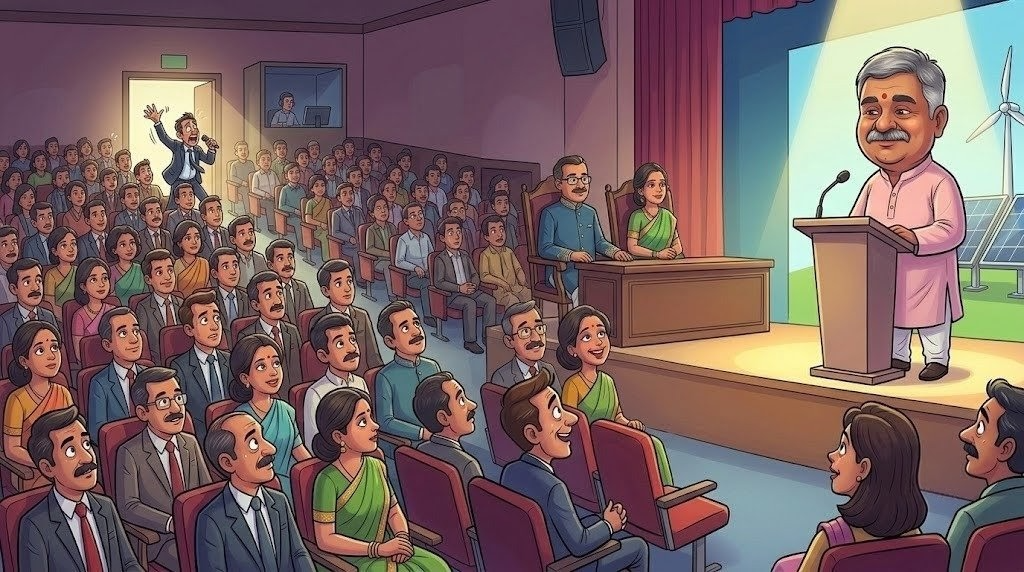
This tendency unfolded in full glory during a grand renewable energy summit at a plush hotel in Hyderabad. The hall was packed with Ministers, corporate leaders, policy makers and engineers, all discussing solar power policies for rural India. On stage sat a veteran engineer, a man who had spent thirty years in dusty fields actually building power grids while others merely made presentations. The organizer invited him to address complex grid integration rules. With effortless calm, the veteran dismantled difficult technical doubts raised by nervous investors. Impressed by this intervention, one the ministers on stage introduced him as a true pioneer who had built foundational solar models during his long tenure at a reputed national energy agency.
Sitting in the last row, dressed in a suit three sizes too sharp, was a newly baked successor, Sharma from that very same agency. Sharma possessed very little knowledge about power grids, but he had an endless supply of self importance. Watching the veteran receive unanimous praise was too much for Sharma to digest. Insecurity hit him like a jolt of high voltage electricity.
Before anyone could stop him, Sharma leaped out of his chair like a jack in the box. He practically began shouting his name and company title into it. I am Sharma from National Energy, I am Sharma, he declared, as if announcing a grand arrival. The room fell silent, expecting some brilliant technical insight. Instead, Sharma launched into an energetic speech about two rural electrification drives, completely missing the fact that the conference was discussing solar grid integration, not basic wiring. To make matters funnier, those two projects he boasted about were actually designed and executed years ago by the veteran himself, long before Sharma even learned how to spell infrastructure. Sharma gesticulated wildly, dropping buzzwords that made no sense together, while senior engineers in the audience exchanged suppressed giggles.
The moderator, trying hard to keep a straight face, finally interrupted the performance. Mr Sharma, the moderator asked politely, do you have any specific suggestion regarding rural grid policy, or should we move back to the agenda? Sharma froze. His mouth stayed open for a second like a landed fish. He looked around, realized nobody was clapping, stammered something about how his organisation has managed projects and that they plan to also empanel under the project, and quickly collapsed back into his seat. His desperate attempt to make his presence felt, born purely out of insecurity and incompetence, turned what could have been a silent afternoon into the best entertaining break of the summit.
A classic case of
Trying to Steal Thunder ending up Catching Lightning
During a Satsang organized a couple of days ago (on 29th August 2026) by Art of Living volunteer faculty Hemadri ji and other volunteers at the Yoga Hall in Omkar Layout Centre, several participants raised common questions on how to address naysayers who critique the life and actions of Shri Krishna. Sri Krishna is one of the most revered deities in Sanatana Dharma. His life presents fascinating paradoxes that deeply inspire millions of devotees across the globe. To an untrained mind, seeing Bhagavan Shri Krishna as a butter thief, a flirt, or hearing Mahamantra of wisdom like Bhagavad Gita on a battlefield full of violence might appear contradictory. However, deeper spiritual study reveals profound truths hidden inside these divine events. Towards the end, I have also shared 3 popular anecdotes and lessons that we can draw from those.
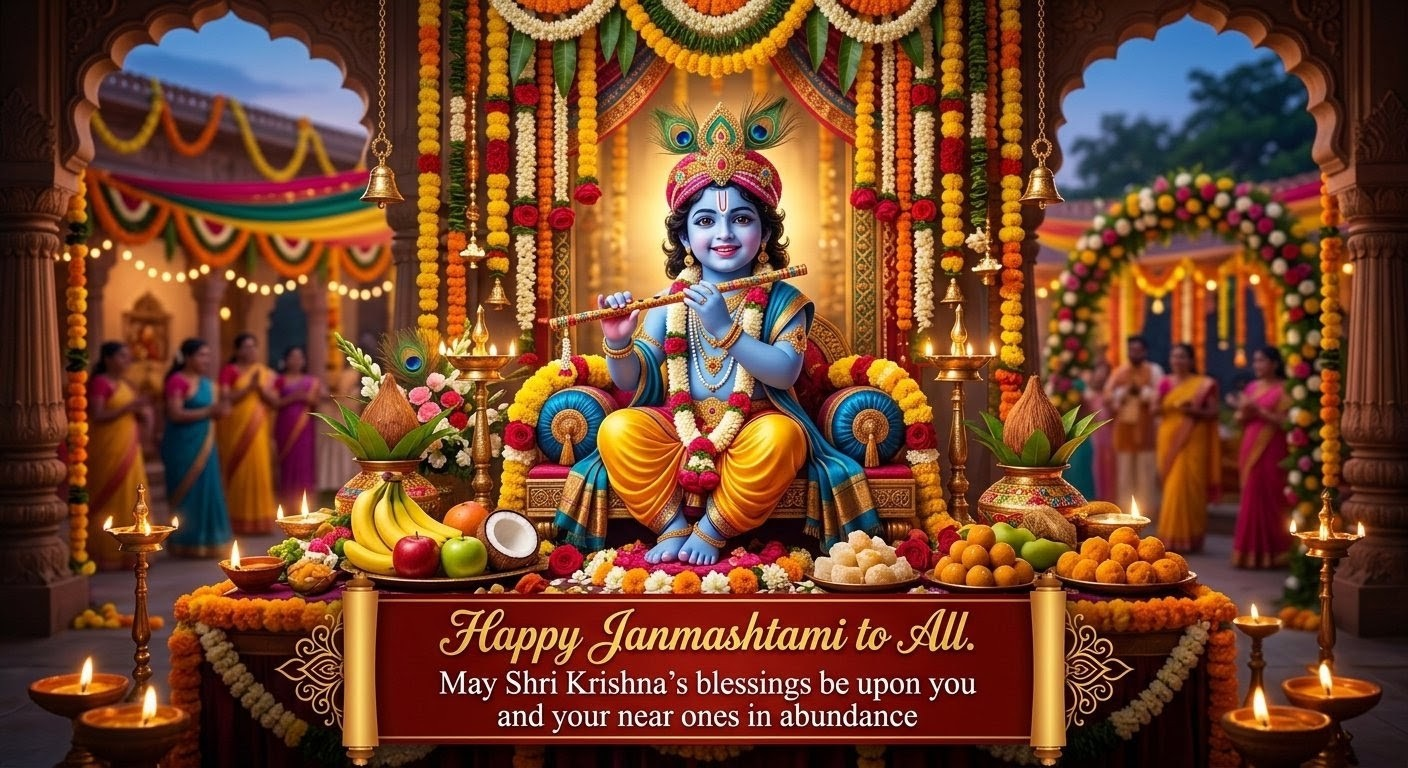
Shri Krishna Janmashtami marks arrival of divine consciousness in world clouded by ignorance and chaos. Beyond midnight celebrations and fasts, life of Bhagavan Shri Krishna serves as practical guide for modern living. Whether viewed as divine incarnation, philosopher, or master strategist, His life stories offer universal values that apply directly to daily challenges, workplaces, and communities. We often think of Janmashtami as a historic event celebrated at midnight. But spiritually, Krishna’s birth represents light arriving in the darkest of places. And let’s be honest, between work pressure, personal challenges, and global uncertainty, we all face our own “dark midnights” occasionally.
Please read my earlier Article Beyond the Festivities: Shri Krishna Janmashtami in which I have described traditions, legends, and spiritual significance of Shri Krishna Janmashtami. From divine childhood miracles to vibrant South Indian home celebrations and community satsangs, I share how welcoming little Krishna brings enduring hope, peace, and joy into our everyday lives today.
Navaneeta Chor
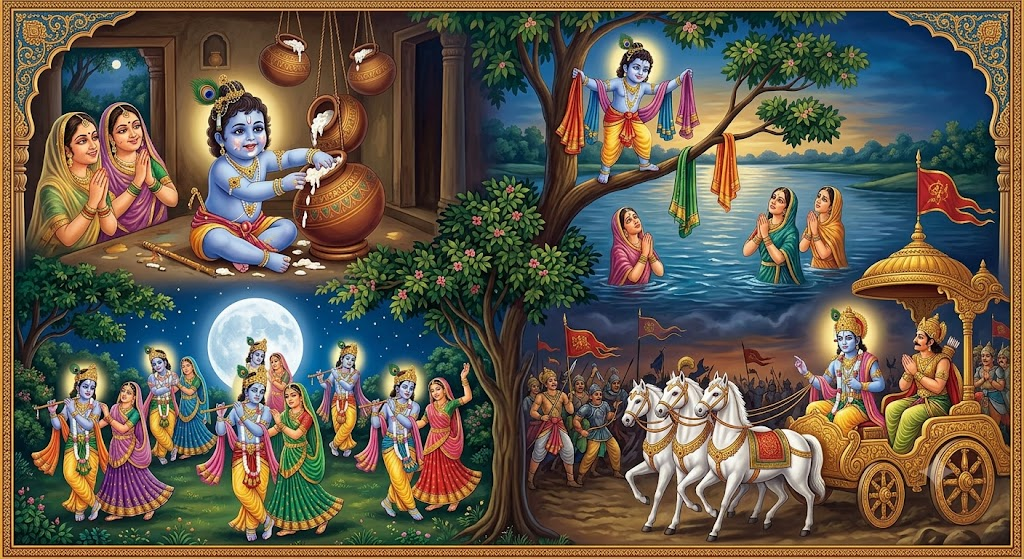
In his childhood at Vrindavan, Shri Krishna frequently stole butter from cowherd women called Gopis. This act was not driven by material greed, but carried deep Vedantic symbolism. Butter comes only after patient churning of milk. It represents pure essence of human mind, free from worldly impurities. Gopis used to hide butter pots near roof ceilings, which symbolizes how human beings conceal their pure devotion under ego and worldly fear. By breaking those pots and taking butter, Shri Krishna actually steals ego and accumulated karmas of his devotees. Unlike human theft which arises from greed, divine theft is supreme grace where Ishvara claims what originally belongs to him.
Vastra Harana
Another pastime often misunderstood by critics is Sakae Vastra Harana, where young Shri Krishna hid the clothes of bathing Gopis on the banks of Yamuna. This act was not about physical nakedness or mischievous pleasure, but an essential lesson in shedding spiritual ego. The Gopis were performing Katyayani Vrata, seeking Shri Krishna as their divine lord, yet they retained their last lingering layer of worldly attachment—body consciousness, bodily shame, and social conditioning. By removing their clothes, Shri Krishna showed that one cannot approach the Supreme Divine while holding onto worldly masks or physical illusions. True devotion requires absolute innocence and complete surrender without any hidden layers between Jivatma and Paramatma.
Shri Krishna- Living Life to Fullest
Life of Shri Krishna teaches us to live with total freedom and joy. He is not a distant ruler watching from heaven, but an approachable divine entity who can be loved as a child, friend, or guide. Through his divine play called Leela, Shri Krishna shows that spiritual path does not require complete isolation or sorrowful asceticism, which is how we have come to associate spirituality with. One can celebrate every moment of life while remaining detached from material worldly traps.
Rasa Leela and Maya Roopa
To a worldly mind blinded by material desire, Rasa Leela might appear like human romance or flirtation. However, ancient scriptures like Srimad Bhagavatam clarify that Rasa Leela is the ultimate spiritual union between Jivatma, the individual soul, and Paramatma, the supreme soul. Gopis of Vrindavan were not ordinary women seeking physical romance, they were realized sages and pure devotees who spent lifetimes doing intense penance to attain closeness with Bhagawan Shri Krishna. When Shri Krishna played his divine flute on full moon night of Sharad Purnima, Gopis instantly abandoned their homes, families, and worldly responsibilities. This sudden exit symbolizes complete surrender where a seeking soul breaks all physical bondages, ego, and worldly attachments to merge with divine supreme consciousness.
During Rasa Leela, Shri Krishna expanded himself into multiple divine forms using Yogamaya, his divine potency. This cosmic phenomenon created a divine play where every Gopi experienced Paramatma standing directly beside her, dancing exclusively with her. This Maya Roopa or divine manifestation proves that God is omnipresent and capable of reciprocating unlimited personal love to every single devotee simultaneously. Moreover, scriptures mention that Shri Krishna was merely a young child during this event, proving that Rasa Leela is entirely transcendental, sacred, and completely free from any material or carnal desires. Through Rasa Leela, Purushottama Shri Krishna revealed the pinnacle of Bhakti Yoga, where pure spiritual love conquers all material limitations.
Bhagavad Gita on Battlefield
Many wonder why supreme knowledge of Bhagavad Gita was revealed amidst conch shells, war cries, and impending death at Kurukshetra instead of a quiet forest ashram. The war field represents internal conflict inside human mind where righteousness constantly fights against ignorance. Spirituality that works only in peaceful environment is incomplete. By guiding Arjuna during peak moments of panic, Bhagavan Shri Krishna proves that true spiritual wisdom must help us navigate chaotic real world challenges.
Facing Duty Without Fear
Arjuna wanted to run away to forest to avoid fighting his own relatives. Sanatana Dharma teaches that running away from righteous duty due to emotional attachment is delusion, not true detachment. Shri Krishna taught Nishkama Karma, which means performing one’s duty without attachment to final results. Bleak setting of battlefield also served as perfect background to explain immortality of Atman. While bodies perish in war, eternal soul remains completely untouched by weapons, fire, or time. Through this timeless message, Purushottama Shri Krishna inspires humanity to stand firm in duty with unwavering mind.
Lessons from 3 Anecdotes from His Lfe
Signing off this article sharing three powerful anecdotes from His life highlight how simple actions can teach us about humility, environmental respect, teamwork, and duty.
Friendship Beyond Status
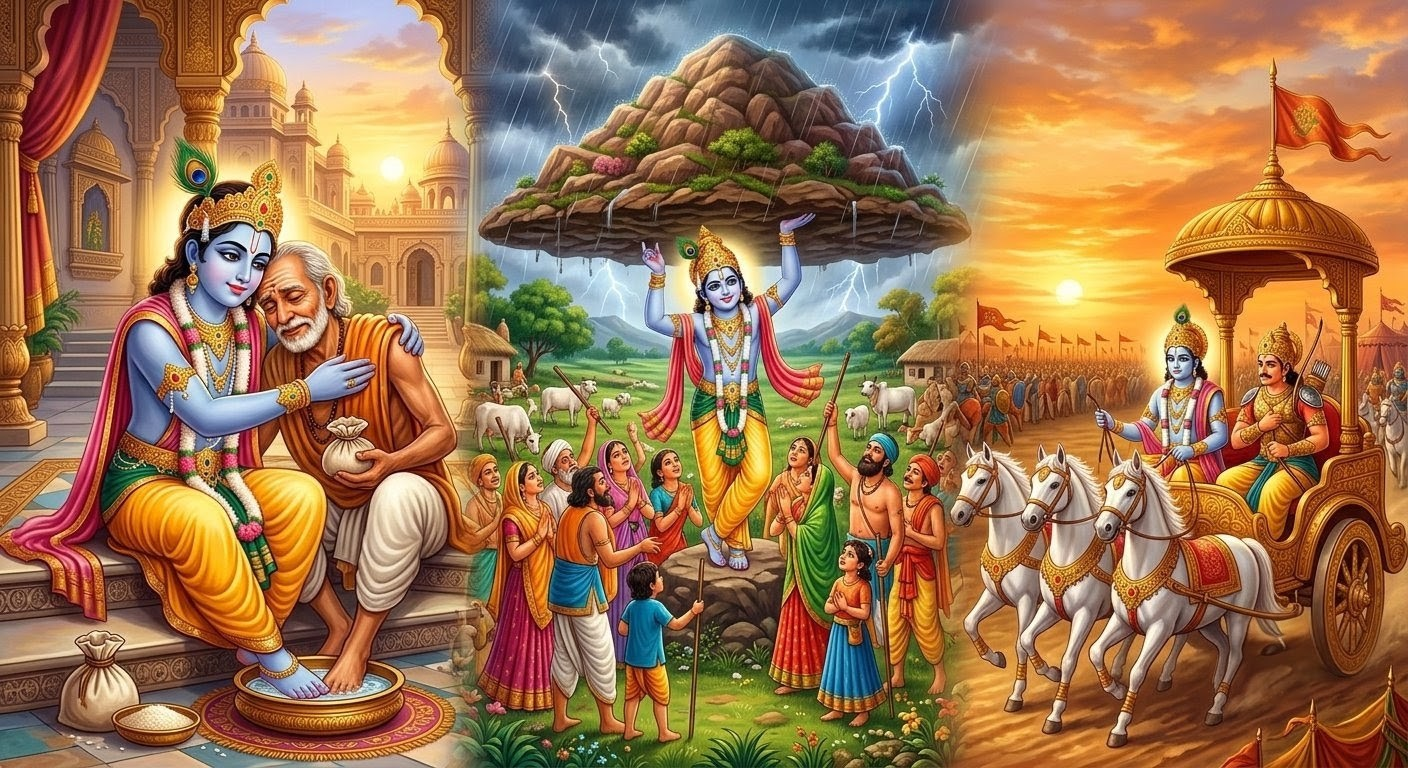
One of most touching accounts in life of Bhagavan Shri Krishna is His reunion with childhood friend Sudama. While Shri Krishna ruled as King of Dwarka, Sudama lived in extreme poverty. When Sudama visited Dwarka, he carried only small pouch of flattened rice as humble offering. Upon seeing his old friend, Bhagavan Shri Krishna did not care about social standing or wealth. He ran barefoot to welcome Sudama, washed his feet with tears of deep affection, and accepted simple offering with great joy.
In modern workplaces and society, people are frequently judged by titles, designations, and material success. This story reminds us that authentic relationships are built on respect and emotional connection, not social status. True leadership begins with humility and treating every individual with dignity, irrespective of position.
Strength in Unity and Environmental Consciousness
During His youth in Gokul, villagers regularly performed rituals to appease Lord Indra for rain. Young Shri Krishna encouraged people to shift their gratitude toward Govardhan hill, forests, and cattle that directly nourished their community. When torrential storms followed, Bhagavan Shri Krishna lifted Govardhan hill on His finger and asked every villager to support weight with their wooden sticks.
This incident carries dual significance for contemporary world. First, it emphasizes ecological balance and necessity of protecting natural resources that sustain life. Second, it demonstrates strength of collective effort. Complex challenges are rarely solved by single individual; real progress happens when communities unite and contribute toward common objective.
Dignity of Labor and Calm Guidance
On battlefield of Kurukshetra, Bhagavan Shri Krishna assumed role of charioteer for Arjuna. Despite being supreme authority, He drove chariot, tended to horses, and steadily guided Arjuna through intense conflict and moral doubt.
In daily professional and personal life, individuals often hesitate to take up tasks perceived as secondary or low-profile. Bhagavan Shri Krishna demonstrated that no work is small when performed with sincerity and commitment. True excellence lies in carrying out responsibility with focus, keeping ego aside, and remaining calm in midst of chaos.
Living the Wisdom Today
Shri Krishna Janmashtami is not merely historical remembrance. It serves as continuous reminder to approach life with balance, practice empathy in relationships, work collaboratively, and fulfill responsibilities without fear. By integrating these timeless principles into daily routine, individuals can build meaningful lives and stronger communities.
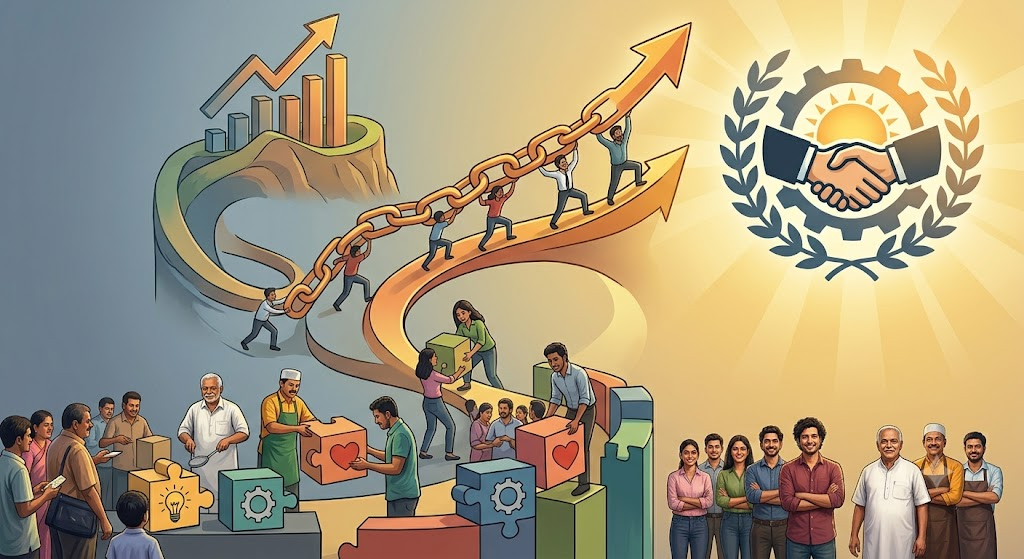
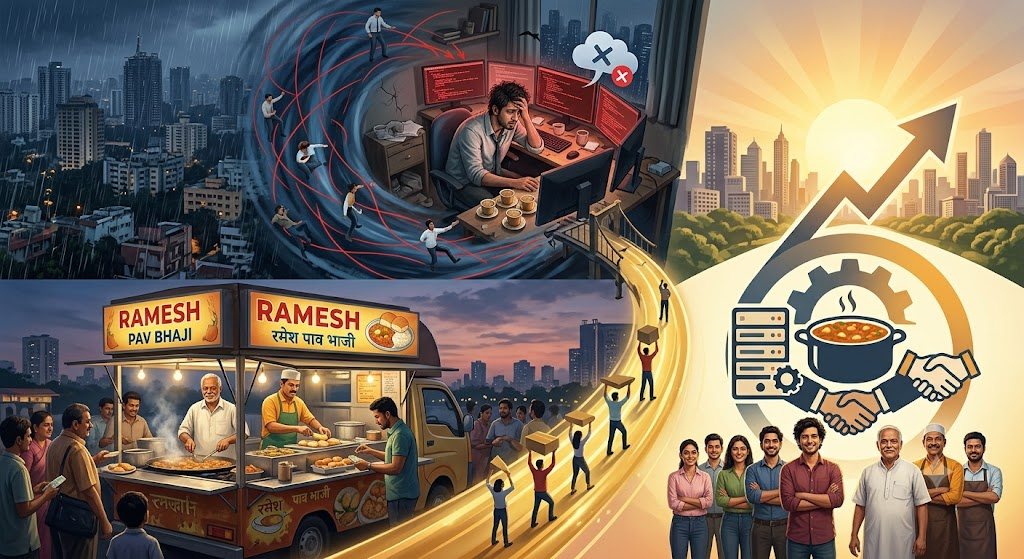
Lone wolves make great stories, but pack of wolves wins hunt every single time. PC: Gemini
There is old saying in Bengaluru startup corridors that if you throw stone in HSR Layout, it will either hit tech founder or delivery executive carrying cold coffee. Two years back, young software developer named Rohan decided he was too smart to work for multinational company. He packed his bag, quit his job with dramatic speech, and started artificial intelligence startup named BrainWave Solutions. Rohan was typical genius coder who wrote hundred lines of code before breakfast. He believed single human mind powered by caffeine and determination can build next Google. In his head, other people were just distractions who took long lunch breaks and asked silly questions in meetings. So for first six months, he worked eighteen hours every day, sitting in dark room with three monitors. He was chief executive officer, chief technology officer, janitor, and social media manager, all packed into one exhausted body.
Everything went smoothly until big venture capital firm showed interest in his app. They called him for live demo on Monday morning. On Sunday night, server crashed, payment gateway threw error, and landing page started displaying pictures of stray cats instead of financial dashboard. Rohan tried fixing everything alone. He drank four cups of strong filter coffee, but by three in morning, his eyes were burning and brain stopped working completely. He accidentally deleted main database while trying to fix minor button color. Next morning, he walked into venture capital office looking like ghost, holding broken app and empty promise. Board members looked at him with sympathy and asked simple question. They did not ask about algorithm or cloud storage. They asked where his team was. That day Rohan learned hard lesson. One brilliant mind can spark idea, but it takes whole squad to keep fire burning when storm hits.
Now jump from glossy glass building of tech park to busy street corner near Dadar railway station in Mumbai. Here stands Ramesh and His Magical Pav Bhaji Truck. Ramesh is not wearing branded hoodie or talking about series funding, but he runs enterprise that feeds five hundred hungry customers every single evening. Few years back, Ramesh thought he could run food truck all by himself to save money on staff salaries. He was master cook, so he decided he would take orders, chop onions, fry pav in butter, pack parcels, and collect cash. First day of experiment was complete disaster. By seven in evening, crowd of angry commuters surrounded his truck like swarm of bees. Somebody got pav without butter, somebody got bhaji without salt, and one tired uncle waited forty minutes only to receive extra spicy dish he never ordered. Ramesh was sweating like butter on hot tawa, shouting at customers, and making mistakes every two minutes.
By eight o’clock, Ramesh gave up, sat on wooden crate behind truck, and closed shop early after losing half his inventory and all his peace of mind. Next morning, Ramesh realized cooking great dish is only twenty percent of food business. Remaining eighty percent is smooth coordination between hands. He immediately hired three young boys from his village. He did not organize expensive corporate retreat in hill station with trust falls and laser tag. Instead, he built simple team rhythm right on pavement. He appointed Suresh as master chopper, Ganesh as butter king responsible for frying bread, and Asif as cash collector and order manager. Every afternoon before opening shop, four of them sat together over tea to discuss evening plan. They talked about who handles extra rush, how to pass plates quickly without crashing, and who takes over when someone needs water break.
Magic happened within one week. Ramesh’s food truck started running like Swiss watch. Order time dropped from fifteen minutes to three minutes. Ganesh knew exactly when Suresh needed fresh batch of chopped coriander without even asking. Asif managed angry customers with smile while Ramesh focused purely on main taste. Business tripled in one month. Small food truck on noisy street proved same principle that big corporate boards pay millions to consultancies to learn. Team building is not luxury activity saved for big companies with massive human resource budgets. It is fundamental law of physics for any work involving more than one task.
Look around modern business world today, whether it is small hair salon in Chennai, digital marketing agency in Delhi, or massive automobile factory in Pune. Pattern is completely identical. Lone ranger approach looks heroic in movies, but in real life, single point of failure is dangerous risk. When business relies on one hero, that business is always one headache, one sick leave, or one mental burnout away from total shutdown. Team building creates safety net. It allows individual strengths to multiply while covering up individual weaknesses. Rohan might be genius at coding, but he needs designer who understands colors and marketer who knows how to talk to customers. Ramesh makes world class bhaji, but he needs fast hands of Ganesh and calm face of Asif to deliver that hot food to hungry worker before train arrives.
Team creates safety net
Real team building does not mean forcing employees to wear matching colored shirts or making them sing company song every Friday morning. It is simply process of building trust, clarity of role, and mutual respect among people working for common goal. In Rohan’s company, after his failure, he hired two junior coders and customer support girl. First month was bumpy because he kept micro-managing them. But slowly he learned to trust their work. He realized that even if junior coder takes two hours extra to solve problem, it frees up his own mind to think about long term product growth. In Ramesh’s food truck, team building meant sharing small portion of daily profit with his assistants so they felt like partners rather than daily wage helpers.
Inevitability of team building comes from simple fact that human capacity has strict limit. Hours in day are fixed at twenty-four, and human energy drains after continuous effort. When business grows, workload increases exponentially, not linearly. Single business owner trying to handle sales, operations, quality control, customer complaint, and tax filing simultaneously will eventually break down. Modern market is fast and unforgiving. Customer standing at food truck wants pav bhaji in three minutes, and client downloading software app expects bug fix in ten minutes. Speed demands specialization, and specialization demands team structure.
Today, Rohan’s startup has grown into twenty member team with proper departments, while Ramesh has expanded his food truck business to three different locations across Mumbai. Both leaders came from completely different worlds, used different tools, and catered to different customers. Yet both reached exact same conclusion through painful trial and error. You can dream alone, you can start alone, and you can even celebrate short term win alone. But if you want to build something that lasts, something that survives bad weather and heavy traffic, you must step back, put away your ego, and build strong team around you. Lone wolves make great stories, but pack of wolves wins hunt every single time.
PS: Both are True Stories(Names and places changed)