When Silence Teaches: A Quiet Ganesh Chaturthi

Different Kind of Chaturthi

This year, Ganesh Chaturthi arrives at a quiet threshold in my life. We just returned after a blissful and fulfilling Pilgrimage to Pandharpur and the contemplation that follows comes on my birthday, a day that traditionally brings celebration, but this time carries a profound, aching stillness. The contrast couldn’t be more obvious, my first birthday 3 days back, and our family’s first Chaturthi, without our Mother. Her absence lingers, turning a day usually defined by warmth and festive cheer into a period of deep introspection. Without the outward rush of celebrations, grief and grace have met at the same altar, steering my mind toward the eternal truth behind the rituals.

Usually by this time of year, house is filled with joyful chaos. Aparna would be busy planning delicacies, while our excited kids Vishnu, Divya, Sindhu & others and now along with Grandson Anay would be making eco-friendly decorations and gathering all adornments for Him, and eagerly counting down days until arrival of elephant-headed deity. We would not have planned a Pilgrimage outing like now, definitely not on the eve of Ganesh Chaturthi. But this year, house is quiet, we are not conducting any puja, inviting guests, or installing clay murti in home this time.

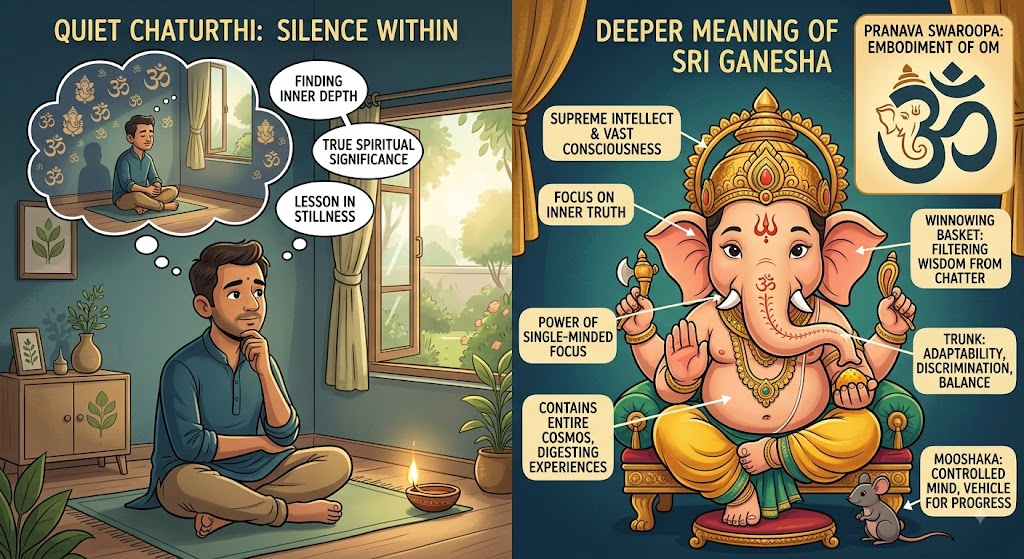
In this stillness, away from usual rush of bringing home murti, preparing hundred modakas, and welcoming neighbors, mind has naturally turned inward. Sitting in quiet corner, I find myself contemplating true spiritual depth of Ganesh Chaturthi. Perhaps this year, without outward rituals and noise, Bhagwan Ganesha is teaching our family deeper lesson about His divine presence within us.

Bhagwan Ganesha as Cosmic Reality and Sacred Form

In Sanatana Dharma, Bhagwan Ganesha is not merely god of beginnings or remover of material obstacles. He is Prathama Pujya, worshipped first before any sacred undertaking, because He represents foundational energy of universe. Sacred texts describe Him as Pranava Swaroopa, physical embodiment of primordial sound Om. In fact, if one observes sacred script of Sanskrit, shape of Ganesha closely mirrors curve and flourish of sacred syllable Om.

When we observe sacred form of Bhagwan Ganesha, every physical detail carries profound significance:

  • Large Head: Elephant head signifies supreme intellect, vast consciousness, and infinite cosmic wisdom.
  • Small Eyes: Small, sharp eyes remind us to look beyond physical appearances and focus on inner spiritual truth with concentration.
  • Large Ears: His broad ears act like winnowing baskets, listening patiently to prayers of all devotees while retaining only essence of wisdom and filtering out useless chatter.
  • Single Tusk: Known as Ekadanta, single tusk teaches us power of single-minded focus and transcendence of dualities like pleasure and pain, good and bad.
  • Curved Trunk: Trunk represents adaptability, discrimination, and balance between worldly efficiency and spiritual focus.
  • Large Belly: His broad belly contains entire cosmos, teaching us to digest all experiences of life, both sweet and bitter, with equal equanimity.
  • Mooshaka: Small mouse sitting at His feet represents human mind and lower desires. Uncontrolled, mouse eats away everything in house, but when controlled and guided by wisdom, wild desire becomes efficient vehicle for spiritual progress instead of master of our destiny.

Legends of Devotion and Eternal Wisdom

Our Puranas are filled with beautiful stories that illustrate supreme wisdom and devotion of Bhagwan Ganesha. Reminiscing these legends during this period of contemplation brings great comfort to heart.

Circuit of the Universe

One famous legend tells of contest between young Ganesha and His brother Kartikeya (Subramanya). Bhagwan Shiva and Devi Parvati, offered divine fruit of knowledge to whoever circambulated the entire world three times first. Kartikeya immediately mounted his swift peacock and zoomed across continents and oceans.

Ganesha, with His heavy body and slow-moving mouse, knew He could not match speed of Kartikeya. Instead, He walked around His divine parents three times with deep devotion and folded hands. When asked why He did so, Ganesha replied that His parents contained whole cosmos within them and encircling them was equivalent to encircling entire universe. In any case, He declares that His parents are His World. This legend shows us that true knowledge lies not in restless wandering across external world, but in recognizing divinity at source.

As Scribe of Mahabharata

Another profound legend is about creation of great epic Mahabharata. When Sage Vedavyasa sought competent scribe who could write down complex epic continuously without stopping, Ganesha accepted task on one condition that sage must recite verses without pause. Sage Vedavyasa agreed but added condition that Ganesha must understand meaning of every verse before writing it down.

During writing process, iron pen of Ganesha broke under speed of creation. Without stopping flow of sacred epic for even second, Ganesha broke off His own right tusk without hesitation and used it as stylus to continue writing. This legendary sacrifice of His own tusk symbolizes absolute commitment to spiritual knowledge and truth, earning Him title Ekadanta.

Behind Sacred Rituals and Earthly Clay

Every practice associated with Chaturthi carries deep symbolic purpose that transforms routine actions into spiritual exercises. Customarily, idol is sculpted from sacred earth or clay, worshipped with devotion for few days, and then immersed back into water body during Visarjan.

This journey from clay to divine form and back to water is direct reminder of impermanence of physical existence. Body made of five elements eventually merges back into nature. Only divine consciousness inside remains eternal. Watching immersion teaches us non-attachment, lesson that feels especially poignant to me this year as I process loss of my mother. Ritual tells us that what takes physical form must one day dissolve, yet essential spirit never dies.

Siddhi and Riddhi, personifications of spiritual achievements and prosperity, are divine consorts of Bhagwan Ganesha, demonstrating that true wealth and wisdom go hand in hand when guided by righteousness. Offerings like Modaka, sweet delicacy wrapped in outer rice shell, represent sweet bliss of self-realization hidden deep inside outer physical body.

Avoiding Chandra Darshana

Ancient practice of avoiding Chandra Darshana on Ganesh Chaturthi night holds both puranic and psychological meaning that often confuses modern minds.

Purana narrates that after heavy feast on Chaturthi night, Ganesha was riding His mouse home. Suddenly, mouse stumbled upon seeing snake, and Ganesha fell, causing His belly to burst open and modakas to roll out. Ganesha calmly tied snake around His waist to hold Himself together. Seeing this comic sight, Moon God Chandra laughed aloud in arrogance, proud of His own physical beauty and bright light. Due to vanity of His appearance, Chandra was cursed by Ganesha that whoever looks at moon on this night would face false accusations and disgrace.

Spiritually, Moon represents human mind, emotions, and vanity, as mind is said to be governed by lunar cycles. On this sacred night, looking at moon symbolizes letting mind fall into trap of pride, superficial judgment, and sensory distraction. By consciously avoiding sight of moon, seeker learns to look inward rather than getting enchanted by external shines and egoistic pride. It is invitation to conquer ego and bow before eternal wisdom represented by Elephant-headed Lord.

Please read “Legend of Symantaka Mani” which is also a Parihara just in case you happen to see the Moon by mistake.

Eternal Presence Within Our Home

Though everyone miss excitement of festival decorations, and traditional grandeur of kitchen, this phase of silent remembrance has brought us closer to real spirit of Ganesha.

Bhagwan Ganesha does not live only in clay murti that we bring home for few days. He resides permanently in Mooladhara chakra, root energy center of our existence, guiding every breath and every step toward spiritual awakening. Loss and grief teach us impermanence of physical form, but devotion restores our inner balance. As we offer our silent prayers this year, we seek His grace to overcome internal obstacles of grief, ignorance, and attachment, knowing that His divine presence is forever within us.

In this silence, away from usual rush of bringing clay murti, preparing modakas, and welcoming neighbors, mind has naturally turned inward. Sitting in quiet corner, I find myself contemplating true spiritual depth of Ganesh Chaturthi. Perhaps this year, without outward rituals, Bhagwan Ganesha is teaching us deeper lesson about His presence within us.

Please read my earlier blog which is a translation of Pujya Gurudev Sri Sri Ravi Shankar explaining how Bhagwan Ganesha is not an external power and Ganesh Chaturthi is about awakening Ganesha Tatva within us

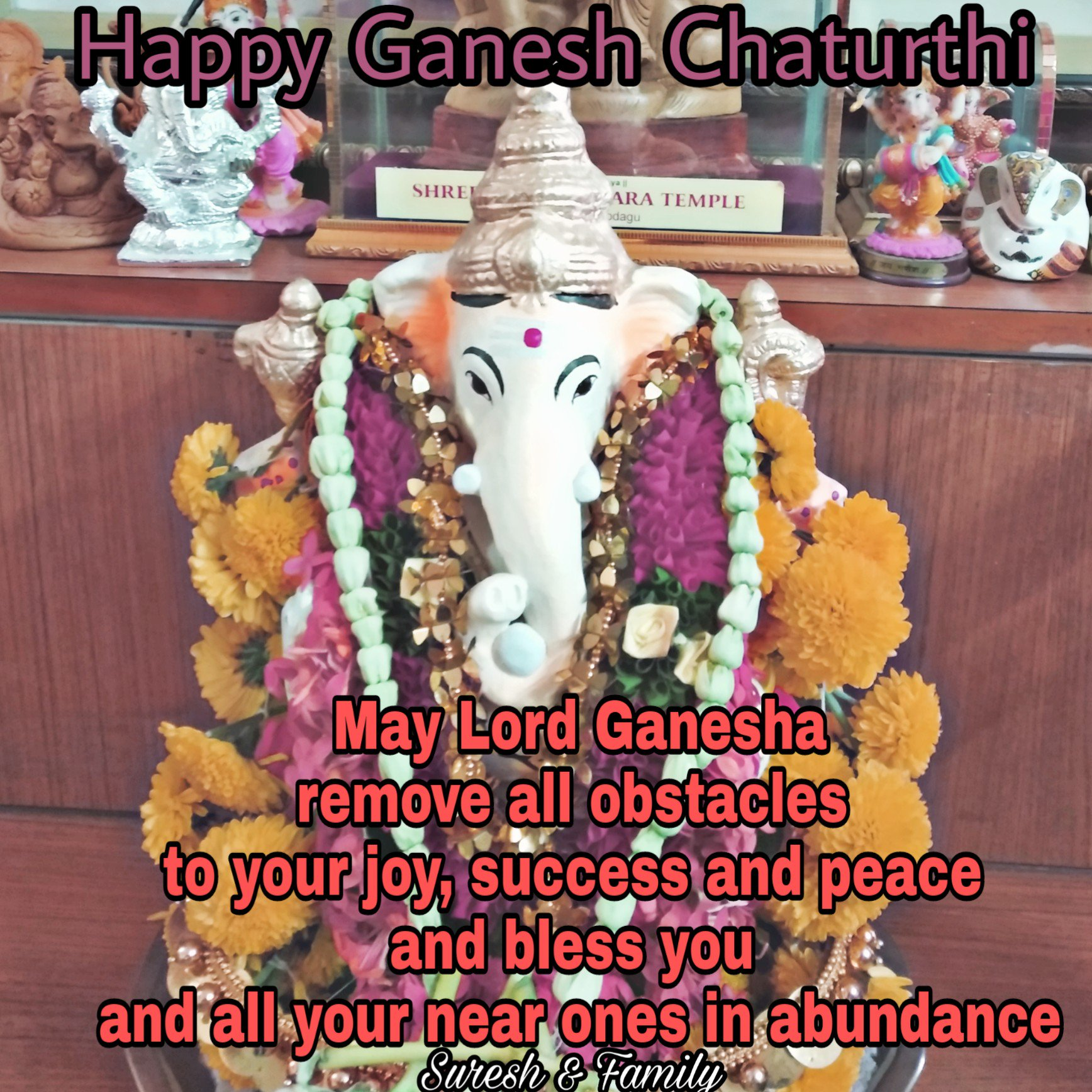
Home Ganesha – some years earlier

Insecurity: Child of Incompetence

This story is inspired by a real incident last Friday, where a moment of quiet professional validation was abruptly interrupted by an awkward display of public insecurity. While the setting, industry, and individual identities have been completely changed to protect the privacy of those involved, the underlying behavior remains entirely authentic. The intent behind sharing this narrative is not to criticize or demean anyone, but rather to highlight a valuable workplace lesson on professional maturity, true competence, and the self-defeating nature of unprovoked insecurity.

Insecurity and incompetence are inseparable companions. A person who truly knows his craft remains composed, content to let his work do the talking. When real expertise is missing, however, every gathering feels like a threat to a fragile ego. Insecurity drives incompetent people to make noise at the most unexpected moments, desperately hoping to appear important. Sadly for them, this urge to steal the spotlight usually backfires, transforming simple ignorance into comedy for everyone else in the room.

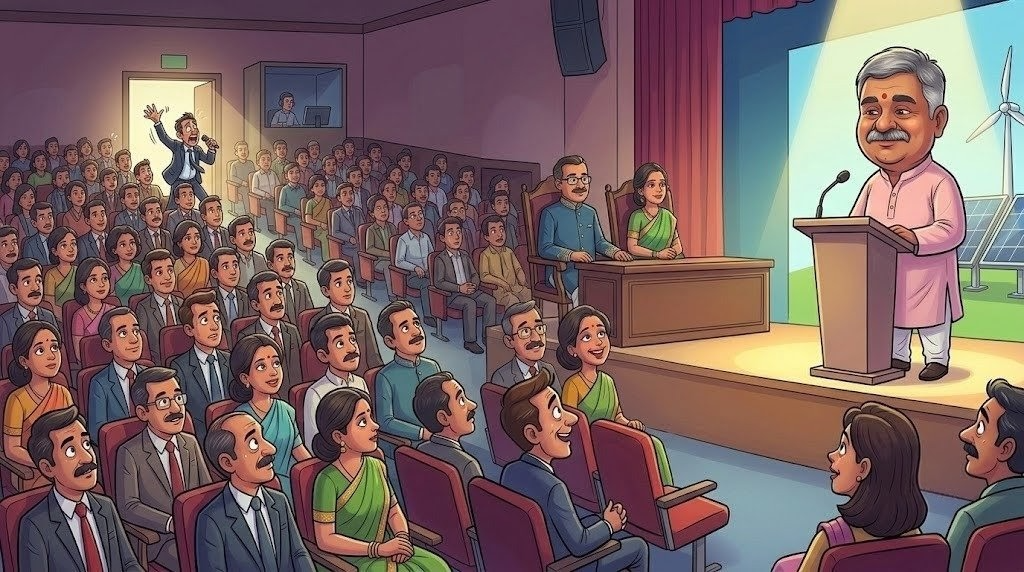
This tendency unfolded in full glory during a grand renewable energy summit at a plush hotel in Hyderabad. The hall was packed with Ministers, corporate leaders, policy makers and engineers, all discussing solar power policies for rural India. On stage sat a veteran engineer, a man who had spent thirty years in dusty fields actually building power grids while others merely made presentations. The organizer invited him to address complex grid integration rules. With effortless calm, the veteran dismantled difficult technical doubts raised by nervous investors. Impressed by this intervention, one the ministers on stage introduced him as a true pioneer who had built foundational solar models during his long tenure at a reputed national energy agency.

Sitting in the last row, dressed in a suit three sizes too sharp, was a newly baked successor, Sharma from that very same agency. Sharma possessed very little knowledge about power grids, but he had an endless supply of self importance. Watching the veteran receive unanimous praise was too much for Sharma to digest. Insecurity hit him like a jolt of high voltage electricity.

Before anyone could stop him, Sharma leaped out of his chair like a jack in the box. He practically began shouting his name and company title into it. I am Sharma from National Energy, I am Sharma, he declared, as if announcing a grand arrival. The room fell silent, expecting some brilliant technical insight. Instead, Sharma launched into an energetic speech about two rural electrification drives, completely missing the fact that the conference was discussing solar grid integration, not basic wiring. To make matters funnier, those two projects he boasted about were actually designed and executed years ago by the veteran himself, long before Sharma even learned how to spell infrastructure. Sharma gesticulated wildly, dropping buzzwords that made no sense together, while senior engineers in the audience exchanged suppressed giggles.

The moderator, trying hard to keep a straight face, finally interrupted the performance. Mr Sharma, the moderator asked politely, do you have any specific suggestion regarding rural grid policy, or should we move back to the agenda? Sharma froze. His mouth stayed open for a second like a landed fish. He looked around, realized nobody was clapping, stammered something about how his organisation has managed projects and that they plan to also empanel under the project, and quickly collapsed back into his seat. His desperate attempt to  make his presence felt, born purely out of insecurity and incompetence, turned what could have been a silent afternoon into the best entertaining break of the summit.

A classic case of

Atma Nivasi Ram to AnantAnsh – Journey of 5 Decades

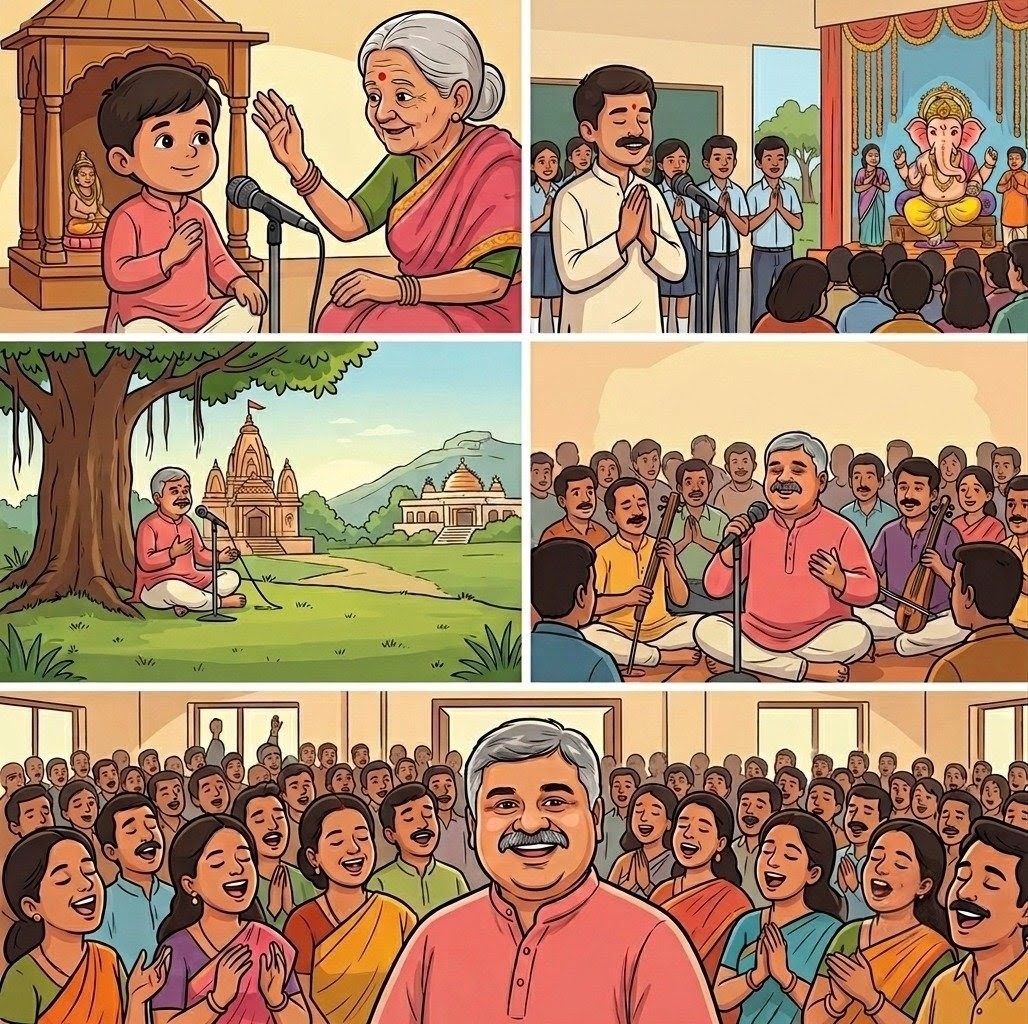
My connection with Bhajans began long before I understood their spiritual depth. None of this would have unfolded without my parents. They never forced devotion upon me. Instead, they gently created favorable circumstances for me to step onto this path of my own volition. As five year old child, I remember being taken to local Ayyappa Bhajana Mandali. I sat quietly amidst aroma of camphor, incense, and fresh flowers, soaking in thunderous reverberation of Kanjira, rhythmic clash of manjira, and collective chanting and Bhajans. I did not know exact meaning of every chant or Bhjans then, but sacred environment my parents ushered me into allowed that energy to seep deep into my consciousness.

The true turning point arrived when I was in Class 3, barely eight years old. It was crisp cold Deccember evening, and Ayyappa Bhajana Mandali in Lakkasandra (then operating out of a seasonally rented hall) was filled with devotees. Someone handed me lead microphone. My hands were tiny around it, and my heart raced. I closed my eyes and began Atma Nivasi Ram, a Bhajan taught to me by Madam Saraswathi in KM School (Yes, this school founded by Late Shri Sridhar and Late Narmada were as intrumental to instill a sense of Sanatana Dharma in me). As verse unfolded, initial nervousness gave way to sudden, overwhelming stillness. I was not just chanting, chant was singing itself through me. Afterward, elderly lady walked up, placed gentle hand on my head, and praised innocence and power in my voice. Thereafter it became a regular affair in the Mandali. She passed away recently, but her quiet blessing remains frozen in my memory as moment simple childhood habit turned into life calling. Today this Bhajan Mandali is a full fledged Swami Ayyappa Temple in Laljinagar, Bengaluru built as advised by renowned Kerala Temple Architect Shri Kanipayyoor)

From that evening on, there was no looking back. Bhajans became unyielding rhythm of my youth. Every year was anchored by intense discipline of Mandala Makaravilakku season, consisting of 56 unbroken days of devotion with 41 days of Mandala Kalam followed by 15 days of Makaravilakku. Rain or shine, homework or exams, those 56 evenings belonged entirely to Swami Ayyappa. My school days were equally steeped in this devotion. Whether leading morning assemblies or standing before massive crowds at neighborhood Samoohik Ganesh Pandals during Ganeshotsav, Namasankirtan was where I felt most grounded.

When my professional journey began and took me to Nashik, Bhajan life slowed down slightly. My demanding routine left little space for large gatherings, but inner yearning for Satsang never faded. I remember wandering into newly establishing ISKCON center during those early days in Nashik. Sitting on floor with small group of devotees and taking turns to chant the Shri Krishna Mahamantra, I realized distance and context did not matter because divine string was unbreakable.

After my stint in Nashik, I returned to Bengaluru, keeping my connection to Bhajans alive before work took me to Chennai. That move to Chennai deepened this journey immeasurably. My regular and intense association with Art of Living shifted everything. It is here that my deepest sense of gratitude belongs, to Pujya Gurudev Sri Sri Ravi Shankar. Through His unconditional love and guidance, He sharpened my ability to conduct Satsangs dedicated purely to His teachings. Gurudev taught me most profound lesson of all, to make Satsang entirely about Act of devotion and never about Actor leading it. Ego melted away, leaving behind only pure instrument of His grace.

In Chennai, this realization turned into wonderful journey alongside incredible souls like Soundar ji, Dhanraj ji, late Anju ji, Aravind, both Vijis, and so many others who made those years unforgettable.

Returning home to Bengaluru permanently in 2006 sealed my path forever. Satsang ceased to be something I did on special occasions and became essential part of my daily existence. This piece would be incomplete without honoring where current Bengaluru chapter began at Uttarahalli Art of Living Centre. We started as one large passionate team, and today that single seed has grown into multiple sub teams performing Satsang Seva concurrently across many places.

Out of this collective movement grew AnantAnsh, (you can click on the link that takes you to the official You Tube Channel of our Team), the name that reminds us that we are simply small part of Infinite. I am especially grateful to Sindhu who has been integral and crucial pillar of AnantAnsh since 2009 and along with Sweta, Bharathi, who are regular fellow Satsangis these days. Our original team of Sumathi, Saraswati, Rajeshwari, Latha, Nalini, Raghav, Kavya, Vinay, Hema, Swati, Alpita, Veeru ji, Hemadri ji, Lalitha ji, Ravikala ji, Sumathi ji, Roopa, Mahesh Nyamati ji, Krishna Raju ji, Manjunath ji, Prabhakar ji and endless list of dedicated souls made the journey so fulfilling. My heartfelt gratefulness also goes out to our Bannerghatta Road volunteers/teachers, Sujatha, Padmini ji, Vinita ji, Prashanth ji, Vijay, Dipanvita ji, Prasad ji, Vikrant ji, Sapna ji, Aarti ji, Shantesh ji, Sandhya ji, Shruti ji Preeti ji, and so many more who regularly organise Rudra Pujas, Gurupujas and Satsang. Special thanks to Sadhvi Madhubala ji for connecting us to beautiful Sahasra Deepika where we regularly do Satsangs with 80+ girls who are taken care by this amazing organisation. Not to forget Varadaraj ji of Sneha Seva Trust, Vishwas Helpline for having us over to regularly conduct Sessions for the Children they support for their education.

To all teachers and devotees who organize Guru Puja Satsangs and invite us to lead them, thank you. Thanks to them, we are able to conduct over 100 Satsangs every year, balanced alongside our demanding work schedules. It is living miracle that by Gurudev grace and blessings, time, energy, and bandwidth somehow expand to make room for this Seva.

None of this would be possible without my family, Aparna, Divya, Vishnu, and now Anay. Their unconditional support has given me freedom to pursue this passion wholeheartedly. Without their constant backing, this long journey would not have been possible, let alone as joyful and fulfilling as it has been.

Finally, my deepest gratitude goes to every single rasika who joins us, sits with us, and participates. To everyone who encourages us and gifts us their genuine smiles, you are ones who make us want to carry out this Seva forever.

What we have consciously decided as a team is to avoid any kind of professional instruments or make the Bhajan sessions very professional, just Simple, straight from the heart and not as a performance. Have always kept it simple, even got rid of a Keyboard that used to regular accompaniment and stick to traditional, Dholak, manjira. Satsangs are conducted in a manner anyone can join the team and lead the Bhajan. Very rarely we seat in Stage-Audience formation. The Satsang team is always part of the audience. And most importantly it is done absolutely Free of any Cost to the organiser. Absolutely FREE. We carry our own Audio system and instruments and with our own transport. We conduct Satsang for any number in the audience be it 20 or 2000. We have kept the format spontaneous without any set template or patterns, the unpredictability makes it even more enjoyable, just like the nature of our Guru & how he wants it done

Looking back across decades, everything has shifted, including cities, stages, and faces in room. Yet when we sit down today with team of AnantAnsh, close our eyes, and start chant, feeling is identical to that eight year old child leading Atma Nivasi Ram. Outer world quietens down, mind settles, ego disappears, and all that remains is Name.