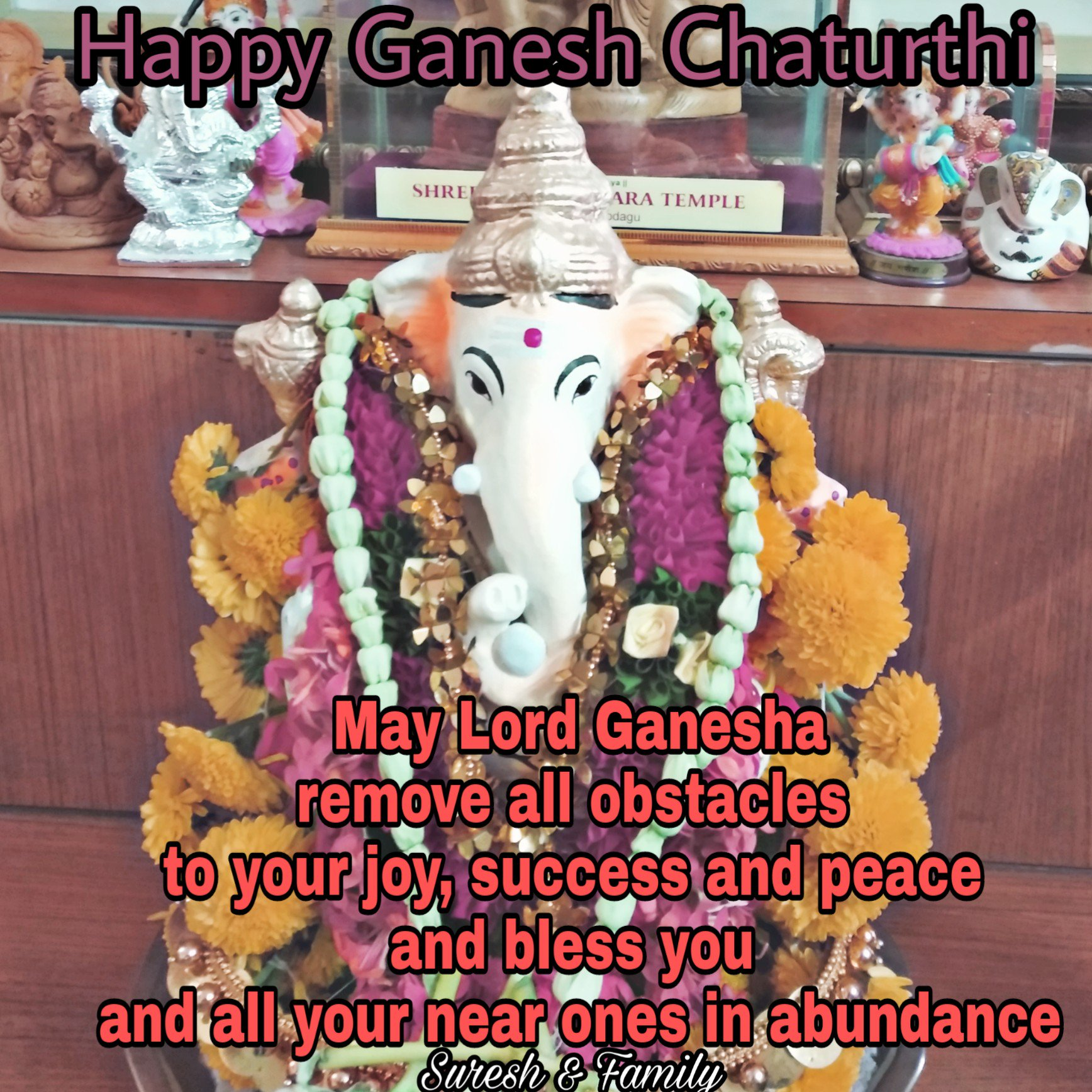
Different Kind of Chaturthi
This year, Ganesh Chaturthi arrives at a quiet threshold in my life. We just returned after a blissful and fulfilling Pilgrimage to Pandharpur and the contemplation that follows comes on my birthday, a day that traditionally brings celebration, but this time carries a profound, aching stillness. The contrast couldn’t be more obvious, my first birthday 3 days back, and our family’s first Chaturthi, without our Mother. Her absence lingers, turning a day usually defined by warmth and festive cheer into a period of deep introspection. Without the outward rush of celebrations, grief and grace have met at the same altar, steering my mind toward the eternal truth behind the rituals.
Usually by this time of year, house is filled with joyful chaos. Aparna would be busy planning delicacies, while our excited kids Vishnu, Divya, Sindhu & others and now along with Grandson Anay would be making eco-friendly decorations and gathering all adornments for Him, and eagerly counting down days until arrival of elephant-headed deity. We would not have planned a Pilgrimage outing like now, definitely not on the eve of Ganesh Chaturthi. But this year, house is quiet, we are not conducting any puja, inviting guests, or installing clay murti in home this time.
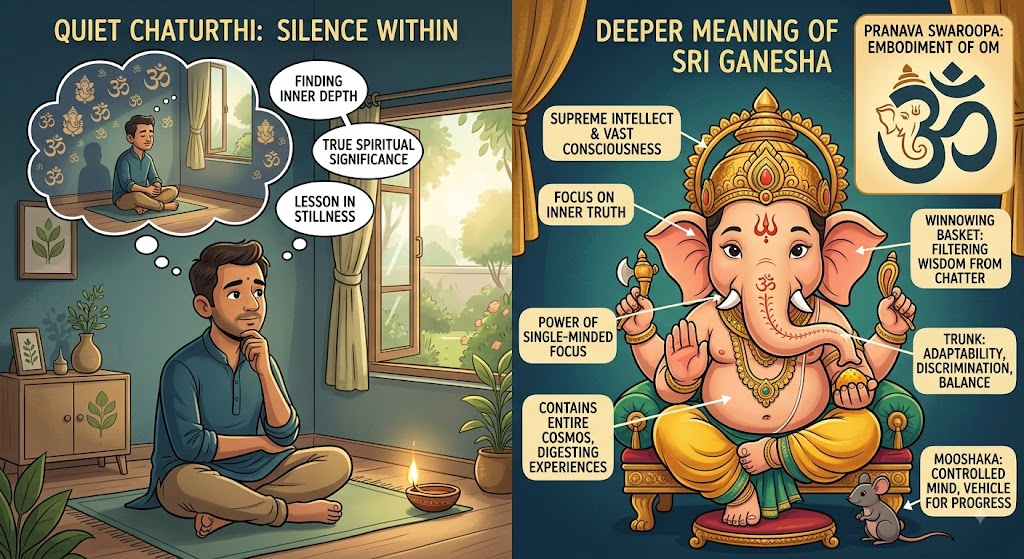
In this stillness, away from usual rush of bringing home murti, preparing hundred modakas, and welcoming neighbors, mind has naturally turned inward. Sitting in quiet corner, I find myself contemplating true spiritual depth of Ganesh Chaturthi. Perhaps this year, without outward rituals and noise, Bhagwan Ganesha is teaching our family deeper lesson about His divine presence within us.
Bhagwan Ganesha as Cosmic Reality and Sacred Form
In Sanatana Dharma, Bhagwan Ganesha is not merely god of beginnings or remover of material obstacles. He is Prathama Pujya, worshipped first before any sacred undertaking, because He represents foundational energy of universe. Sacred texts describe Him as Pranava Swaroopa, physical embodiment of primordial sound Om. In fact, if one observes sacred script of Sanskrit, shape of Ganesha closely mirrors curve and flourish of sacred syllable Om.
When we observe sacred form of Bhagwan Ganesha, every physical detail carries profound significance:
- Large Head: Elephant head signifies supreme intellect, vast consciousness, and infinite cosmic wisdom.
- Small Eyes: Small, sharp eyes remind us to look beyond physical appearances and focus on inner spiritual truth with concentration.
- Large Ears: His broad ears act like winnowing baskets, listening patiently to prayers of all devotees while retaining only essence of wisdom and filtering out useless chatter.
- Single Tusk: Known as Ekadanta, single tusk teaches us power of single-minded focus and transcendence of dualities like pleasure and pain, good and bad.
- Curved Trunk: Trunk represents adaptability, discrimination, and balance between worldly efficiency and spiritual focus.
- Large Belly: His broad belly contains entire cosmos, teaching us to digest all experiences of life, both sweet and bitter, with equal equanimity.
- Mooshaka: Small mouse sitting at His feet represents human mind and lower desires. Uncontrolled, mouse eats away everything in house, but when controlled and guided by wisdom, wild desire becomes efficient vehicle for spiritual progress instead of master of our destiny.
Legends of Devotion and Eternal Wisdom
Our Puranas are filled with beautiful stories that illustrate supreme wisdom and devotion of Bhagwan Ganesha. Reminiscing these legends during this period of contemplation brings great comfort to heart.
Circuit of the Universe
One famous legend tells of contest between young Ganesha and His brother Kartikeya (Subramanya). Bhagwan Shiva and Devi Parvati, offered divine fruit of knowledge to whoever circambulated the entire world three times first. Kartikeya immediately mounted his swift peacock and zoomed across continents and oceans.
Ganesha, with His heavy body and slow-moving mouse, knew He could not match speed of Kartikeya. Instead, He walked around His divine parents three times with deep devotion and folded hands. When asked why He did so, Ganesha replied that His parents contained whole cosmos within them and encircling them was equivalent to encircling entire universe. In any case, He declares that His parents are His World. This legend shows us that true knowledge lies not in restless wandering across external world, but in recognizing divinity at source.
As Scribe of Mahabharata
Another profound legend is about creation of great epic Mahabharata. When Sage Vedavyasa sought competent scribe who could write down complex epic continuously without stopping, Ganesha accepted task on one condition that sage must recite verses without pause. Sage Vedavyasa agreed but added condition that Ganesha must understand meaning of every verse before writing it down.
During writing process, iron pen of Ganesha broke under speed of creation. Without stopping flow of sacred epic for even second, Ganesha broke off His own right tusk without hesitation and used it as stylus to continue writing. This legendary sacrifice of His own tusk symbolizes absolute commitment to spiritual knowledge and truth, earning Him title Ekadanta.
Behind Sacred Rituals and Earthly Clay
Every practice associated with Chaturthi carries deep symbolic purpose that transforms routine actions into spiritual exercises. Customarily, idol is sculpted from sacred earth or clay, worshipped with devotion for few days, and then immersed back into water body during Visarjan.
This journey from clay to divine form and back to water is direct reminder of impermanence of physical existence. Body made of five elements eventually merges back into nature. Only divine consciousness inside remains eternal. Watching immersion teaches us non-attachment, lesson that feels especially poignant to me this year as I process loss of my mother. Ritual tells us that what takes physical form must one day dissolve, yet essential spirit never dies.
Siddhi and Riddhi, personifications of spiritual achievements and prosperity, are divine consorts of Bhagwan Ganesha, demonstrating that true wealth and wisdom go hand in hand when guided by righteousness. Offerings like Modaka, sweet delicacy wrapped in outer rice shell, represent sweet bliss of self-realization hidden deep inside outer physical body.
Avoiding Chandra Darshana
Ancient practice of avoiding Chandra Darshana on Ganesh Chaturthi night holds both puranic and psychological meaning that often confuses modern minds.
Purana narrates that after heavy feast on Chaturthi night, Ganesha was riding His mouse home. Suddenly, mouse stumbled upon seeing snake, and Ganesha fell, causing His belly to burst open and modakas to roll out. Ganesha calmly tied snake around His waist to hold Himself together. Seeing this comic sight, Moon God Chandra laughed aloud in arrogance, proud of His own physical beauty and bright light. Due to vanity of His appearance, Chandra was cursed by Ganesha that whoever looks at moon on this night would face false accusations and disgrace.
Spiritually, Moon represents human mind, emotions, and vanity, as mind is said to be governed by lunar cycles. On this sacred night, looking at moon symbolizes letting mind fall into trap of pride, superficial judgment, and sensory distraction. By consciously avoiding sight of moon, seeker learns to look inward rather than getting enchanted by external shines and egoistic pride. It is invitation to conquer ego and bow before eternal wisdom represented by Elephant-headed Lord.
Please read “Legend of Symantaka Mani” which is also a Parihara just in case you happen to see the Moon by mistake.
Eternal Presence Within Our Home
Though everyone miss excitement of festival decorations, and traditional grandeur of kitchen, this phase of silent remembrance has brought us closer to real spirit of Ganesha.
Bhagwan Ganesha does not live only in clay murti that we bring home for few days. He resides permanently in Mooladhara chakra, root energy center of our existence, guiding every breath and every step toward spiritual awakening. Loss and grief teach us impermanence of physical form, but devotion restores our inner balance. As we offer our silent prayers this year, we seek His grace to overcome internal obstacles of grief, ignorance, and attachment, knowing that His divine presence is forever within us.

In this silence, away from usual rush of bringing clay murti, preparing modakas, and welcoming neighbors, mind has naturally turned inward. Sitting in quiet corner, I find myself contemplating true spiritual depth of Ganesh Chaturthi. Perhaps this year, without outward rituals, Bhagwan Ganesha is teaching us deeper lesson about His presence within us.
Jai Shri Ganesha
Ganapati Bappa Morya