Navaratri 2025-Colors of the Day

DISCLAIMER: Though this article provides a manufactured Spiritual significance, sharing the origin of this practice which was a marketing tool of Maharashtra Times which became a harmless yet pleasant Tradition and a unifying factor cutting across all religions today.

Each region has its own set of rituals and practices associated with this festival. A compilation of some of them here specifically with respect to the attire here. List of the nine colours of Navratri to be worn by Goddess Durga as well as Devotees, with their significance:

First Day – Paadyami
Shailaputri Maa is the first amongst Navadurgas worshipped during Navaratri. ‘White‘ is the colour of the day. It represents purity, peace, serenity and new beginnings.

Second Day – Dwitiya
Maa Bharmacharini is the form of mother goddess which is worshipped on the second day. ‘Red’ is the color of the day, which represents love, passion, and strength.

Third Day – Tritiya
Chandraghanta is the form of the goddess worshipped on the third day of Navaratri. ‘Royal Blue’ is the color of the day and it represents calmness, divine energy and stability

Fourth Day – Chaturthi
Kushmanda is the fourth form of goddess that is worshipped on the fourth day of Navratri. ‘Yellow’ is the color of the day and it symbolizes joy and brightness, and brings a sense of unparalleled optimism and joy.

Fifth Day – Panchami
Skandamata is a face of Maa Durga always known for demolishing the demons and worshipped on day 5 of Navaratri. ‘Green’ is the color to be worn on this day and it represents growth, nature, and fertility. Green also represents new beginnings in life.

Sixth Day – Shashti
Katyayani is worshipped on the sixth day of Navratri. ‘Grey‘ is the color of the day which is symbolic of control and balance emotions and keeps the person down-to-earth. It also represents overcoming darkness in a calm manner.

Seventh day – Sapthami
Kaalratri is the seventh figure of Goddess Durga. Maha Saraswathi Devi is also worshipped on this day. ‘Orange‘ is the color of the day and it represents energy and strength, or courage and determination.

Eighth day – Ashtami
Maha Durga is worshipped on the eighth day(Durgashtami). On this day, ‘Peacock Green‘ is regarded as the colour for all, which signifies beauty, grace, and positivity.

Ninth day – Maha Navami
Siddhidatri is the form of Maa Durga for the ninth day of Navratri. ‘Pink‘ is the colour of the day for devotees which is the color that signifies love, compassion, and universal harmony

Tenth day – Vijaya Dashami

Vijayadashami is the day of Victory of Good over Evil. The Goddess is dressed in Glowing Gold & the color for devotees is also Gold or Peacock Blue.

To summarize: Colors of attire advised on 9 days of Navratri

Day 1: White
Day 2: Red
Day 3: Royal Blue
Day 4: Yellow
Day 5: Green
Day 6: Grey
Day 7: Orange
Day 8: Peacock Green
Day 9: Pink

Origins of this practice: (Source: https://www.cntraveller.in/story/from-trend-to-tradition-how-the-9-colours-of-navaratri-became-a-thing-maharashtra-times/)

In 2003, the innovative marketing team at Maharashtra Times conceived a brilliant strategy to engage more female readers. During the occasion of Navaratri, they unveiled a captivating narrative that put forward the significance of the nine distinct colours to be worn each day of the Hindu festival. Each colour was thoughtfully linked to an avatar of the Goddess Durga, thereby bestowing a sense of authenticity upon this “tradition”— orange for Goddess Shailputri, white for Goddess Brahmacharini, red for Goddess Chandraghanta, green for Goddess Katyayani, and so on.

Throughout the nine days of the festival, Maharashtra Times featured captivating images of women elegantly adorned in the colour of the day, presenting a compelling aspirational value and igniting a sense of enthusiasm among their audience and beyond. The newspaper also invited women to share photographs of themselves in their colour-coordinated attire, which were subsequently showcased in the following day’s edition, making the trend all the more viral.

Under the guidance of the then-editor, Bharatkumar Raut, this story enjoyed monumental success according to The Quint, triggering an intentional wave of enthusiasm across the state of Maharashtra—eventually spreading across the nation to cities like Delhi. It swiftly morphed into an accepted tradition and became an indispensable part of the festival for many of its participants; to this day, Maharashtra Times still holds a Navaratri photo contest on their website, where people submit group photos in colour-coordinated clothing corresponding to the given festival day. Dressing up in said colours has even evolved into a contemporary workplace activity championed by HR teams, expanding to the likes of cubicle decorations.

What’s remarkable is that this practice didn’t vanish like a seasonal fad, rather it became an important cultural cornerstone. Created before the age of social media and viral hashtags, the trend stands as proof of the sheer influence of media and the importance of evolving traditions.
Unlocking Skills in Non-STEM Education

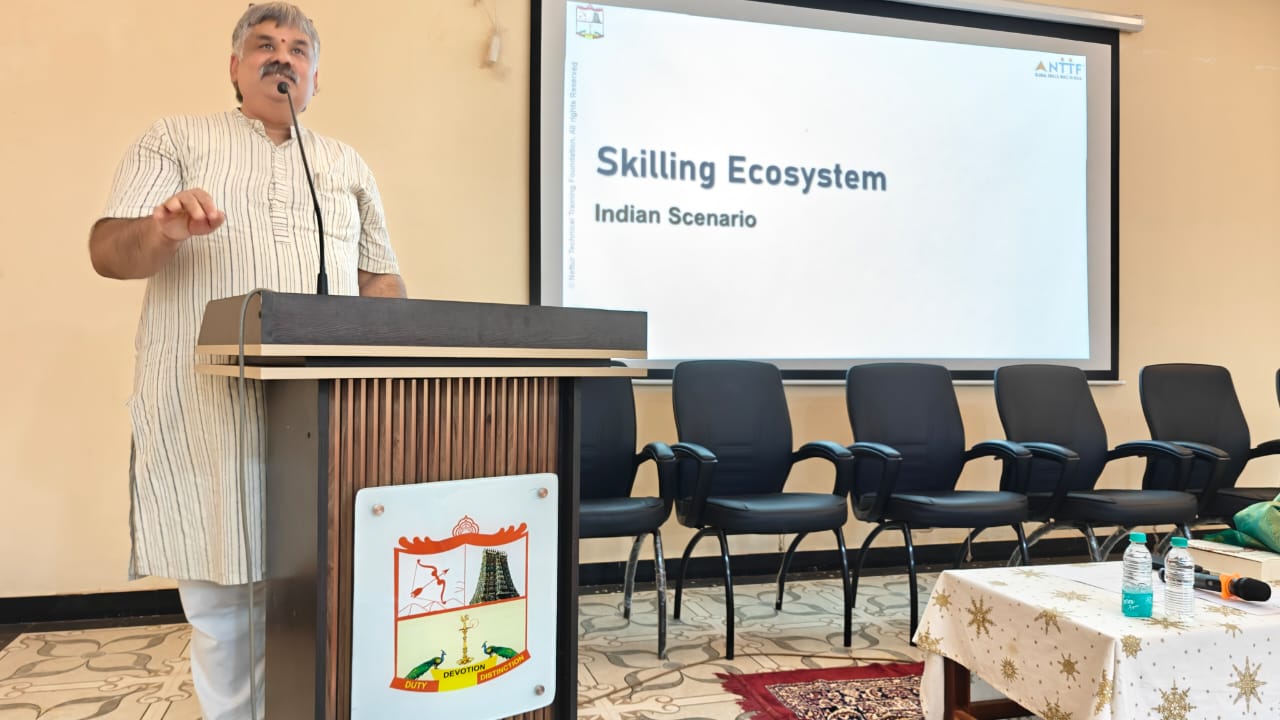
Upon invitation by Secretary, Shri Narayanan and the leadership team of Saraswathi Narayanan College of Arts and Science, Madurai, to deliver an interactive session on the Skilling Ecosystem and its relevance in Arts, Humanities, and Social Sciences, wanted to share the learnings for wider reach. Although initially planned as a talk with Q&A, the format was shifted to a fully interactive session from the start, which proved to be more effective. Using data at national, state, and district levels, the session highlighted the critical gap in skills among graduates across all streams, making a strong impact on the audience.

The perception, no different in this audience too (major percentage from Non-STEM branches), that non-STEM programs is “all about knowledge” and not “skills” is widespread—but it’s also quite misleading for following reasons

In STEM fields like science and engineering, hands-on activities are common, with students spending time in labs, coding, or working on projects. In contrast, non-STEM subjects are traditionally focused on theory, critical thinking, and abstract reasoning, and they often lack clear, tangible “hands-on” components.

In India, non-STEM courses often use essays, exams, and theoretical discussions as their main forms of assessment. While these methods test a student’s ability to recall and interpret information, they can hide the practical skills being developed.

A skill is the ability to do something well, which is gained through practice and experience. While skills can be physical or mental, those like critical thinking, communication, empathy, and cultural literacy are difficult to measure. Because of this, they are often undervalued compared to more easily quantifiable skills like programming or data analysis.

Employers tend to look for hard skills like Excel and Python, which are simple to teach and test. This creates a misconception that non-STEM graduates aren’t as “job-ready,” even though these graduates often have strong soft skills essential for leadership, collaboration, and innovation.

Changing the Mindset
Non-STEM fields develop crucial transferable skills such as creativity, communication, critical thinking, research, and empathy.
These skills are often implicitly embedded in the coursework rather than explicitly taught. For example, a history student’s work on analyzing sources and constructing arguments teaches them research and communication skills without those being the explicit focus of the assignment.
Modern non-STEM education is evolving to make these skills more explicit through methods like project-based learning, internships, and the integration of digital tools like GIS and data visualization.

Making these Skills Visible
To better showcase the value of non-STEM education, there are four key strategies:
Curriculum Design: Clearly state the skills students will gain in all course materials and assessments.
Skill Mapping: Create frameworks that help students and faculty identify and explain the skills being developed
Industry Collaboration: Work with employers to demonstrate the unique value non-STEM graduates bring to the workforce.
Aspirational: Highlight success stories of non-STEM graduates who have become leaders, innovators, and entrepreneurs.

Skills in Various non-STEM Disciplines
Literature focuses on building skills in critical thinking, empathy, communication, and cultural literacy.
History hones abilities in research, analytical reasoning, and argumentation.
Psychology emphasizes observation, data interpretation, and interpersonal skills.
Sociology develops systems thinking, qualitative analysis, and ethical reasoning.
Philosophy strengthens logic, ethical decision-making, and abstract reasoning.
Fine Arts cultivates creativity, design thinking, and visual communication.
Media Studies teaches storytelling, media literacy, and audience analysis.

Skill development is vital in all academic fields, both STEM and non-STEM, because it gives students the practical ability to use their knowledge in real-world situations. While STEM focuses on technical skills, non-STEM fields build equally important competencies like critical thinking, communication, and creativity. These skills are essential for leadership and innovation and are highly valued by employers. Ultimately, incorporating skill development into all education ensures graduates are not just knowledgeable but also capable and adaptable in the workforce.

The Big Leap – To take the plunge or Not!


For a legacy technical school, transforming itself into a Strategic Business Unit (SBU) is no longer an option, but a dire necessity in today’s rapidly changing education and employment ecosystem.

Milking the advantage of legacy of 6 decades of credibility, alumni network, and trust, offer a strong foundation to scale skill development initiatives. Couple it with Industry Alignment skill development as SBU, it allows the institution to align its offerings with industry 4.0 needs (AI, robotics, green jobs, digital skills etc). Most importantly revenue diversification by positioning itself as a SBU creates sustainable income streams beyond traditional programs. It also allows a formal and sustained engagement process with Government & corporates for CSR/funding Partnerships. Last but not the least, without diluting its core values which is lasting Social Impact and inclusivity, it direct contributes to employability, entrepreneurship, and livelihoods for youth, women, and underserved communities.

A seismic shift like this doesn’t come without some risks that needs to be hedged. A cultural makeover like moving from a purely academic mindset to a market-driven SBU approach may face internal (and market) resistance. It also exposes legacy institutions to competition demanding high levels of agility, aggressiveness, and tech-savviness, which may appear daunting but inevitable challenge that has to be overcome. Additionally, safeguards need to be in place to address risk of overdependence on short term funded projects that may end up affecting long term viability. Next challenge is adaptability of the most critical resource – the Faculty – they need to change the mindset, need upskilling in pedagogy and technology to address pressing needs. The organisation may also run into most critical Risk (according to me) Risk of Brand Dilution. Without clear strategic intent and process to support the intent, the core academic reputation could get overshadowed.

In pursuing the Philosophy of “Business unit is supposed to do business”, the change managers of “not for profit” tend to become ruthless to achieve the business goals. Any organisation is about humans, not just pillars, walls, ceiling, equipment or machineries. Weight of the platform or launchpad for the transforming organisation is borne by those humans who toiled and sweated for it for years, so much so that an important organisational value of being humane, is forgotten. For a legacy Not-For-Profit, even at a signficant cost to the organisation, this is a core value. When Humans become just a line item in the spreadsheet, it manifests as responses and loss of goodwill which runs risk of a spiralling effect if not addressed by change managers

The transition of this legacy institution into a Strategic Business Unit is a painful but critical and necessary evolution. It’s about moving from a reactive to a proactive stance, leveraging decades of goodwill and expertise to build a sustainable, future-ready model. By embracing a business-first approach, the school can ensure its long-term viability and, more importantly, continue its mission of social impact by providing students with the skills they need to secure jobs and livelihoods in a competitive landscape. This strategic shift will not only honor the institution’s history but also position it as a Center of Excellence in Skills, setting a new standard for educational impact and relevance.