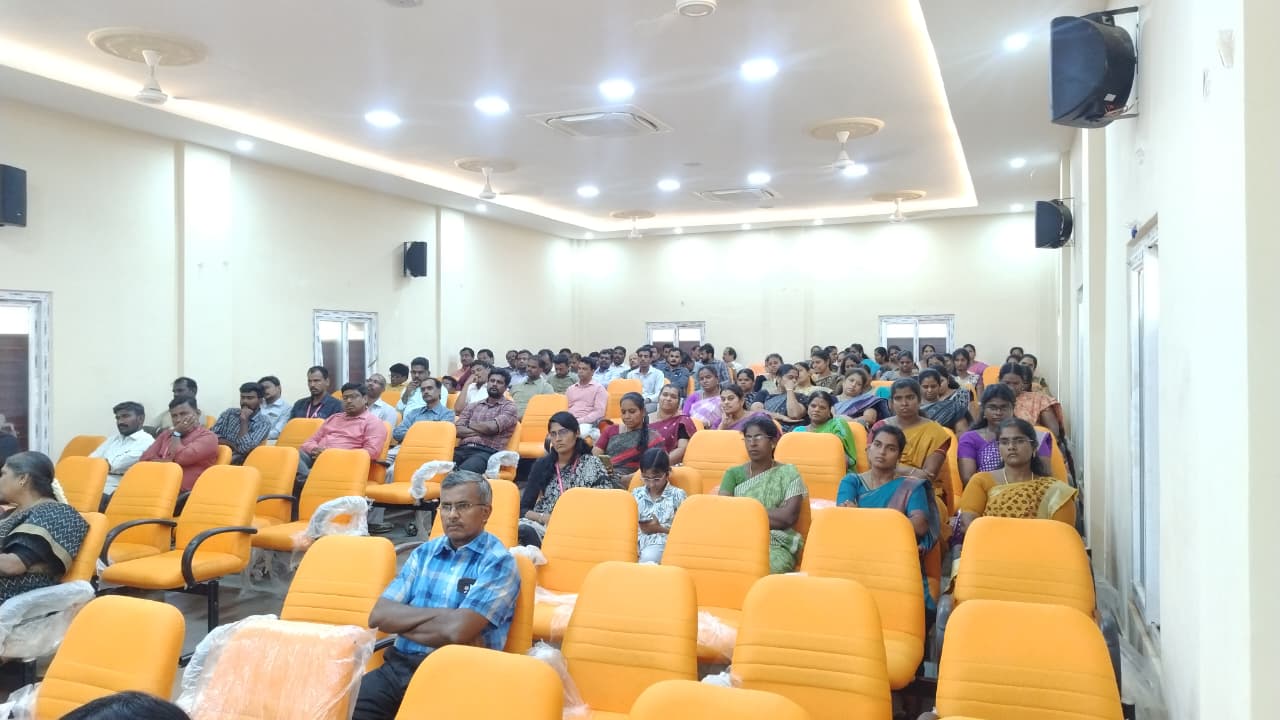
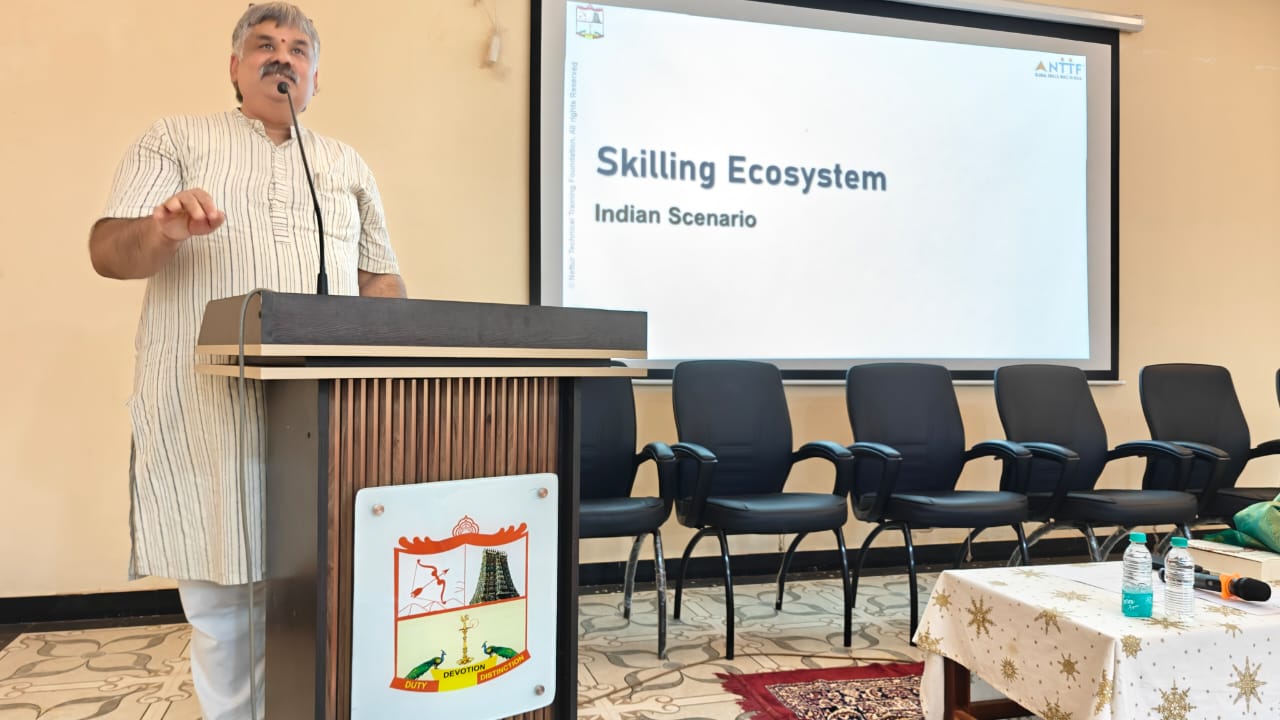
Upon invitation by Secretary, Shri Narayanan and the leadership team of Saraswathi Narayanan College of Arts and Science, Madurai, to deliver an interactive session on the Skilling Ecosystem and its relevance in Arts, Humanities, and Social Sciences, wanted to share the learnings for wider reach. Although initially planned as a talk with Q&A, the format was shifted to a fully interactive session from the start, which proved to be more effective. Using data at national, state, and district levels, the session highlighted the critical gap in skills among graduates across all streams, making a strong impact on the audience.
The perception, no different in this audience too (major percentage from Non-STEM branches), that non-STEM programs is “all about knowledge” and not “skills” is widespread—but it’s also quite misleading for following reasons
In STEM fields like science and engineering, hands-on activities are common, with students spending time in labs, coding, or working on projects. In contrast, non-STEM subjects are traditionally focused on theory, critical thinking, and abstract reasoning, and they often lack clear, tangible “hands-on” components.
In India, non-STEM courses often use essays, exams, and theoretical discussions as their main forms of assessment. While these methods test a student’s ability to recall and interpret information, they can hide the practical skills being developed.
A skill is the ability to do something well, which is gained through practice and experience. While skills can be physical or mental, those like critical thinking, communication, empathy, and cultural literacy are difficult to measure. Because of this, they are often undervalued compared to more easily quantifiable skills like programming or data analysis.
Employers tend to look for hard skills like Excel and Python, which are simple to teach and test. This creates a misconception that non-STEM graduates aren’t as “job-ready,” even though these graduates often have strong soft skills essential for leadership, collaboration, and innovation.
Changing the Mindset
Non-STEM fields develop crucial transferable skills such as creativity, communication, critical thinking, research, and empathy.
These skills are often implicitly embedded in the coursework rather than explicitly taught. For example, a history student’s work on analyzing sources and constructing arguments teaches them research and communication skills without those being the explicit focus of the assignment.
Modern non-STEM education is evolving to make these skills more explicit through methods like project-based learning, internships, and the integration of digital tools like GIS and data visualization.
Making these Skills Visible
To better showcase the value of non-STEM education, there are four key strategies:
Curriculum Design: Clearly state the skills students will gain in all course materials and assessments.
Skill Mapping: Create frameworks that help students and faculty identify and explain the skills being developed
Industry Collaboration: Work with employers to demonstrate the unique value non-STEM graduates bring to the workforce.
Aspirational: Highlight success stories of non-STEM graduates who have become leaders, innovators, and entrepreneurs.

Skills in Various non-STEM Disciplines
Literature focuses on building skills in critical thinking, empathy, communication, and cultural literacy.
History hones abilities in research, analytical reasoning, and argumentation.
Psychology emphasizes observation, data interpretation, and interpersonal skills.
Sociology develops systems thinking, qualitative analysis, and ethical reasoning.
Philosophy strengthens logic, ethical decision-making, and abstract reasoning.
Fine Arts cultivates creativity, design thinking, and visual communication.
Media Studies teaches storytelling, media literacy, and audience analysis.
Skill development is vital in all academic fields, both STEM and non-STEM, because it gives students the practical ability to use their knowledge in real-world situations. While STEM focuses on technical skills, non-STEM fields build equally important competencies like critical thinking, communication, and creativity. These skills are essential for leadership and innovation and are highly valued by employers. Ultimately, incorporating skill development into all education ensures graduates are not just knowledgeable but also capable and adaptable in the workforce.