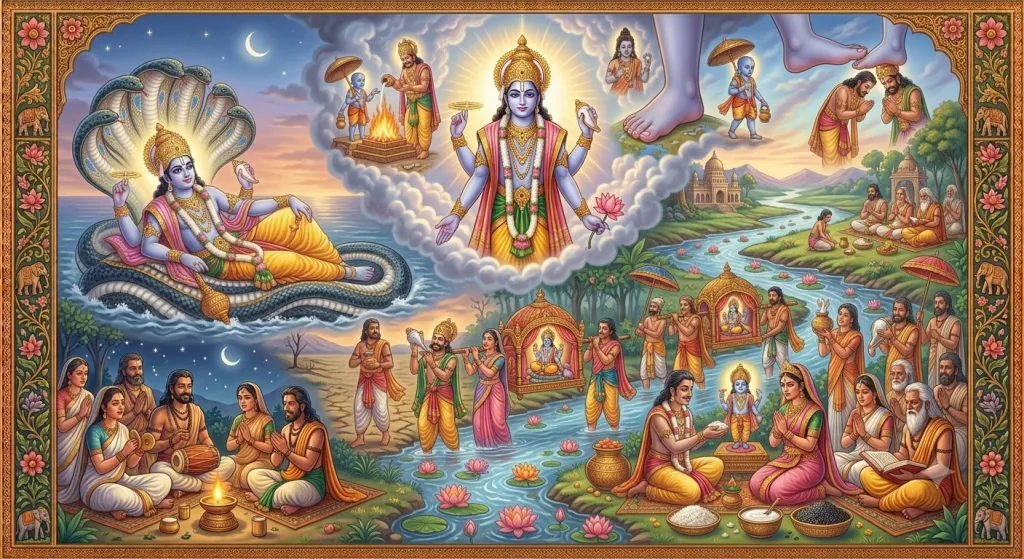
Parsva Ekadashi: Cosmic Transformation and Divine Surrender

Parsva Ekadashi occurs during Shukla Paksha (waxing phase of moon) of Bhadrapada month (August-September). It is highly revered Ekadashi occurring during middle of Chaturmas period. On this sacred day, Bhagawan Vishnu changes his sleeping position from left side to right side while in cosmic sleep (Yoga Nidra) on Sheshnag. Devotees dedicate this day to worship Lord Vamana form of Bhagawan Vishnu to seek relief from sins and attain spiritual elevation.

Meaning and Significance of Parsva Ekadashi

In Sanskrit, Parsva means side or flank. Therefore, Parsva Ekadashi translates to 11th day when Lord Vishnu turns on his side during cosmic slumber. It is also popularly known as Vamana Ekadashi, Jaljhulani Ekadashi, or Parivartini Ekadashi owing to cosmic shift occurring on this day.

This day holds special spiritual power as change in cosmic posture of Bhagawan Vishnu symbolizes positive transformation and renewal of spiritual energy. Observing fast on Parsva Ekadashi cleanses mind of past sins and negative tendencies. Scriptures mention that sincere devotion on this day grants merit equal to performing Vajapeya Yajna, bringing happiness, purity, and guiding soul towards ultimate liberation or Moksha.

Legend associated with Parsva Ekadashi

Scriptures describe sacred story narrated by Bhagawan Krishna to King Yudhishthira, involving demon King Bali and Lord Vamana. King Bali, grandson of noble devotee Prahlada, was ambitious and powerful ruler who conquered three worlds, defeating Devas and occupying Svargaloka. Despite being demon by birth, King Bali was deeply righteous, generous, and devoted to performing sacrifices and charity.

Devendra Indra and other celestial beings approached Bhagawan Vishnu in Ksheera Sagara, seeking help to regain control of Svargaloka. Bhagawan Vishnu promised to protect Devas and took avatar as dwarf Brahmin named Vamana, son of Sage Kashyapa and Aditi. Lord Vamana approached sacrificial hall where King Bali was performing grand Ashwamedha Yajna.

Guru Shukracharya recognized Lord Vamana as divine manifestation of Vishnu and warned King Bali not to offer anything to dwarf Brahmin. However, King Bali refused to go back on his word and welcomed Lord Vamana with total reverence, offering to grant whatever wish young Brahmin possessed. Lord Vamana simply requested land measuring three paces of his small feet for performing penance.

King Bali agreed happily. Instantly, Lord Vamana expanded into his cosmic form (Trivikrama). With his first step, Lord Vamana covered entire earth, and with his second step, he covered entire sky and celestial realms. With no space left for third step, Lord Vamana asked King Bali where to place his foot. Showing ultimate surrender and humility, King Bali offered his own head for third step.

Pleased by extreme devotion and truthfulness of King Bali, Lord Vamana placed his foot on Bali head, pushing him gently into Sutala Loka (underworld). Lord Vamana granted King Bali eternal reign over Sutala Loka and promised to personally guard his kingdom forever. Devotees commemorate this divine event on Parsva Ekadashi by worshiping Vamana form of Bhagawan Vishnu.

Rituals to be performed on Parsva Ekadashi

Devotee must wake up early in morning during Brahma Muhurta and take ritual bath using clean water without using soap, shampoo, or such cosmetic products.

Puja area should be cleaned thoroughly and idol or photo of Bhagawan Vishnu, specifically Lord Vamana form, should be placed respectfully.

Light ghee lamp, offer fresh yellow flowers, sandalwood paste, incense, and Tulsi leaves to Bhagwan Vishnu.

Chant Vishnu Sahasranama, Hare Krishna Mahamantra, or Om Namo Bhagavate Vasudevaya continuously throughout day.

Listen to or read Parsva Ekadashi Katha with family members in peaceful state of mind.

Offer your respects to parents and other elders, especially Guru, seeking their heartfelt blessings on this sacred morning.

Observe fast during entire day according to individual health capacity. Healthy individuals can observe strict fast without water or taking only water. Milk, curd, and fruits can be consumed if complete fasting is difficult due to health reasons. Rice, wheat, barley, lentils, pulses, and all food grains must be avoided strictly. Heavy spices, regular salt, garlic, onion, tea, coffee, outside processed food, and alcohol must be strictly avoided.

Perform evening Aarti with devotion, offer special Naivedya to Bhagwan Vishnu, and maintain noble thoughts, avoiding anger, backbiting, falsehood, or harsh speech.

Break fast next day on Dwadashi tithi during scheduled Parana time. Fast should be broken after sunrise once Hari Vasara period concludes. Offer naivedya to Bhagwan Vishnu, perform short prayer, and break fast by consuming prasada, water, or fruits before eating regular food.

PS: Article re-formatted into blocks and Header Image changed

Onam Message – Celebrate Act not the Actor

Onam 2013 has turned out to be significantly different compared to the earlier ones that I have celebrated with friends and families in the past. A new insight as I was discussing with a lot of my friends who have contributed to my understanding of the festivities and rituals. A personal thanks.

Upfront a personal note

This may not be the traditional belief, but purely my take and hence pardon my ignorance in case of conflicts with my understanding – a word on what caused it would be highly appreciated.

Onam_0356
Our Chennai Days – With Sri Sukumaran and Family

While discussing with those who celebrate Thiruvonam (or simply Onam as it is popularly known) in a traditional way I could not help be awestruck realizing of the deeper significance of this Harvest Festival and the legend behind it.

Onam is celebrated over 10 days starting Attham (Hasta) Nakshatra in the month of Chingam (Solar Calendar followed in Kerala) and ends on Thiruvonam (Shravana) Nakshatra  (the 10th day) . It is also celebrated by some in the Coastal Karnataka with equal gaiety and pomp.

Mahabali was the King of Asuras, grandson of Prahlada, who despite being born as an asura was known as paragon of devotion to Lord Vishnu. Mahabali was brought up under the tutelage and guidance of Prahlada from whom he imbibed the qualities of devotion and governance.

Mahabali Visits Art of Living Ashram :-) Panchakarma Centre
Mahabali Visits Art of Living Ashram 🙂 Panchakarma Centre

During Mahabali’s reign, the kingdom never saw poverty, crime or any societal ills and hence revered by his subjects. But Asura that he was, was not considered trustworthy and his ambition made him expand his kingdom and becomes Ruler of all the 3 worlds – an Asura ruler was against the laws of nature. Devas approach Lord Vishnu for a solution and when Mahabali was performing Ashwameda Yaga, Lord Vishnu appears in the form of a small brahmin boy (Vamana Avatara) and seeks to fulfill his desire as promised by the King during the Yaga. Upon which the righteous Mahabali offers to fulfill any demand that was placed by the boy who demands land covered by 3 steps.  Despite warnings from his Guru who foresaw disaster and had a vision that it indeed was Lord Vishnu who appeared in this form to deprive Mahabali of all his belongings. But Mahabali who valued Maana (Honor) even at the cost of his life told his Guru: “I should be the most fortunate one as the Lord, who gives everything to mankind, is seeking something from me.” So saying he offered to donate the Three steps that the brahmin boy sought. Vamana then grew in size so mammoth that one step covered the entire earth, the next the whole of Heaven and there was nothing left to claim for the 3rd step.  Mahabali the man of honor did not hesitate to offer his own head in lieu of land. Vamana steps on his head and sends him to Sutala, the heaven of Patala (the netherworld). It is believed that spot in which Vamana had sent Mahabali to Sutala is at Thrikkakara. The place where the holy feet (Trikkal) of Vishnu touched came to be known as Thrikkakara (Pictures of the Thrikkakara Vamana Moorthi Temple below)

Lord Vishnu also appoints him as the King of Netherworld and also position of Indra for one Manvantara. Mahabali who loved his subjects very dearly also seeks Lord Vishnu to allow him to visit them once every year. And it is this visit that is celebrated as Onam.

The festivities includes ceremonial welcome of Mahabali on the first day. Clay idols painted red (called Trikkakarappan, also called Onathappan) to which all the harvests are offered first thanking him for the Gift of abundance showered.

Trikkakarappan-Representing Vamana (Mahabali too)
Trikkakarappan-Representing Vamana

Maveli nadu vaneedum kalam,
manusharellarum onnupole
amodhathode vasikkum kalam
apathangarkkumottillathanum

(When Maveli ruled the land, All the people were equal. And people were joyful and merry; They were all free from harm.).  On the last day of Onam (Thiruvonam), the clay idols are immersed in sea/river with a prayer to Mahabali to return next year.

An essential part of the fesitiviy is laying out of the now famous & renowned flower rangoli called Pookalam. Some pictures below, the way we celebrated with friends

In Nasik - With Mr. Thomas (yes, it "was" secular)
In Nasik (Anything Non-Hindu here?)

General_0022
In Chennai – With Sri Sukumaran & Family

Traditionally each day the Pookalam gets bigger and the 10th day was the grandest one.  And this in itself was an enjoyable ritual for children, thanks to friends who celebrated it traditionally.

And then business part (for me) of any festival the famous, Onam Sadhya (Onam Feast)

Enjoying the Feast - With Sri Sukumaran
Enjoying the Feast – With Sri Sukumaran

Feast Next Year - With Sri Sukumaran & family in Chennai
Feast Next Year – With Sri Sukumaran & family in Chennai

The Sadhya... More items to come.
The Sadhya… More items to come This are just the sidies 😉

Other associated rituals and fesitivities include Pulikali (Tiger Dance), Thiruvathirakali (Women dancing in honor of Lord Shiva), Kummattikali

Now that the fun part is done, for some deeper significance (May not be politically or even religiously correct but this is what the festival held out as learnings for me)

This festival is the best example of Sanatana Dharma tradition – Even an Asura who is a true Bhakta (devotee) is venerated – Goes to show that it is not the “Who” that matters but the “What”. Being an Asura did not preclude him from being worshipped, his virtues were recognized and aspired for. Which by extension also means there is no concept of Sinners – only people who commit acts of sin. Love or hate the “Act” not the “Actor” It is a value that I alway cherished & forms part of my introduction in the “About” page

Secularism (in true sense, it just means being a Hindu) was an essential part of our Festivals. It was all about revering and honoring the nature. Even the Mahabali song (in red above) indicates the Secular (Hindu way) character. Bharateeya Sanskriti never talks in terms of  “Tolerance” but in terms of “Acceptance” (A bane these days? I tend to think so). I celebrated Onam with Mr. Thomas and family in 1993 while living in Nasik (though it did not include the rituals that accompanies the celebrations, Sadhya was the motive). Not sure if the radicalized society that the state has become, still allows him such niceties

Idols made of clay (I was told it is traditionally made from the soil for the fields that sustains their livelihood) is honoring the land that gives us everything and the immersion of the clay idol finally is to signify whatever we take has to be restored back to nature.

WISHING EVERYONE A VERY HAPPY ONAM

PS: In the Mahabali picture is Sri Praseed an ashramite and an ardent follower of His Holiness Sri Sri Ravi Shankar ji of The Art of Living