Job Security vs. Institutional Results

PC: Gemini

The recent controversy surrounding remarks by Karnataka Chief Minister DK Shivakumar and his daughter Aishwarya regarding the quality and accountability of government school teachers has once again exposed a deep-seated administrative fault line. Their comments on the gap between state-funded salaries and actual classroom performance sparked immediate pushback from teacher representatives and public sector advocates. However, rather than viewing this incident as a isolated political dispute, it serves as a critical trigger to examine the broader structural failure that plagues public-private partnerships across the state’s social sector.

Public-private partnerships (PPPs) in public governance, whether in government schools or Industrial Training Institutes (ITIs), continually run into the same structural wall: the split between operational management and administrative control.

Core Paradox: Power Without Authority

When private players or trusts adopt government institutions under Corporate Social Responsibility (CSR) or PPP frameworks, they are expected to improve outcomes, modernise infrastructure, and raise standards. However, they possess zero supervisory control over permanent government employees.

Permanent government staff derive their security from civil service rules, state appointment frameworks, and powerful employee unions rather than performance metrics. Private partners cannot hire, fire, transfer, dock pay, or issue formal disciplinary notices. External management interventions are often viewed as unsolicited oversight rather than support. Without administrative teeth, external partners can only persuade, which fails when absenteeism or lack of accountability is already habitual.

Why ITIs and Schools Share Same Failure Pattern

This phenomenon is not unique to school education and follows a predictable path across sectors. CSR initiatives frequently turn into cash injections for infrastructure, such as smart classrooms, machinery in ITIs, bus services, or toilet blocks. While physical assets improve, pedagogy and operational rigor remain unchanged because the human capital layer is untouched.

Government staff are evaluated, if at all, on administrative compliance like census work, election duties, record keeping, and scheme rollouts. Reality is that appraisal and growth is time based nor performance based in Government Institutions. On the other hand, Private partners evaluate them on output quality such as student pass rates, skill employable ratios, and daily classroom hours.

Structural Hesitation: Infrastructure Capital vs Human Capital

This systemic lack of operational control explains why private entities and corporate foundations deliberately limit their involvement to physical infrastructure. Donating smart boards, renovating laboratory facilities, building sanitation blocks, or gifting school buses allows corporate donors to achieve visible, measurable outcomes without entering administrative conflict. High-value physical capital creates immediate visual impact for corporate social responsibility metrics while insulating the private entity from the friction of staff absenteeism, union pushback, and entrenched workplace culture.

True institutional reform and modernisation cannot occur through hardware upgrades alone. Operational success depends entirely on human resources. When management frameworks lack the authority to enforce daily accountability, performance tracking, or pedagogical standards, institutional staff revert to established habits. Infrastructure improvements without corresponding authority over staff management yield minimal long-term change, leaving structural reform unrealised despite substantial private investment.

Ground Reality: Lessons From ITI Interventions

Direct experience in ITI interventions across various models confirms that collaborative operations succeed only when complete management control, including staffing, is handed over to the private partner. While augmenting existing institutions by retaining incumbent government staff carries long-term merit on paper, it often remains a good intention defeated by a total lack of accountable participation. During an Industry-Government meet on PM-SETU, a renowned industrialist repeatedly pressed government officials on whether operational management control included staffing control. The policy representatives offered no convincing answer beyond stating that they would cross that bridge when they come to it. Leaving such fundamental rules of engagement unaddressed guarantees friction. Clear frameworks on staffing governance, measurable outcomes, and enforced accountability must be defined well in advance rather than deferred to post-implementation crisis management.

Structural Solutions for Functional Co-Management

To make public-private adoption work without stripping public servants of their statutory protections, systemic governance changes are necessary:

  • Statutory Delegation of Supervisory Powers: Adopting entities should receive formal, delegated authority to sign off on performance-linked incentives, daily attendance logs, and internal quality appraisals.
  • Non-Teaching Duty Relief: As highlighted in defense of public sector staff, teachers and instructors are often burdened with non-educational administrative duties. Public policy must ring-fence their hours purely for instruction before enforcing strict attendance standards.
  • Third-Party Metric Auditing: Independent state-sanctioned bodies—rather than internal department heads or private adopters—must handle attendance tracking and performance audits to bypass union pushback and institutional apathy.

Confronting the Human Element in Public Education

The controversy surrounding the statements made by Aishwarya and DK Shivakumar brings this long-evaded reality into sharp focus. When the state provides substantial salaries to public school educators, expecting proportional commitment and outcome delivery is not an unreasonable corporate demand, it is basic institutional governance.

This core issue is often obscured by defensive rhetoric, such as the pushback from JD(S) MLC A P Ranganath (representing the Bangalore Teachers’ Constituency), who claimed that questioning teacher performance “insults” them because they clear rigorous recruitment exams. This argument fundamentally misunderstands the purpose of public service: clearing a competitive test is merely the entry ticket, not the end goal. Recruitment exams test potential at a single point in time, but daily performance and classroom engagement decide the future of lakhs of children. Similarly, accusations from groups like the Save Public Education Committee, claiming the government is passing the buck onto teachers, ignore the reality that teachers remain the single most critical factor in learning outcomes. Shielding staff behind past credentials or union solidarity ensures educational reform remains a distant dream.

If the goal is truly to safeguard accessible, quality education for underprivileged students, a pragmatic economic model must replace political posturing. The government can continue funding base salaries according to existing public remuneration scales, while private partners fund performance-linked top-ups and resource gaps. In return, teachers must commit to strict, enforceable standards of discipline and measurable student outcomes. Without this balanced accountability framework, no amount of public funding or private goodwill can fix the system.

Skill Should be a Choice, not Compulsion

As leaders, policymakers, and industry experts gather at the Bengaluru Skill Summit 2026 under the banner of Workforce 2030: Scale, Systems, Synergy, the conversation around human capital in India stands at a critical crossroads. Building a resilient economy demands that we move beyond expanding skilling numbers to addressing the fundamental societal perception of vocational careers. True progress requires making skilled craftsmanship an aspirational primary choice rather than a fallback option. Here is two bits on what it takes to make this happen on the ground

Skill development in India historically suffers from deep-seated perception issue where vocational training gets categorized as backup option. Society views hands-on learning as route for candidates who fail to secure traditional academic seats. Real progress demands structural shift where vocational tracks become intentional choice rather than compromise. Integrating skill modules into early school education exposes students to practical disciplines, allowing them to pursue craftsmanship out of genuine passion. When youth opt for technical trades as primary ambition, standards of quality, innovation, and expertise naturally rise across industries.

Cultural Trap of White-Collar Aesthetics

Deeply rooted social biases often overshadow actual economic success and career progression, as illustrated by real-life example from Andhra Pradesh. Daughter of farm labourer independently chose vocational training as specialized Tool Maker, driven by genuine interest in technical machinery despite her parents lacking formal education to guide her. Upon visiting her industrial workspace, her parent was dismayed to find her in heavy overalls, drenched in sweat with hands covered in grease.

This shock persisted despite her earning significantly higher salary than her elder brother, who held traditional University Engineering Degree and was in his third year of corporate employment. Furthermore, her specialized program offered structured academic pathway allowing her to complete her Engineering Degree concurrently while enjoying strong headstart in her career. Parent continually insisted that educated daughter should be working in air-conditioned halls, wearing formal suit, and operating computer. This stark contrast demonstrates how societal obsession with white-collar aesthetics creates artificial barrier against making technical craftsmanship aspirational.

Dignity of Craftsmanship

Nations like Germany and Switzerland demonstrate power of dual-education systems where master craftspeople enjoy equal social prestige alongside university degree holders. German Meister qualification carries immense public respect and opens structured career pathways. India requires similar cultural transformation to break long-standing bias that favors white-collar desk jobs over practical mastery. Recognizing skilled workers as indispensable drivers of economic growth instills pride in craftsmanship. Elevating public perception around technical skills validates efforts of artisans and encourages future generations to pursue vocational careers with confidence.

Overhaul of Regulatory Frameworks

Seamless academic mobility and aspirational skill pathways demand massive improvement in effectiveness of regulatory bodies and qualification architectures. While National Council for Vocational Education and Training (NCVET), National Skills Qualifications Framework (NSQF), and National Credit Framework (NCrF) provide policy intent, ground-level execution gaps prevent real-world impact. Higher education institutions frequently resist recognizing skill-based credit transfers under NCrF, forcing students into repetitive learning loops.

NSQF levels require drastic restructuring in close alignment with industry standards to ensure certifications signal practical mastery rather than theoretical hours. Furthermore, NCVET must shift from passive accreditation to active quality enforcement, auditing assessment agencies and streamlining Recognition of Prior Learning (RPL) so informal skilled workers gain credible credentials, wage enhancements, and formal economic standing.

From Minimum to Proud Wages

National conversation around workforce compensation must move away from bare survival figures toward sustainable income. Framing labor value around statutory minimum wages keeps skilled workers in state of perpetual financial uncertainty. Industry and policymakers must collaborate to establish proud wages that truly reflect expertise, precision, and effort involved in skilled trades. Fair and lucrative compensation structures create strong economic incentives, motivating workers to constantly upskill while transforming technical professions into highly attractive long-term career choices for ambitious youth.

Trap of Gig Economy

Unregulated expansion of gig platform economy actively hinders long-term skill development among Indian youth. Delivery platforms and ride-hailing services offer immediate daily cash payouts, luring young workers into low-skill algorithmic tasks. While gig work provides short-term financial relief, it lacks structured career progression, formal training, or skill accumulation. Workers spend productive years completing repetitive tasks without building specialized expertise required for higher-value trades. Algorithmic management leaves gig workers highly vulnerable to sudden pay cuts, arbitrary account suspensions, and total lack of social safety nets, trapping energetic labor force in precarious cycle without sustainable future growth.

The NSQF Dilemma – Degrees or Competencies

Indian Skilling Ecosystem & NSQF – A Quagmire

Various conversations with key stakeholders across Indian skilling landscape reveal sharp contrast between policy design and field implementation. Interactions with teams at NCVET and NSDC and also as an observer of their activities, highlight clear national blueprint aimed at unifying qualification standards.

However, direct feedback from Colleges, Schools, Technical and Vocational Education and Training institutions, referred to as TVETs, and Industry partners uncovers operational friction points. School administrators report resource constraints when rolling out early vocational modules. TVET centers express concerns regarding high capital expenditure needed for modern lab infrastructure. Colleges highlight administrative difficulties when mapping legacy curricula to credit standards. Private industry partners continue to voice skepticism regarding practical readiness of certified candidates.

National Skills Qualifications Framework, widely known as NSQF, has emerged as main backbone of Indian vocational education and training sector. Supported by National Education Policy 2020 and National Credit Framework, short for NCrF, NSQF is bridging gap between academic learning and practical vocational skills across country.`

Implementation of NSQF has picked up speed across multiple domains in India. Integration with school and higher education through NCrF allows students to move between academic and vocational streams without losing study time. Under Samagra Shiksha scheme, over 25,000 schools across Indian states now offer NSQF aligned vocational courses covering more than 130 job roles.

Ministry of Skill Development and Entrepreneurship together with National Council for Vocational Education and Training, known as NCVET, has rationalized old qualifications. Outdated courses are removed, making space for modern domains like Artificial Intelligence, Green Energy, Cybersecurity, Cloud Computing, and Drone Technology.

Major national skilling schemes like Pradhan Mantri Kaushal Vikas Yojana, Industrial Training Institutes, and PM Vishwakarma mandatory map their curriculum to NSQF levels. Skill India Digital Hub platform enables seamless digital certification and tracking for learners across country. Furthermore, Recognition of Prior Learning allows millions of informal workers and traditional Indian artisans to get official NSQF certificates based on existing workplace skills.

Despite ambitious structural reforms under NSQF and National Credit Framework, several deep-rooted systemic bottlenecks continue to slow down real ground impact. Primary issue remains social mindset surrounding vocational training, which is still widely viewed as secondary alternative for students who fail in general academic streams. This perception gap severely dampens student enrolment numbers and reduces willingness of parents to choose skill courses early in school life.

On industry front, major disconnect exists between official NSQF certifications and private sector hiring criteria. While government departments and public sector undertakings recognize NSQF levels, private employers across India still rely heavily on traditional university degrees or conduct separate internal tests, largely ignoring NSQF level scores during recruitment.

Fragmented governance among various awarding bodies and state level training missions often leads to compliance focused implementation rather than outcome-based learning. Many training providers focus on completing mandatory short-term targets to claim government subsidies instead of tracking long term job placement or wage growth.

Quality of infrastructure and availability of certified trainers present another massive operational challenge, particularly across tier two and tier three towns. Trainers themselves often lack exposure to modern industrial tools and digital tools, leaving students with theoretical knowledge rather than true practical competencies.

Lastly, execution of seamless credit transfers under NCrF requires high level of digital readiness and administrative alignment across universities, ITIs, and school boards. Many higher educational institutions lack necessary operational guidelines or motivation to grant lateral entries to vocational diploma holders, creating friction in multiple entry and exit pathways envisioned by National Education Policy.

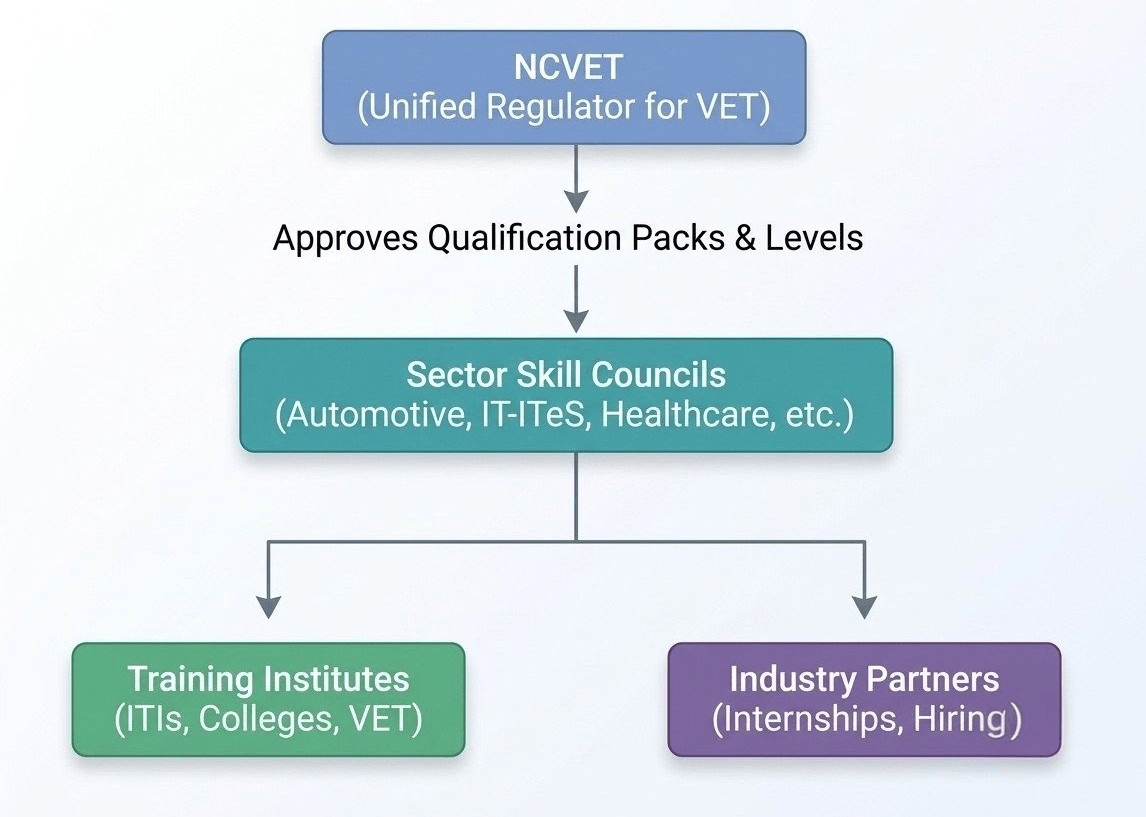
Sector Skill Councils, commonly called SSCs, act as crucial bridge between Indian industry requirements and skilling standards. Operating under regulation of NCVET, SSCs shape quality and relevance of skill training in India.

SSCs define job roles and performance standards across more than 30 major sectors including Automotive, Healthcare, Retail, Electronics, and IT-ITeS. These standards form base for Qualification Packs approved by NCVET.

SSCs continuously update curriculum to match future industry needs like Green Hydrogen and Electric Vehicles. Leading corporate houses and original equipment manufacturers partner directly with SSCs to align in-house employee training with national standards. SSCs also supervise independent assessment agencies to conduct outcome-based practical tests across training centers.

National Credit Framework unifies credit allocation across school education, higher education, and vocational training in India.

One credit equals roughly 30 hours of total learning effort. One full academic year of 1,200 learning hours translates to 40 credits.

Learning TypeHours per WeekCredits Earned
Theory or Lecture1 hour1 Credit
Practical or Lab Work2 hours1 Credit
On the Job Training / Field Work3 hours1 Credit
3 Month ApprenticeshipFull Duration10 Credits
NCrF LevelQualification / Education Stage
Level 8.0  Doctoral or Post Doctoral Studies
Level 7.0  Master Degree or Advanced Vocational
Level 6.0  Bachelor Degree 4th Year Honours
Level 5.5  Bachelor Degree 3rd Year
Level 5.0  Diploma or Higher Vocational Training
Level 4.5  Undergraduate Certificate
Level 4.0  Class 12 or ITI National Trade Certificate
Level 3.0  Class 10 or Foundation Skills

Equating NSQF competency levels directly to standard educational qualifications like Class 10, Class 12, or Bachelor degrees risks undermining fundamental purpose of skill framework. Main objective of NSQF is to measure practical capability, hands on mastery, and workplace performance rather than classroom seat time or academic test scores. When skill levels are strictly mapped to formal academic degrees, system shifts focus back to earning certificates rather than demonstrating actual workplace competence. Training providers end up designing courses to meet traditional academic equivalency guidelines instead of customizing learning to dynamic industry needs. This approach reduces NSQF to mere degree equivalent system, encouraging rote memorization and academic bureaucracy while leaving core issue of industry unemployability unaddressed.

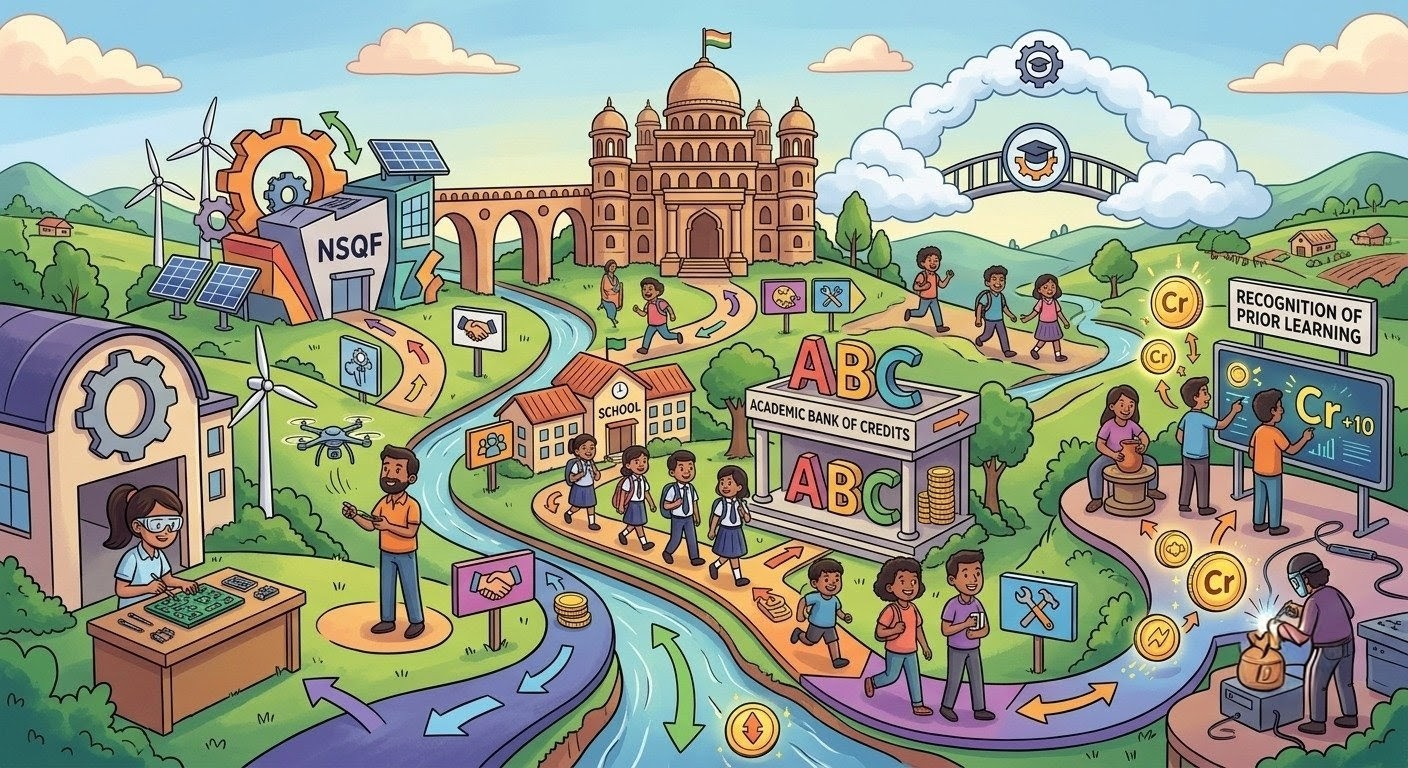
Every student gets unique APAAR ID linked to Academic Bank of Credits. Earned credits from ITIs, school vocational courses, or university programs deposit digitally into this account.

Students can easily transfer credits between general academic subjects and vocational courses. Higher Education Institutions allow up to 50 percent of total degree credits through NSQF aligned vocational courses, internships, or industrial apprenticeships.

Multiple entry and exit options allow student to leave degree program after first year with certificate, work in industry, and return later to resume higher studies using accumulated credits. Workplace knowledge acquired without formal education can also be evaluated through RPL assessment and credited directly to student account.

Implementation of Multiple Entry and Multiple Exit, commonly called MEME, remains one of most struggling components within Indian higher education and skilling frameworks. Designed under National Education Policy 2020 to offer flexible learning pathways, ground execution suffers from massive institutional hesitation and logistical barriers.

NEP Implementation MetricCurrent Adoption Level
Higher Education Institutions offering MEME36 percent
ABC Registered HEIs maintaining active credit logs64 percent
Universities fully adopting NCrF frameworkUnder 7 percent

National implementation studies show only 36 percent of Higher Education Institutions across Indian states have actually operationalized multiple exit options for their students. Furthermore, while over 2,800 institutions registered on Academic Bank of Credits platform, under 7 percent of registered universities have integrated full NCrF equivalence guidelines required for seamless credit mobility. Nearly 36 percent of registered institutions fail to update active credit records on ABC portal, making cross-university student transfers nearly impossible in practice.

Root cause of poor adoption lies in administrative complexity and lack of trust among academic bodies. Most top rank universities hesitate to accept re-entry students from other regional colleges, fearing diluted academic standards. Each institution requires setting up independent Equivalence Committees to manually evaluate prior credits, creating massive red tape and processing delays.

Additionally, industry value of exit awards like Undergraduate Certificates after year one or Diplomas after year two remains unproven. Private sector recruiters rarely view one year certificate holders as job ready graduates, forcing most students to complete full four year degree without opting for early exit options.

Transforming Indian skilling landscape from policy vision into functional reality requires closing implementation gaps across all ecosystem players. While foundational frameworks like NSQF, NCrF, and credit banking systems offer promising architecture, true success depends on active collaboration among regulators, educational institutions, and private industry. National level bodies like NCVET and NSDC must streamline accreditation processes while encouraging universities and TVET institutions to simplify credit transfers. Simultaneously, private sector employers need to align entry level hiring requirements with NSQF competencies rather than relying strictly on conventional degrees. Addressing social perceptions around vocational education, strengthening teacher training quality, and establishing clear industry recognition for exit certificates will ensure Indian youth gain meaningful employability through seamless skill pathways.