PM-SETU: Ratios Matter

Indisciminate Increase of Load on the Hub

PM-SETU Scheme

Pradhan Mantri Skilling and Employability Transformation through Upgraded ITIs program aims to completely upgrade government industrial training institutes across country. Main goal is modernizing technical education so students learn modern skills needed for jobs today. Government wants to build strong network where students from different areas easily access high quality training facilities and expert teachers.

Hub and Spoke Cluster Architecture

Program uses special network design known as hub and spoke model. Overall plan upgrades 1,000 government institutes structured into 200 central hub institutes connected with 800 supporting spoke institutes. Standard setup links 4 spoke institutes to 1 central hub. States and union territories can adjust layout based on local needs. North Eastern region and hilly states use mini hubs with relaxed rules to handle tough geographical terrain.

Financial Outlay and Budgeting

Government fixes maximum money for single central hub at ₹81 crores over 5 years. Funding follows 3-way sharing model where central government gives up to ₹40 crores while state government provides ₹30 crores and industry partner brings ₹11 crores. Every single supporting spoke institute gets budget capped at ₹40 crores over 5 years with center giving ₹18 crores, state providing ₹17 crores, and industry contributing ₹5 crores. Total budget for standard cluster with 1 hub and 4 spokes reaches ₹241 crores evaluated through strategic investment plan.

Funding Mechanics and Rules

Money from center, state, and industry goes into special bank account called escrow account managed by special purpose vehicle. Release of funds depends entirely on strict performance rules. Institutes receive initial 10% advance payment first. Next yearly funds depend on maintaining at least 75% money usage and achieving target performance goals.

Operational Challenges in Expanded Clusters

Adding extra spoke institutes beyond standard 4 limit creates serious practical problems across daily administration, technical training, and student mobility. When administrators stretch hub-and-spoke ratio to 5, 6, or more spokes, system faces severe stress points:

  • Physical Overload of Advanced Machinery: Central hub acts as center of excellence housing high-end equipment, specialized production units, and advanced toolrooms. Managing practical training sessions for students coming from too many extra institutes overloads physical capacity of hub workshop and leads to frequent equipment breakdown.
  • Severe Commuting Hardship and Travel Strain: Wider geographical radius increases travel distance between outlying spoke institutes and central hub. Students and faculty members waste precious academic hours traveling long distances just to access specialized labs or mandatory practical training modules.
  • Diluted Administrative Oversight: Management committee and special purpose vehicle face immense difficulty maintaining close supervision over numerous disparate campuses. Continuous monitoring of key performance indicators, attendance tracking, and quality audits becomes weak and ineffective across scattered institutes.
  • Industry Partner Disengagement: Anchor industry partners committed to specific cluster configurations find it hard to manage joint placements, curriculum alignment, and apprentice tracking when student volume exceeds planned capacity. Overstretched batches reduce individual attention from corporate mentors.
  • Faculty Burnout and Resource Shortage: Expert trainers based at central hub struggle to split their teaching schedules effectively among too many outlying spokes. Traveling instructors face exhaustion, leading to irregular classes and poor delivery of advanced technical concepts.
  • Severe Financial and Infrastructure Imbalance: Spreading fixed capital budget across inflated number of institutes leaves laboratories underfunded and libraries short of resources. Adding extra spokes without increasing hub budget creates major financial gaps and severely hurts overall training quality.

Strategic Priority for High Student Density

Any necessary adjustment in hub-and-spoke ratio must lean strictly toward a higher configuration rather than a lower one, particularly in densely populated urban and semi-urban student regions. Expanding the operational radius downward by packing fewer institutes into a hub underutilizes high-end infrastructure, which still is better than stressing the resources by lowering the ratio, whereas prioritizing higher capacity ensures that massive student enrollments receive adequate technical exposure. Managing high student density effectively requires robust structural reinforcement and proportional budget scaling so that swelling trainee numbers never overwhelm central hub facilities.

Detailed Cost Impact of Adding Spokes

Hub institute works both as normal training center and as central hub supporting other spokes. Dividing ₹81 crores across 5 units including hub itself, means about ₹16.2 crores supports each unit. If cluster adds more spoke institutes instead of standard 4, hub requires extra investment to keep distribution fair. Adding extra spokes without increasing hub budget creates major financial imbalance and hurts training quality. Typically for each Spoke ITI added to the hub should call for additional outlay of ₹16.2 Crore at hub ITI and ₹40 Crore each for the added Spoke ITI

Conclusion and Need for Rigorous Implementation

Protecting original design and rules of PM SETU program remains extremely important to prevent past failures where huge money spent produced poor results. Changing core structural ratios or financial safety limits risks repeating old mistakes of spending funds without achieving real skill development or employment targets. Keeping strict hub and spoke framework ensures proper resource use and strong accountability.
Rewriting The Script – Flawed Compassion vs Educational Reform

Imagine picking up the newspaper to this jarring headline and news early this morning to my utter shock. With no disrespect to the intent, I write here on what (or everything that) is wrong with this messaging

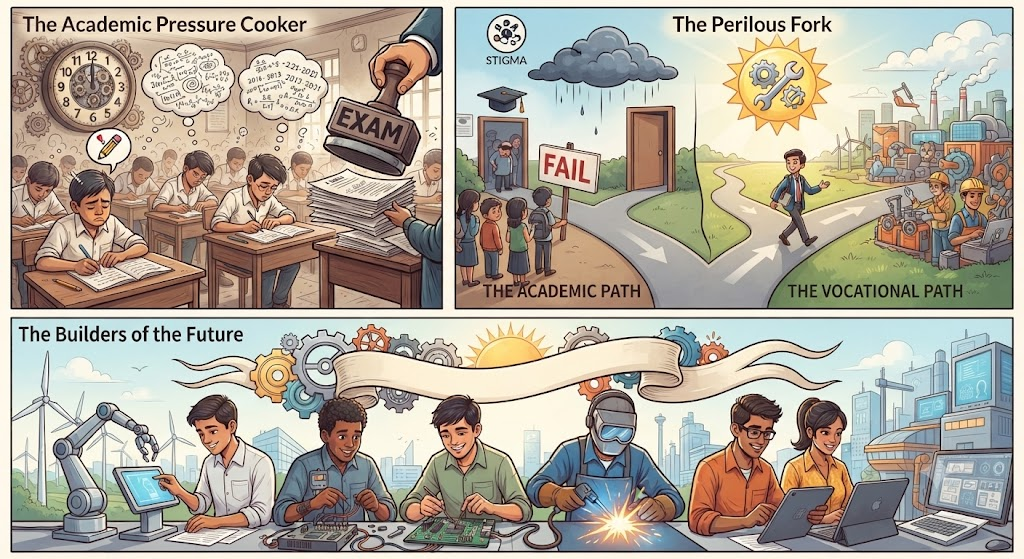
PC: Gemini

Compassion for struggling students remains paramount in any progressive society. Bihar recently decided to drop fail label from Class 10 and Class 12 marksheets and replace term with eligible for skills. Initiative aims to soften blow for students failing board exams. Ministers argue inability to secure expected marks does not reflect true talent of child. However execution of noble thought creates dangerous paradox. Messaging damages exact cause government intends to promote.

Stigma Attached To Skill Development

Vocational education always struggled for respectability across country. Society traditionally links success solely with degrees and desk jobs. Parents push children towards endless race of rote learning and competitive tests. Government actions must elevate dignity of technical training. Instead policy links skilling directly with academic rejection. Youth immediately reads between lines. Skill programs suddenly become fallback option for academic non-performers. Perception hurts long-term mission of building skilled workforce.

Memory Tests Versus True Capability

Current examination structure relies heavily on memorisation rather than genuine understanding. System tests ability to recall text overnight instead of practical aptitude. Students failing such rigid exams often possess exceptional hands-on intelligence. Protecting them from societal shame is necessary step forward. Labelling them as failures destroys confidence prematurely. Yet solution cannot involve redirecting them towards vocational streams as consolation prize. Real capability requires equal respect across all domains.

Elevating Vocational Education

Economic future of nation depends heavily on quality of workforce. Vocational training cannot remain secondary choice for struggling learners. True transformation demands elevating skilling to top tier of career choices. Systemic changes must make technical education attractive and rewarding for everyone. We have enough reasons to make it lucrative and “want-to-pursue” and not as a fall-back or last resort option for the youth. I speak this out of personal experience and next sections explore vital steps needed for this crucial transition.

Economic Growth And Demographic Dividend

India possesses massive young population ready to join workforce. Demographic dividend remains empty slogan without robust practical training. Modern industries require specialized technical expertise across manufacturing and digital sectors. Economy expands rapidly creating massive demand for skilled professionals. Vocational education provides direct bridge between unemployment and productive employment. Making trade skills aspirational unlocks true economic potential of nation.

Dignity Of Labour In Modern Economy

Society historically attaches social stigma to manual and technical work. White collar jobs enjoy disproportionate respect compared to trade professions. Changing mindset requires cultural shift towards dignity of labour. Skilled technician contributes just as much as corporate manager. Schools must celebrate electricians and plumbers and mechanics with equal pride. Respect for hands-on work builds inclusive and balanced society.

Curriculum Modernization And Industry Integration

Current educational framework often relies on outdated equipment and obsolete syllabi. Vocational courses must align directly with modern industrial requirements. Collaboration with private sector ensures students learn latest technologies. Apprenticeships and hands-on factory training must form core part of study. Industry certification adds immense market value to student profiles.

Financial Incentives And Career Progression

Vocational training demands robust financial backing and scholarship support. Modern labs and workshops require heavy capital investment from state. Clear career pathways must exist for skilled workers entering job market. Continuous skill upgradation programs allow technicians to rise to leadership roles. Equal pay scales and formal recognition elevate status of vocational careers permanently.

Building Aspirational Pathways For Youth

True empowerment demands genuine respect for vocational careers. Students must choose technical trades out of passion and economic potential. Treating skill training as alternative path for academic dropouts defeats core purpose. Policy makers must frame reforms carefully. Competence in practical work deserves equal status alongside theoretical brilliance. Future growth depends on skilled hands building nation with pride. Messaging from top must inspire excellence everywhere instead of reinforcing old biases.

From Attappady to Conference Room – Inspirational Journey of Neeli

Memorable and Inspirational Journey
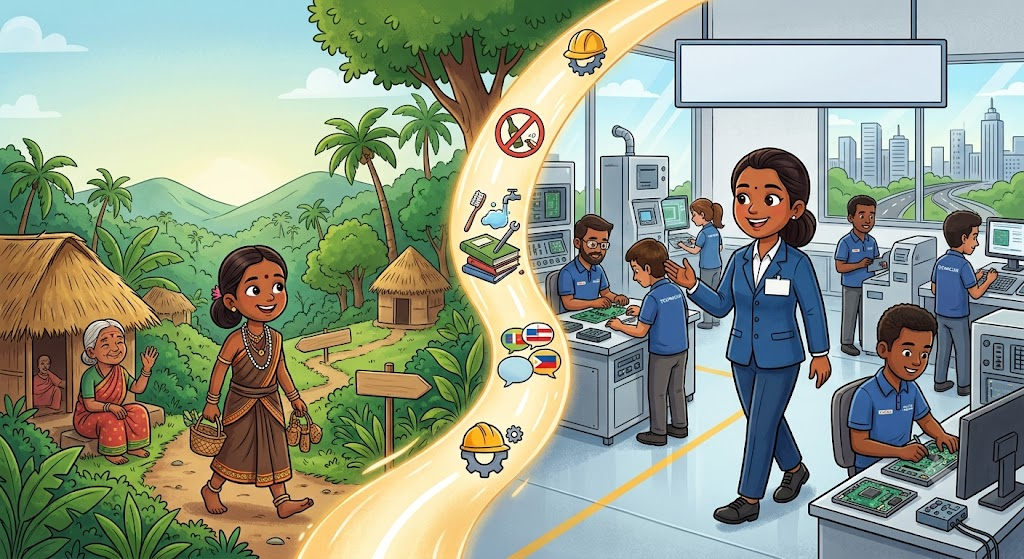
Cartoonised from Original Photographs using Gemini

Last Sunday, I walked into a humble but cozy home in Bengaluru for a birthday lunch. My host was a young girl from the 2016 Government of Kerala sponsored batch, a group of over 200 tribal youth brought down from remote forests of Attappady to be trained as Electronic Technicians. She now shares this home with five of her classmates from that very same batch, a visual treat when I saw how far they have all come together.

Over lunch, memories came rushing back. She recalled her early days in the city, intense culture shock, daunting language barrier, and overwhelming urge to pack her bags and run back to familiar sanctuary of the hills. She reminded me of how I had refused to let her give up as it was during my tenure as head of the training institution, deploying every method from firm discipline to patient counseling to help her navigate those initial hiccups.

Her gratitude was not just for a career or monthly paycheck, it was for dignity and security it brought her family. With tears in her eyes, she shared a moment that meant more to her than any corporate milestone, the day she was able to take her ailing mother to a proper, well-equipped hospital for treatment, stepping away forever from a thatched hutment that passed for a clinic in their native forest.

Her journey from a quiet, hesitant girl in the woods to a thriving professional in the heart of India’s tech hub is a story of grit, transformation, and unshakeable resolve.

When Neeli first left her hamlet in 2016, morning mist hung low over dense forests of Attappady. She had never stepped out of the hills, had worn only traditional attire, and spoke a native tribal dialect mixed with broken Malayalam. The world outside was a myth she had only heard of until a government sponsored skill development drive brought her batch down to Bengaluru.

The transition was brutal.

The bustling metropolis was an alien planet. For Neeli and her peers, primary hurdles were not just circuit diagrams or soldering irons, they were foundational lifestyle shifts. Structured environment demanded strict personal hygiene, formal attire, and relentless punctuality, concepts entirely foreign to life governed solely by sun, moon and seasons.

Compounding the struggle were ingrained habits. Weaning the group away from routine tribal addictions required immense patience, firm counseling, and constant monitoring. Language felt like an insurmountable wall. Technical terms in English sounded like noise, and even basic daily communication in the hostel was a battle. Many in the batch wept in silence, paralyzed by homesickness and culture shock, ready to pack their bags and flee.

Neeli almost broke too. But every time she felt like giving up, she remembered her mother working tirelessly under harsh sun back in Attappady, struggling just to secure two meals a day. Neeli’s resolve was not built on ambition for personal fame, it was forged in a quiet promise to give her mother a dignified life.

She decided to fight.

When training hours ended, while others rested, Neeli stayed back. She spent hours in front of a mirror, practicing basic phrases to overcome her language barrier. She adapted to disciplined routine, taking pride in her clean uniform and sharp presentation. She picked up soldering wire, studied circuit boards until her eyes burned, and slowly began grasping logic behind electronic components.

Her quiet determination did not just change her, it inspired the rest of her batch. Seeing her dedication, others found their footing, shedding reluctance and leaning into discipline required to succeed. By the end of the rigorous program, Neeli was unrecognizable from the shy, hesitant girl who had stepped off the bus months earlier. She graduated as a skilled, confident technician.

Her real trial began when she secured placement at a top French multinational electronics manufacturing firm. Stepping onto a high-tech shop floor filled with state-of-the-art machinery and strict global standards, she faced a whole new level of pressure.

Yet, grit honed during her training days paid off. She moved up from assembly line operator to taking on complex technical responsibilities. Her sharp eye for quality, unwavering work ethic, and ability to bridge communication gaps earned respect of both her peers and management.

Today, Neeli works as Line Manager at that French multinational, directly leading a team of technicians and engineers.

The girl who once struggled to speak outside her forest dialect now leads operational stand-up meetings. The family that once survived on daily wages in the hills now lives in comfort, supported by a daughter who refused to let her background define her horizon. Neeli’s journey stands as living testimony to what pure resolve and a daughter’s love for her mother can achieve.

PS:

I respectfully acknowledge the role of Visionary Kerala Bureaucrat Shri Subaiah Sankaran, IAS (Click for his LinkedIn Profile) in shaping destiny of thousands of unserved sections of the society. It was his idea to ensure sustained livelihood for the community through Skill Training, instead of propping them through Dole.

Name of the trainee changed to protect her identity