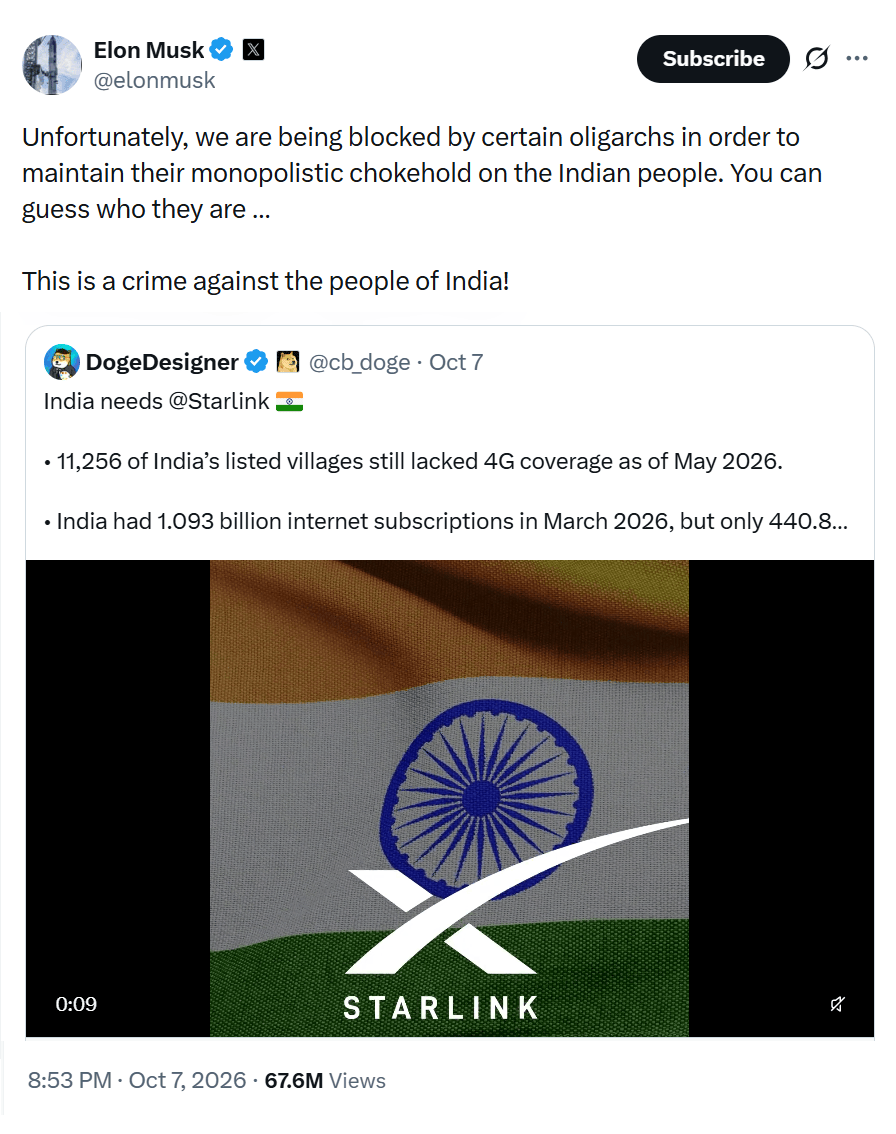
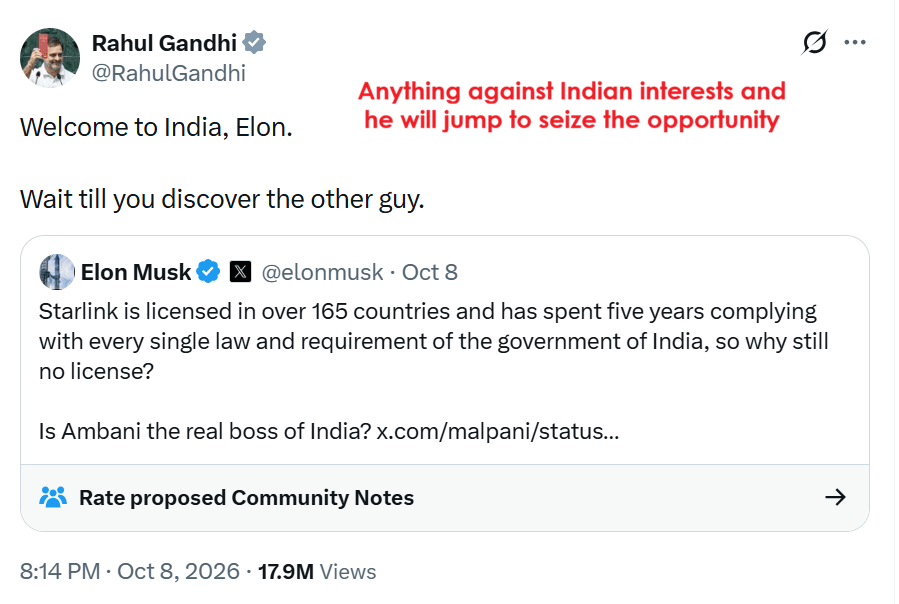
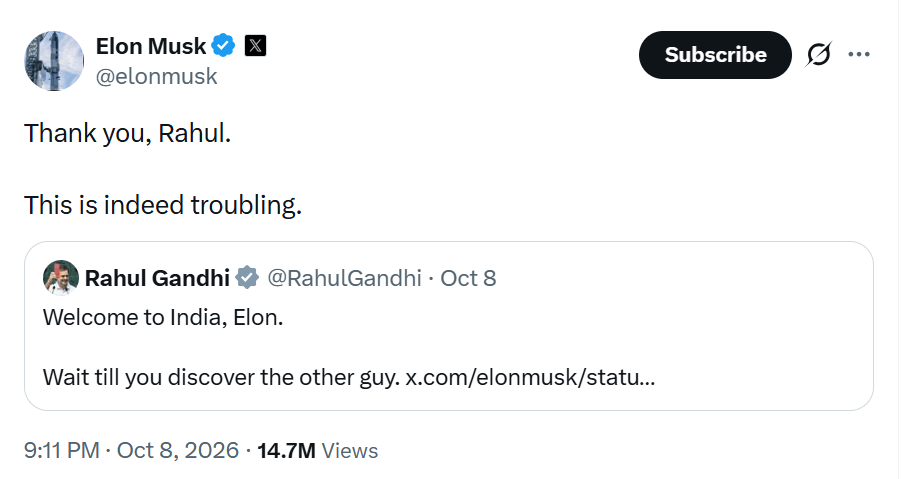
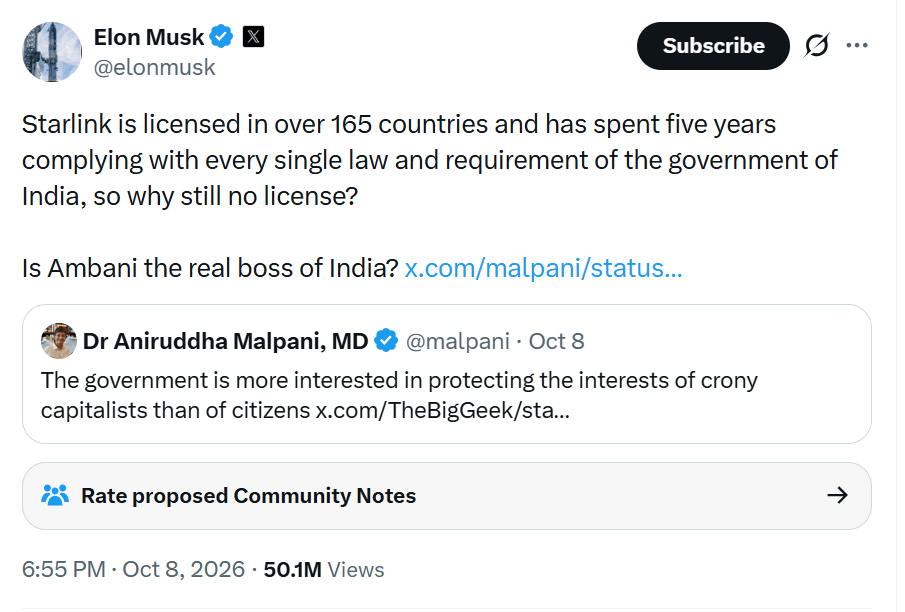
As a common citizen watching our digital landscape evolve, recent media circus kicked off by Elon Musk on X feels deeply unsettling. Musk took to social media to whine about local oligarchs supposedly blocking Starlink entry into our country, throwing a tantrum because his corporate venture faces legitimate regulatory checks. What made this entire episode farcical was the response from our Leader of Opposition, Rahul Gandhi, who jumped into the fray with an imbecile remark telling Musk to welcome him to India and wait till he discovers the other guy. When top constitutional functionaries abandon matters of state sovereignty to score cheap political points alongside a foreign billionaire, it exposes a worrying lack of seriousness regarding our national security.
Regulatory Friction And National Security Worries
The biggest issue raising red flags for our security establishment is control. Unlike traditional telecom providers whose cables, servers, and switches sit firmly on our soil and remain accountable to our laws, satellite networks operate from outer space. This creates a massive blind spot for regulatory enforcement. Critics and policy analysts have frequently pointed out the deep ties between foreign private space ventures and western intelligence or military apparatuses. Handing over critical communication pathways to a system controlled by a foreign billionaire whose erratic behavior is globally known invites unnecessary geopolitical vulnerability.
Real Incidents Close To Home
Authorities recently detected and seized smuggled Starlink terminals utilized by smuggling rings in strategically sensitive Andaman and Nicobar archipelago, prompting a privacy standoff when Indian law enforcement requested user logs and historical usage data to trace the operators, as Starlink reportedly pushed back by citing data privacy policies and directing authorities to route requests through international protocols or U.S. law enforcement. Simultaneously, unauthorized Starlink hardware was flagged and seized by security agencies in Manipur, where security reviews indicated that unauthorized or border-bleeding satellite signals were being eyed by factions seeking to bypass local telecom shutdowns. Although Elon Musk publicly asserted that Starlink beams remain disabled over Indian territory, attributing minor leakages to geofencing limitations near borders like Myanmar, these incidents highlight glaring vulnerabilities regarding grey-market hardware imports. These security concerns are far from theoretical paranoia, evidenced by ground realities such as security forces recovering illicit satellite communication hardware during counter-insurgency operations in sensitive regions like Manipur. Even though heated debates continue over whether those specific terminals were active or actively communicating, the mere presence of such portable, easily concealable foreign-linked terminals in sensitive border zones remains a nightmare for defense forces, as unregulated or poorly monitored satellite links can effortlessly bypass local internet shutdowns and provide rogue or armed groups with secure communication channels right under official noses.
Here is a report from a prominent News Channel
Performance Realities Versus The Rural Coverage Humbug
We are often fed this grand narrative that satellite internet is the ultimate messiah for remote and rural populations. In my view, this entire rural coverage argument is absolute humbug. If we look at mature markets like America, fibre networks wipe the floor with satellite options in terms of raw speed, bandwidth, and stability. Fibre gives consistent gigabit speeds with minimal latency, while satellite connections fluctuate badly depending on weather, line-of-sight obstructions, and network congestion. Claiming that satellite is mandatory for rural upliftment ignores the rapid expansion of our own indigenous optical fibre grids and 5G fixed wireless solutions. Pushing expensive satellite dishes onto everyday rural folk is nothing more than marketing hype for a high-priced niche product.
Cost Comparison With Local Providers
When it comes to pricing, the contrast is staggering and exposes how detached these foreign services are from our economic reality. Local domestic providers like Jio and Airtel offer fibre or fixed wireless connections starting at very affordable monthly rates, often ranging from a few hundred rupees to a couple of thousand for high-speed unlimited data. On the other hand, foreign satellite subscriptions and heavy upfront hardware import costs run into tens of thousands of rupees, translating to thousands of rupees every single month. For an average Indian household, paying many times the local price for inferior or erratic connectivity makes zero economic sense.
Rural Penetration Numbers in US (contradicts to his claim)
Percentage of US Population: Starlink is used by approximately 0.8% of the US population (representing roughly 2.7 million active subscribers or households in a nation of 340+ million people).
Percentage of US Households: In terms of residential broadband connections, Starlink serves around 2% of total US households.
Rural Market Specifics: Over 85% of Starlink’s US user base resides in strictly rural or remote areas where fiber optics and reliable cable infrastructure are absent. In those low-density rural zones, Starlink covers about 3% to 5% of households.
Global Reach Across Licensed Markets
Across the 150+ countries and territories where Starlink holds regulatory approval or commercial licenses, total global adoption stands at approximately 12 million subscribers.
Because the vast majority of these 150+ licensed markets are either small island nations, developing countries with limited purchasing power, or nations with well-established terrestrial fiber grids, penetration rates in individual foreign markets remain very low:
| Market / Region | Estimated Penetration & Reach | Key Characteristics |
| United States & Canada | ~0.8% of population (~2.7M subscribers in US) | Largest market; heavily concentrated in rural off-grid areas. |
| Australia & New Zealand | ~1.0% – 1.5% of population | Strong uptake in remote Outback properties where fiber rollout is unviable. |
| European Union Nations | <0.1% of population | Very low adoption due to dense, affordable fiber networks and strict local regulations. |
| Latin America & Africa | <0.05% of population | Extremely low adoption due to high hardware import costs and subscription fees relative to local incomes. |
| Global Overall (150+ Markets) | <0.15% of total population across licensed regions | Primarily serves specialized niches, maritime vessels, aviation, defense, and remote commercial outposts. |
Cost And Pricing Differences (US Market)
| Metric | Starlink Satellite Internet | Terrestrial Fiber / Cable Internet |
| Upfront Hardware Cost | $349 to $499 (one-time fee for the dish, router, and cables) | $0 (Equipment like gateways/routers are typically included or rented for nominal fees) |
| Monthly Service Fee | Around $120 / month (Standard residential plan) | $35 to $90 / month (Depending on speeds ranging from standard packages to gigabit fiber) |
| Speed & Performance Value | Asymmetrical speeds capping around 100–400 Mbps with variable latency | Symmetrical gigabit speeds (1,000+ Mbps) with ultra-low latency (<15ms) |
The financial math in mature markets heavily exposes the gap, a standard two-year commitment to Starlink totals well over $3,200 to $3,400 inclusive of hardware, whereas reliable high-speed fibre or cable alternatives generally cost half that amount while delivering several times the bandwidth.
Standing Firm On Our Terms

As citizens, we must ask ourselves why we are bending backward to accommodate foreign corporate interests and entertaining ill-advised political commentary when our domestic infrastructure is already reaching our hinterlands securely and affordably. Beyond grave security risks, Starlink is financially completely unaffordable, particularly for the exact rural market that Elon Musk keeps loudly peddling he is seeking to serve. As per Elon Musk’s own product grok, upfront hardware costs is around ₹34,000 and monthly residential subscriptions is ₹8,600 rupees, which locks out the common man and remains a toy for the elite. India does not need a certificate of being an open market at the cost of its security. We do business on our established laws and norms. If you cannot abide by it, be our guest.