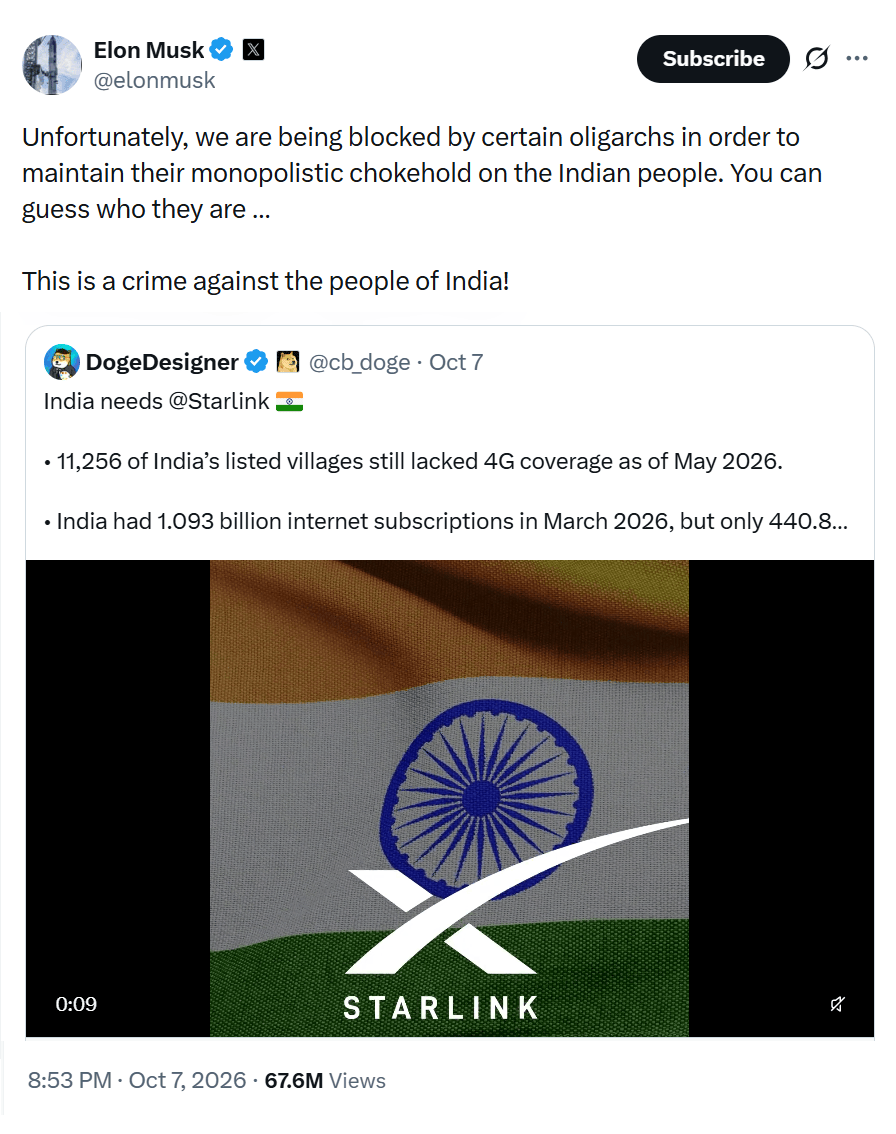
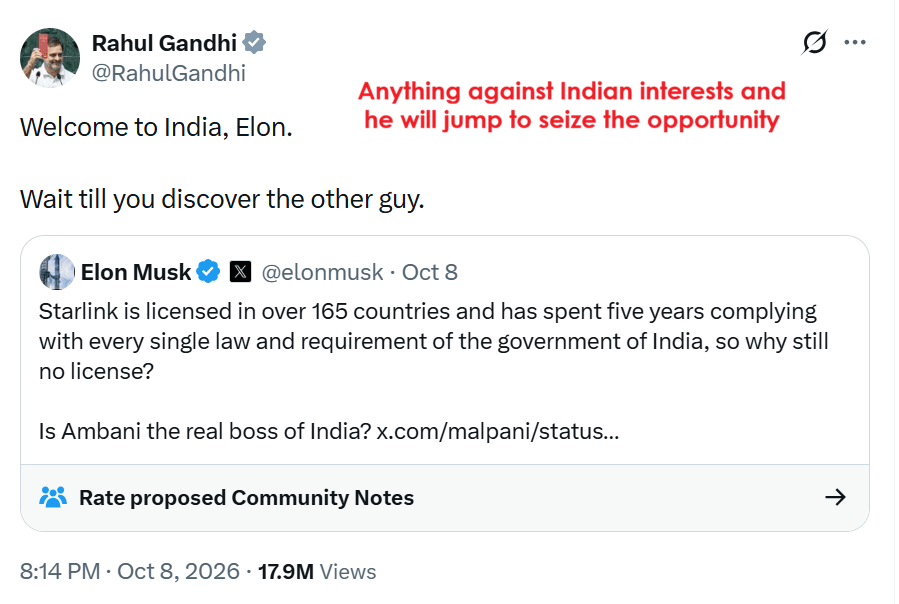
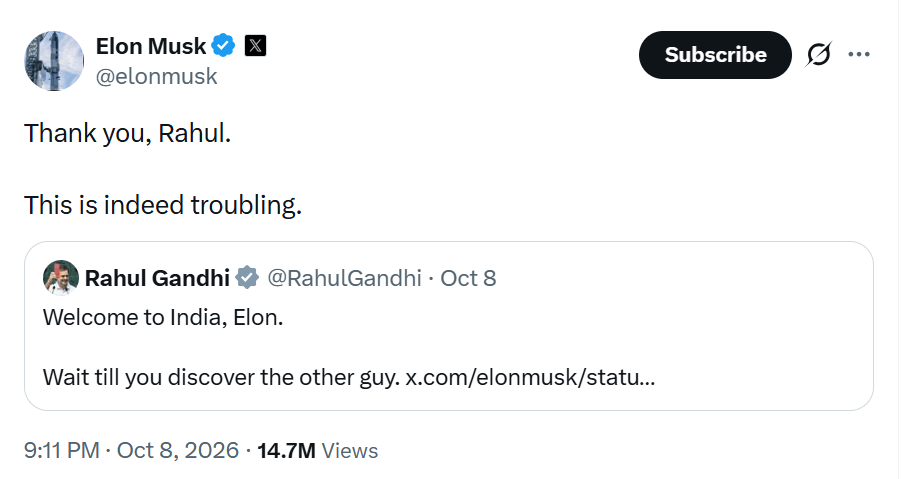
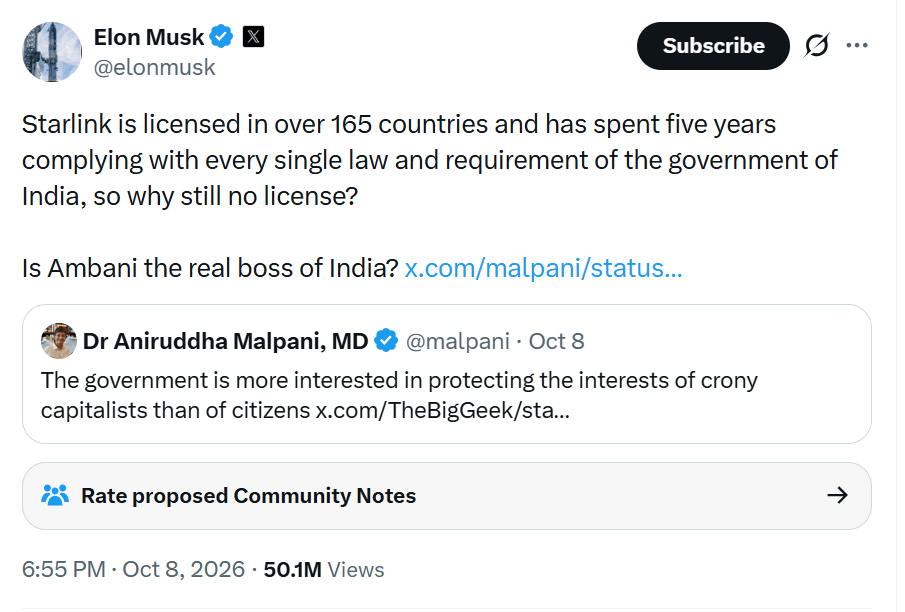
As a common citizen watching our digital landscape evolve, recent media circus kicked off by Elon Musk on X feels deeply unsettling. Musk took to social media to whine about local oligarchs supposedly blocking Starlink entry into our country, throwing a tantrum because his corporate venture faces legitimate regulatory checks. What made this entire episode farcical was the response from our Leader of Opposition, Rahul Gandhi, who jumped into the fray with an imbecile remark telling Musk to welcome him to India and wait till he discovers the other guy. When top constitutional functionaries abandon matters of state sovereignty to score cheap political points alongside a foreign billionaire, it exposes a worrying lack of seriousness regarding our national security.
When a decision is pending, this is a red flag. Attempt to influence – Not happening Man.
Loser did not lose much time – he jumped right onto Anti-India Side as always
And a biscuit was tossed at him as gratitude
He lied here – he already justified why he cannot comply with law in case of Manipur find (read below)
Regulatory Friction And National Security Worries
The biggest issue raising red flags for our security establishment is control. Unlike traditional telecom providers whose cables, servers, and switches sit firmly on our soil and remain accountable to our laws, satellite networks operate from outer space. This creates a massive blind spot for regulatory enforcement. Critics and policy analysts have frequently pointed out the deep ties between foreign private space ventures and western intelligence or military apparatuses. Handing over critical communication pathways to a system controlled by a foreign billionaire whose erratic behavior is globally known invites unnecessary geopolitical vulnerability.
Real Incidents Close To Home
Authorities recently detected and seized smuggled Starlink terminals utilized by smuggling rings in strategically sensitive Andaman and Nicobar archipelago, prompting a privacy standoff when Indian law enforcement requested user logs and historical usage data to trace the operators, as Starlink reportedly pushed back by citing data privacy policies and directing authorities to route requests through international protocols or U.S. law enforcement. Simultaneously, unauthorized Starlink hardware was flagged and seized by security agencies in Manipur, where security reviews indicated that unauthorized or border-bleeding satellite signals were being eyed by factions seeking to bypass local telecom shutdowns. Although Elon Musk publicly asserted that Starlink beams remain disabled over Indian territory, attributing minor leakages to geofencing limitations near borders like Myanmar, these incidents highlight glaring vulnerabilities regarding grey-market hardware imports. These security concerns are far from theoretical paranoia, evidenced by ground realities such as security forces recovering illicit satellite communication hardware during counter-insurgency operations in sensitive regions like Manipur. Even though heated debates continue over whether those specific terminals were active or actively communicating, the mere presence of such portable, easily concealable foreign-linked terminals in sensitive border zones remains a nightmare for defense forces, as unregulated or poorly monitored satellite links can effortlessly bypass local internet shutdowns and provide rogue or armed groups with secure communication channels right under official noses.
Here is a report from a prominent News Channel
A report on where Starlink failed to comply with our laws. They cited US laws for India to get data. He lied in his X post
Performance Realities Versus The Rural Coverage Humbug
We are often fed this grand narrative that satellite internet is the ultimate messiah for remote and rural populations. In my view, this entire rural coverage argument is absolute humbug. If we look at mature markets like America, fibre networks wipe the floor with satellite options in terms of raw speed, bandwidth, and stability. Fibre gives consistent gigabit speeds with minimal latency, while satellite connections fluctuate badly depending on weather, line-of-sight obstructions, and network congestion. Claiming that satellite is mandatory for rural upliftment ignores the rapid expansion of our own indigenous optical fibre grids and 5G fixed wireless solutions. Pushing expensive satellite dishes onto everyday rural folk is nothing more than marketing hype for a high-priced niche product.
Cost Comparison With Local Providers
When it comes to pricing, the contrast is staggering and exposes how detached these foreign services are from our economic reality. Local domestic providers like Jio and Airtel offer fibre or fixed wireless connections starting at very affordable monthly rates, often ranging from a few hundred rupees to a couple of thousand for high-speed unlimited data. On the other hand, foreign satellite subscriptions and heavy upfront hardware import costs run into tens of thousands of rupees, translating to thousands of rupees every single month. For an average Indian household, paying many times the local price for inferior or erratic connectivity makes zero economic sense.
Rural Penetration Numbersin US(contradicts to his claim)
Percentage of US Population: Starlink is used by approximately 0.8% of the US population (representing roughly 2.7 million active subscribers or households in a nation of 340+ million people).
Percentage of US Households: In terms of residential broadband connections, Starlink serves around 2% of total US households.
Rural Market Specifics: Over 85% of Starlink’s US user base resides in strictly rural or remote areas where fiber optics and reliable cable infrastructure are absent. In those low-density rural zones, Starlink covers about 3% to 5% of households.
Global Reach Across Licensed Markets
Across the 150+ countries and territories where Starlink holds regulatory approval or commercial licenses, total global adoption stands at approximately 12 million subscribers.
Because the vast majority of these 150+ licensed markets are either small island nations, developing countries with limited purchasing power, or nations with well-established terrestrial fiber grids, penetration rates in individual foreign markets remain very low:
Market / Region
Estimated Penetration & Reach
Key Characteristics
United States & Canada
~0.8% of population (~2.7M subscribers in US)
Largest market; heavily concentrated in rural off-grid areas.
Australia & New Zealand
~1.0% – 1.5% of population
Strong uptake in remote Outback properties where fiber rollout is unviable.
European Union Nations
<0.1% of population
Very low adoption due to dense, affordable fiber networks and strict local regulations.
Latin America & Africa
<0.05% of population
Extremely low adoption due to high hardware import costs and subscription fees relative to local incomes.
Global Overall (150+ Markets)
<0.15% of total population across licensed regions
$349 to $499 (one-time fee for the dish, router, and cables)
$0 (Equipment like gateways/routers are typically included or rented for nominal fees)
Monthly Service Fee
Around $120 / month (Standard residential plan)
$35 to $90 / month (Depending on speeds ranging from standard packages to gigabit fiber)
Speed & Performance Value
Asymmetrical speeds capping around 100–400 Mbps with variable latency
Symmetrical gigabit speeds (1,000+ Mbps) with ultra-low latency (<15ms)
The financial math in mature markets heavily exposes the gap, a standard two-year commitment to Starlink totals well over $3,200 to $3,400 inclusive of hardware, whereas reliable high-speed fibre or cable alternatives generally cost half that amount while delivering several times the bandwidth.
Standing Firm On Our Terms
He can continue to Cry! What cannot be yours will be denied without any doubt
As citizens, we must ask ourselves why we are bending backward to accommodate foreign corporate interests and entertaining ill-advised political commentary when our domestic infrastructure is already reaching our hinterlands securely and affordably. Beyond grave security risks, Starlink is financially completely unaffordable, particularly for the exact rural market that Elon Musk keeps loudly peddling he is seeking to serve. As per Elon Musk’s own product grok, upfront hardware costs is around ₹34,000 and monthly residential subscriptions is ₹8,600 rupees, which locks out the common man and remains a toy for the elite. India does not need a certificate of being an open market at the cost of its security. We do business on our established laws and norms. If you cannot abide by it, be our guest.
Hollow Core: Why CONgress Continues to Fail the Ballot Test
Spectacle of a leader brandishing a red book might make for a viral moment, but it doesn’t make a government. After 99th electoral loss under Rahul Gandhi’s leadership, message from the Indian voter is loud, clear, and increasingly harsh. Abstract slogans, political theatre, and spewing nonsense doesn’t impress anymore and are no substitute for a roadmap to power. For CONgress, what is known as “crisis of accountability” in Political science, has shifted from a theoretical problem to a terminal one.
Crisis of Accountability
CONgress is currently grappling with a fundamental breakdown in its internal structure. By prioritizing the protection of a few top figures over genuine reform, party has effectively sidelined its most talented grassroots leaders. When primary energy of an organization is expended on defending the senseless and politically useless rhetoric of Rahul Gandhi & Co and their loud mouthed spokespersons whose only day job is to sing paeons of Rahul Gandhi rather than improving its performance, result is a massive drain on the bandwidth required to craft winning, localized narratives.
Absentee Leader and Accountability Gap
Perhaps the most damaging optical failure for the party is recurring image of a seemingly disinterested Rahul Gandhi on the most critical days of the political calendar. While grassroots workers are left to face the brunt of a defeat, he has developed a predictable habit of vamoosing abroad on results day. This pattern strutting through high-profile campaigns, only to vanish to foreign shores when the chips are down, screams of a lack of skin in the game. When a leader is absent during the moment of reckoning, it sends a clear message to the electorate that the battle for India is a part-time pursuit.
“Flash-in-the-Pan” Narratives
A core frustration for the Indian voter is Rahul Gandhi’s habit of raising non-issues that vanish as quickly as they appear. Rahul Gandhi frequently initiates high-decibel campaigns—ranging from the Rafale controversy and the Pegasus row to more recent obsessions like the “merit system” critique or General Naravane’s memoir—only to abandon them the moment they are factually countered or fail to gain traction. This “narrative jumping” leaves the electorate confused and cynical. While these topics might become trending talking points for social media bot accounts and echo chambers, they have a net negative impact on the ground. Real voters prioritize consistent issues like infrastructure and the economy, but they instead witness a leader who treats serious national discourse like a series of experimental hashtags. When the rhetoric shifts every fortnight, the credibility of the message is the first casualty.
Patriotic Pushback
Indian voters today are far from naive; they are a highly patriotic and nationalistic electorate that has fundamentally transformed post-2014. The New India does not take kindly to Rahul Gandhi who runs down country’s democratic institutions or official standing on foreign soil. When Rahul Gandhi embarks on secret sojourns to places like Colombia, Germany, or Vietnam and seeks intervention of foreign powers in domestic affairs, average voter views it as a betrayal of national sovereignty especially considering his mixed parentage. Projecting social faultlines as if they were purely recent creations has backfired spectacularly. Instead of gaining sympathy, these actions have triggered a deep sense of revulsion. Today young voter views the power of the ballot as a means to punish those who appear more comfortable in global echo chambers than in the service of their own nation. In sharp contrast, Narendra Modi has visibly lived and projected an image of a fierce nationalist who consistently demonstrates a “Nation First” approach through decisive actions, from the Balakot airstrikes to the revocation of Article 370. Voters see a Prime Minister who carries the aspirations of 140 crore Indians to the global stage, making the opposition’s habit of projecting social faultlines to foreign audiences appear not just out of touch, but deeply offensive to the national pride.
Death of Pseudo-Secularism
Perhaps most significant tectonic shift CONgress has failed to register is total collapse of its traditional “Secular” brand. For decades, Indian voter watched this brand of politics getting devolved into a tool for cynical vote-bank math rather than genuine inclusivity. This model has now backfired consistently. The electorate has seen through performative tokenism that offered no real empowerment. In sharp contrast, by replacing divisive appeasement with the “Sab Ka Saath, Sab Ka Vikas” framework, BJP has outdone the CONgress model, convincing the masses that development and cultural pride are not mutually exclusive. BJP has effectively dismantled the old guard by successfully establishing a broad Hindu consolidation that transcends caste lines. While CONgress remains trapped in an outdated 20th-century playbook, the voter has moved toward a governance style that feels more authentic and rooted in the national majority’s aspirations. There is a separate section on comparative models towards the end of this piece.
Entitlement Trap and “chINDI” Alliance
Central to the party’s failure is the horribly botched handling of the INDI Alliance partners, fuelled by Rahul Gandhi’s assumed entitlement that he is the leader by default. Instead of a cohesive front, coalition operates more like a collection of rivals who are at each other’s necks during every election cycle. This lack of synergy was on full display during the recent Bengal elections, where Rahul Gandhi’s decision to attack Mamata Banerjee directly paved the way for a humiliating defeat of the alliance partner. When the self-appointed anchor of a coalition spends more time sabotaging its members than building bridges, it is no wonder that critics have rebranded it the “chINDI” Alliance, a fragmented group with no shared vision beyond survival.
Unreliable and Opportunistic Ally
Backstabbers
2026 Tamil Nadu elections served as the ultimate mask-off moment for the CONgress’s Coalition Dharma. Throughout the campaign, CONgress postured as a steadfast pillar of DMK-led alliance, with Rahul Gandhi and Shashi Tharoor aggressively painting Vijay’s Tamilaga Vettri Kazhagam (TVK) as BJP B-Team, lacking grassroots depth. They even weaponized tragic Karur stampede of 2025 to question Vijay’s competence. However, the moment, results revealed a seismic shift, with TVK emerging as the single largest party with 108 seats while a rejected CONgress scraped just 5 seats as a virtual gift from the DMK, the rhetoric vanished.
In a move that DMK spokesperson, Saravanan Annadurai have labeled as backstabbing, CONgress abandoned its trusted partner and the chiINDI alliance to offer conditional support to Vijay to reach the majority mark. This desperate scramble for cabinet berths highlights a blatant hypocrisy. While Rahul Gandhi publicly preached against deriving sadistic pleasure from Mamata Banerjee’s struggles in Bengal, he was privately planning to ditch Stalin the moment a shinier object appeared. The contrast is stark, while =BJP has historically honored mandates, such as insisting Nitish Kumar lead Bihar even when BJP held more seats, CONgress views allies as disposable stepping stones. Voters have realized that while the BJP treats allies as stakeholders, CONgress prioritizes the spoils of victory and its own survival over any sense of consistency or loyalty.
“Glue” vs. Void
There is a prevailing internal argument that the Gandhi Family acts as the glue keeping a faction-ridden party from imploding. However, this raises a vital question. Is it worth running a political party just to survive? Today, CONgress remains intact at the top but is hollowed out at the bottom. Without linking leadership survival directly to electoral performance, evolving a winning strategy is a mathematical impossibility. A party that exists merely to keep a handful of people’s kitchen fires burning cannot expect to compete in a modern democracy.
Mobilization and Fire to Win
There is a stark contrast between BJP’s booth-level mobilization and current state of CONgress machinery. While BJP leaders treat every election with a “fire in the belly” and a genuine commitment to listening to their karyakartas, CONgress leadership especially the blue eyed Rahul andd Priyanka who calls the shots, remains disconnected from the grassroots. People may attend rallies for entertainment, but as the results prove, bandying books and speaking in abstractions does not translate into actual votes at the polling station.
Delusion of Victory in Defeat
A peculiar trend has emerged within the CONgress ranks flowing down from the Top, where party appears contented even in the face of repeated failures. There is a visible high among the rank and file when they celebrate a BJP loss, or even a reduced margin, as if it were a personal victory for their own leadership. This celebratory culture around moral victories is a dangerous distraction, it allows party to avoid painful introspection required after a loss. By finding joy in BJP’s occasional setbacks (so rare now a days considering the CONgress mastery of defeats) rather than their own gains, Rahul Gandhi & Co create a false sense of progress.
Cost of Centralization
Authority in CONgress is heavily centralized, leaving local leadership with almost no power. This top-heavy approach has led to a disastrous exodus of powerful regional satraps who have gone on to form successful parties like the NCP, TMC, and YSRCP, or have joined BJP. For BJP, it is double whammy and victory is twofold, they gain local vote banks, and CONgress loses the pillars that once held its foundation together. Unless CONgress moves from protecting the top to empowering the base, it will continue to be a spectator in the very democracy it once led.
Secularism Schism: Clinical Neutrality vs. Selective Appeasement
The word “Secularism” has become one of the most contested terms in Indian political lexicon. Whether a party qualifies as secular depends entirely on which definition one subscribes to, “separation of religion and state policy” or “equal promotion of all religions.” While CONgress has historically leaned on the latter to justify specific protections, Indian voter has increasingly rejected this model in favour of a more universalist approach.
Definition of Neutrality
True secularism, in its purest spirit, demands separation of faith from state policy. However, for decades, CONgress practiced a form of “Sickularism” that focused on pampering a specific minority i.e Muslims, primarily because they represented a significant vote bank. In contrast, the BJP’s approach of Sabka Saath, Sabka Vikas (Together with all, Development for all) operates on the principle of “justice for all, appeasement of none.” By designing government schemes like Ujjwala, Awas Yojana, or Ayushman Bharat around economic eligibility rather than religious identity, BJP has introduced a clinical, religiously blind form of secularism that removes faith as a filter for welfare which exposed the flawed and failed CONgress model.
Universalism vs. Particularism
When a government moves away from universalism (policies for everyone) toward particularism (policies for specific religions), it triggers a zero-sum perception where one group’s gain is seen as another’s direct loss. CONgress frequently sowed these seeds of division through schemes like special scholarships for one community, 4% reservations for Muslim contractors in government tenders, or the construction of “Shadi Mahals.”
“Sickularism” is an imaginary threat induced to create fear among some in the society, to keep it divided. True secularism is found in universal laws, such as the Uniform Civil Code (UCC) mandated by Article 44 of the Constitution. Advocating for separate personal laws for different religions, as CONgress does, subordinates national identity to religious identity, a practice many now label as Pseudo-Secularism.
Civilizational Correction as Secularism
Critics often label BJP as “Pro-Hindu,” but this is better understood as a much-needed civilizational correction and restoration of India’s indigenous identity, which was suppressed for decades. Indian Voters have increasingly realised that this restoration poses no danger to the secular fabric of the nation. For proof, one only needs to look at the various temple projects undertaken by the current government. Unlike direct monetary handouts to a specific community, these projects are infrastructure and tourism drivers that benefit the entire ecosystem around the site, contributes to the national economy and helps every Indian citizen regardless of their faith.
Responsibility of the Citizen
Ultimately, secularism is the responsibility of every Indian, not just the majority. It cannot be an “affirmative action” program where only one minority i.e. Muslims is the beneficiary of state largesse while being excluded from the duties required to maintain the nation’s secular character. By moving toward a single set of laws governing marriage, divorce, and inheritance for all citizens, the current narrative is shifting the focus back to the individual’s relationship with the state, rather than the state’s relationship with a vote bank.
Drastic Choice: Reform or Relic
Ultimately, CONgress stands at a historical crossroads where path of least resistance leads to total irrelevance. Current trajectory suggests that party has become a vehicle for a single family’s survival rather than a national movement. There is no future for the organization unless it undergoes a radical, systemic overhaul that likely begins with the unthinkable, moving beyond shadow of the Gandhi family. To remain a viable force, CONgress must transform into a truly meritocratic and grassroots-oriented Indian party, one that values electoral performance over lineage and substance over slogans. Until the party finds the courage to decouple its identity from a dynasty that has presided over ninety-nine defeats, it will continue to hollow out, eventually becoming nothing more than a footnote in the history of the democracy it once dominated.
Bottom Line: Regional Erasure vs Kerala Crutch
Recent 2026 assembly elections have once again exposed CONgress party’s dwindling national footprint, masked only by a singular, desperate victory in Kerala. While party celebrates UDF’s return to power in Keralam, broader picture reveals a pathetic performance across several key battlegrounds. In West Bengal, party has been reduced to a literal footnote, securing a mere two seats in a 294-member house, an erasure so complete it signals the end of its relevance in the state. Similarly, in Assam, despite high-decibel campaigns, party trailed far behind the BJP, failing to stop the NDA from securing a record victory and historic third term.
In Tamil Nadu and Puducherry, the story was no different. In Tamil Nadu, CONgress remained a junior, almost invisible partner, managing only five seats as state’s political landscape was upended by the dramatic debut of actor Vijay’s TVK. In Puducherry, NDA comfortably retained power, leaving CONgress with negligible gains. Irony is palpable, Rahul Gandhi and co, appears happy and contented with a coalition victory in Kerala, using it as a crutch to deflect from the fact that they have been nearly wiped off the map in Bengal, TN, and Assam. This tendency to treat a lone regional win as a national vindication only proves CONgress ‘s growing comfort with mediocrity, even as its foundation crumbles across the rest of the country.
An important observation that proves the point being made earlier on Secularism is the results from Assam Assembly elections which has provided perhaps the most stark evidence yet of CONgress party’s tactical retreat into a specific religious corner. In a house of 126 members, CONgress managed to secure only 19 seats, but demographic breakdown of these winners is what has sent shockwaves through political landscape: 18 out of the 19 newly elected CONgress MLAs are Muslims. Out of the 79 non-Muslim candidates the party fielded across the state, a staggering 78 were rejected by the voters, leaving only one Hindu representative to carry the party flag in the assembly. This outcome is not merely an electoral loss, it is a total collapse of the party’s claim to being a broad-based, inclusive platform in the Northeast. By fielding 20 Muslim candidates and seeing 18 of them win, CONgress achieved an incredibly high conversion rate within a single community, while simultaneously becoming untouchable for the state’s majority population. Data suggests that while CONgress was busy playing Religion Card to consolidate a specific vote bank, it effectively abdicated its role as a representative of the indigenous Assamese identity. From the BJP’s perspective, the narrative of CONgress being a “Muslim League 2.0” has been validated not by rhetoric, but by the party’s own winner’s list.
The text as received from Adv Shri Anil Kumar Kappilil, a practicing lawyer from Kochi. Who is responsible for Rahul Gandhi‘s disqualification? Not Narendra Modi ji, not Judiciary, not BJP.
It is CONgress and only CONgress which is squarely responsible .
The Only Truth on his Twitter account
CONgress knew that Rahul is a political liability. They encouraged him to speak utter nonsense against anything & anyone. Lacking common sense & good judgement they knew he would utter nonsense and one day land himself in trouble.
Extinct CONgress means end of career politricksters who once thrived during CONgress rule. They knew Rahul cannot be removed, sacrilege to even think removal of CONgress supremo Sonia’s son and with him around, it was certain that 2024 is the END!
This could well be their sinister plan to fix the thorn in the CONgress neck by sending him to jail and bank on sympathy for the party. It is not new for CONgress – in the past has successfully executed various unscrupulous strategies to grab power.
The cause and reasons for the assassinations of Rahul’s father and paternal grandma still remain unknown. But the effect we saw in both incidents is that they brought the Congress party back to power when it was almost got extinct.
Disqualification from Parliament in view of conviction in a criminal case for defamation is not political but legal issue. He should introspect that current hullabaloo of his party against Government is not going to go down well with people of India.
Clearly , Action as a result of a legal order
Some Congress leaders, kitchen cabinet of Sonia has portrayed Rahul as political incompetent systematically over time. Same coterie did to Rajiv in Bofors scam & IPKF that failed in Sri Lanka. Rajiv was nothing less than a politically naive person.
She should have completed this – A rap on his skull
Sonia and Rahul must be wary about the sinister games of the charlatans in their own party and the rants against Modi government are not going to get them back anywhere near to power again
Why is Sonia not realising this?
1. Sonia is not Indian culturally & emotionally to understand Indian political dharma sutras of Chanakya. Politics of Dharma is the core Indian Psyche and it is powerfully embedded in Indian culture and civilization.
2. She has no knowledge of the language of the majority Indians. Reading a scripted text has no emotional involvement which is exposed.
Inability to read Indian Pulse
3. Trust deficit. Sonia and her family that has made Congress a private enterprise has lost trust of Voters.
4. Out of 150 crore Indians, almost 130 support Narendra Modi because He speaks his heart extempore (and some think Teleprompters make one so talented to make such passionate presentation) followed by concrete actions.
And People are still searching for a Teleprompter – If you heard this address in Ayodhya, any True Hindu would know
Yes. Political illiteracy and sheer incompetence of Sonia & Co is no alternative for a leaping lion like India. People knew it a decade ago. And even your one time close aide Chiddu endorsed it too recently
India is Bharat and a Hindu Rashtra. More emotionally intelligent and competent than all super powers put together.