Knowledge vs Skills
Knowledge is theoretical understanding acquired through reading, listening, and observation. It resides in the mind as information, concepts, and facts. Skills represent the practical ability to execute a task repeatedly with precision and efficiency under real operational constraints. While knowledge answers what and why, skill answers how. Knowing Kirchhoff’s laws, understanding metallurgical phase diagrams, or reading a textbook on CNC programming is knowledge. Wiring an industrial control panel without loose terminals, reading subtle chatter marks on a workpiece, or calibrating a five-axis machine on a busy Peenya shop floor is a skill. An engineering graduate can memorise an entire thermodynamics manual without developing the muscle memory, sensory intuition, or situational judgement required to troubleshoot an actual boiler failure during a midnight shift.
Training vs Education & Role of TVET
Education focuses on broad intellectual development, critical thinking, and foundational theory over long timelines. Training is targeted, intensive, and outcome driven, designed to build specific competencies required for immediate workplace application. Technical and Vocational Education and Training bridges these two worlds by combining essential theoretical principles with rigorous hands-on practice. True TVET prepares learners for real industrial environments, ensuring they possess both the cognitive grasp of their trade and the physical dexterity to deliver results from their very first day on the job. In India, models like the Dual System of Training (DST) partnered with Indo-German chambers and captive industry academies demonstrate how deep shop-floor immersion creates technicians whom employers hire immediately without needing remedial bootcamps.
Real Industry Readiness
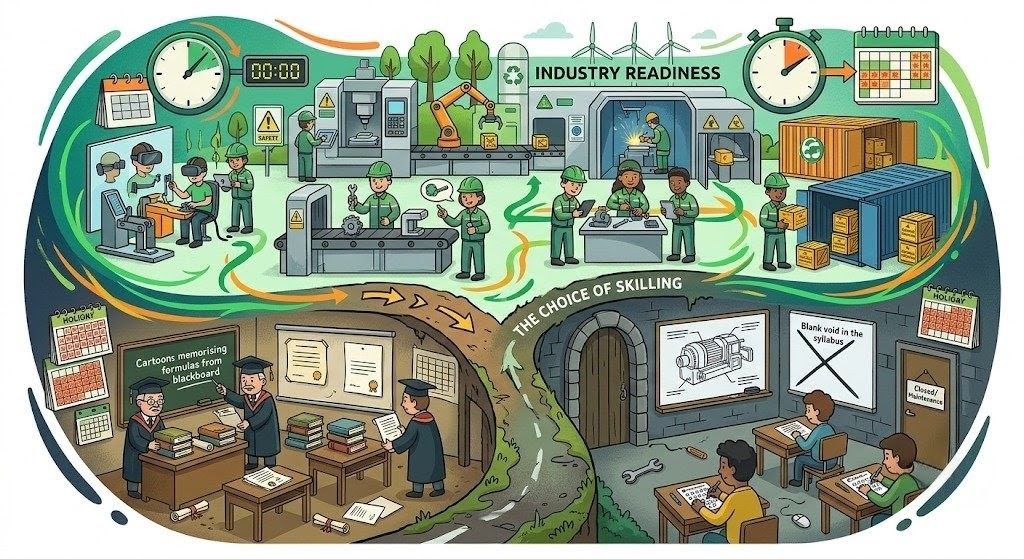
Industry readiness extends far beyond basic technical competence on a machine or software tool. Modern manufacturing plants, logistics hubs, and service enterprises operate on tight schedules, lean margins, and strict safety protocols. Being ready from day one requires conditioning trainees to workplace realities that traditional classrooms never simulate. It demands significantly longer working hours compared to conventional colleges, mirroring actual eight-hour industrial shifts rather than four-hour lecture days. It requires a sharply reduced number of vacations, with leave being entirely planned, documented, and pre-approved just as it is on a real production line. Equally vital are non-technical workplace behaviours such as unyielding discipline, sharp punctuality, cross-functional teamwork, shop-floor housekeeping, safety compliance, and professional etiquette. A technician who knows how to operate a press brake but lacks shift stamina, struggles with team coordination, or treats timelines casually becomes a liability on day one.
Retrograde Shift in Legacy Institutions
Globally, economies are pivoting toward competency based TVET to solve acute talent shortages. Yet several legacy skill development institutions in India are moving in the opposite direction. Driven by a desire for academic parity and National Education Policy credit equivalence, many state polytechnics, older Industrial Training Institutes (ITIs), and legacy vocational boards are forcing practical skill programmes into archaic university frameworks. In doing so, they have systematically diluted the very rigour of the old model that once made them brands to reckon with. Practical workshop hours are steadily slashed to make courses appear easier and more attractive to incoming students, while the curriculum shifts toward classroom lectures and semester theory exams. Instead of investing effort in recruiting and grooming master trainers to teach critical, complex trade topics, institutions take the convenient shortcut of deleting those vital subjects from the syllabus altogether. Assessment standards have been watered down through increased examination attempts designed to force a pass rather than verify genuine mastery. Slowly but surely, what used to be uncompromising shop-floor conditioning is being reduced to rote learning, the very bane of our conventional education system.
Cost of Comfort Over Readiness
The justifications offered for this academic drift often revolve around institutional convenience rather than learner success. Administrators point to formal degree or diploma equivalence, reduced working hours, lighter faculty workloads, and extended university-style summer and winter holidays as markers of progress. In reality, replicating the comfort of traditional colleges directly undermines every pillar of industry readiness. Unplanned breaks, short academic days, and lax attendance norms erode the stamina, punctuality, and shift-work resilience that Indian manufacturing, automotive, and electronics hubs demand. When a skill institute adopts the calendar and pedagogy of an outdated academic system, it inevitably produces the exact same outcome, namely certified diploma and degree holders who still require six to twelve months of basic retraining and behavioural conditioning at centres like the Toyota Technical Training Institute (TTTI) or Bosch Vocational Centre before touching live production lines.
Reclaiming Industry Readiness
Paper credentials cannot substitute for competence and workplace maturity on the factory floor or in a service environment. India’s ambition to become a global manufacturing and Global Capability Centre powerhouse cannot rest on degree-chasing vocational institutes that shelter students from industrial reality. If legacy organisations continue prioritising UGC-style equivalence and institutional leisure over hands-on mastery and behavioural rigour, they risk rendering themselves obsolete while failing the youth they claim to empower. True skill development requires full immersion, long hours of deliberate practice on modern machinery, planned leave discipline, and assessments rooted in real-world performance and workplace conduct rather than memory recall.