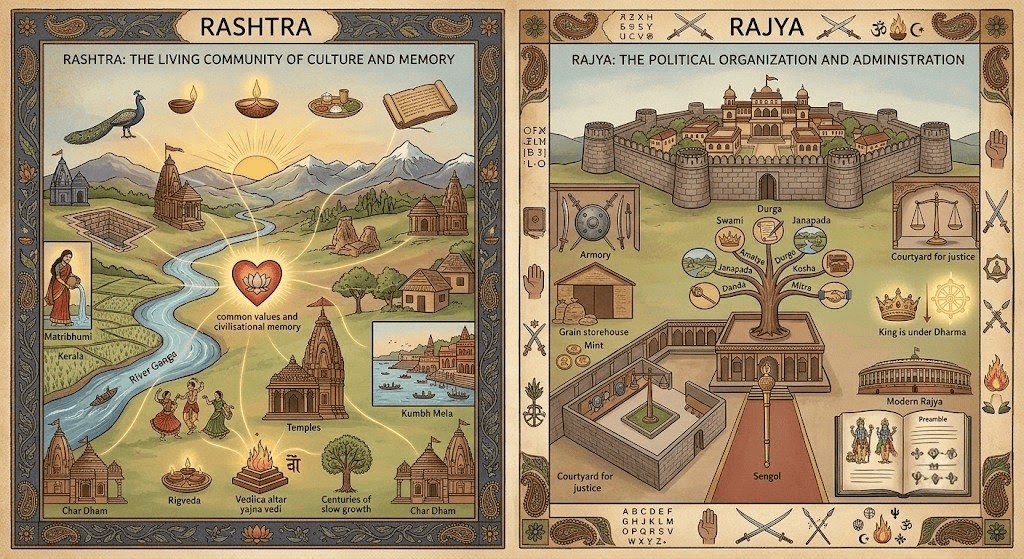
When we say nation in English, we usually mean country with borders, government, flag and army. This idea came to India through colonial education, and many of us now use it without thinking. Bharatiya tradition however has its own vocabulary to speak about people, land, culture and political authority. Two words are central here, Rashtra and Rajya. They are often used as if both mean same thing, but in traditional Bharatiya political philosophy they point to different realities. Understanding this difference helps us read our history better and also helps us understand many debates in India today.
Based on my learnings from various Nationalists and Indian Knowledge System Pandits, sharing how Bharatiya thought defines nation and nationhood, how this differs from Western definitions, and how Rashtra differs from Rajya. Real life examples are given with each idea so that concepts do not remain abstract.
Meaning of Rashtra and Rashtriyata
Rashtra is a Sanskrit word with Vedic origin. It refers to a living community of people who share land, culture, memory and values, and who feel that they belong together. Rashtriyata is nationhood, that is, the feeling and consciousness of being one people. It is not created by a treaty, a constitution or a ruler. It grows slowly over centuries through shared way of living.
In this view, Rashtra is geo-cultural. Land matters, but land alone does not make Rashtra. People matter, but people alone do not make Rashtra either. Land, people and culture together, joined by common values and civilisational memory, form Rashtra. Many thinkers say Rashtra is like body and soul together, where Rajya is only the outer organisation that looks after it.
A useful example is how Indians speak about their land. Bharat is called Matribhumi and Punyabhumi, motherland and holy land. A farmer in Punjab and a fisherman in Kerala may speak different languages and follow different customs, but both bow to river water, both celebrate harvest festivals and both recite stories of Bhagawan Shri Ram and Bhagawan Shri Krishna in their own tongue. This shared inner life, not a passport or a flag, is Rashtriyata in Bharatiya sense.
Vedic Roots of Nationhood
Vedic texts speak of Rashtra with great seriousness. Yajurveda has a well known prayer asking that we remain awake and alert for the sake of Rashtra. Rigveda, in Devi Sukta, speaks of Devi as Rashtri, the one who gathers and holds together all wealth. Atharvaveda has Bhumi Sukta, a long hymn which says Earth is mother and I am her child. This hymn does not see land as property to be owned. It sees land as mother to be served. Here, love for land and responsibility towards fellow citizens come together.
Vishnu Purana gives a clear geographical and cultural description. It says that land lying north of ocean and south of Himalayas is called Bharatavarsha and its people are Bharatiya. This verse was composed long before modern maps or modern states. Pilgrim routes, Sanskrit learning and epics had already given people a sense that one land is home.
Cultural Geography in Daily Life
Bharatiya nationhood is visible in sacred geography. Char Dham in Badrinath, Dwarka, Puri and Rameswaram, twelve Jyotirlinga, fifty one Shakti Peetha and seven sacred cities are spread across entire subcontinent. A pilgrim from Tamil Nadu walks to Kashi, and a pilgrim from Assam travels to Rameswaram. Adi Shankaracharya, born in Kerala, established four Mathas in four corners, at Sringeri, Dwarka, Puri and Jyotirmath, and walked across Bharat debating scholars. Nobody ordered this. No king had to enforce it. Culture itself bound people together.
Kumbh Mela is another example. Crores of people from different languages, castes and regions gather at Prayagraj, Haridwar, Ujjain and Nashik without any invitation by government. Sages, farmers, traders and householders all come because of shared faith in tradition. Kashi Tamil Sangamam, organised in recent years, built on same old links between Kashi and Tamil lands that were maintained for centuries.
Western Definitions of Nation
Western idea of nation developed in specific historical conditions. After Treaty of Westphalia in 1648, Europe moved towards sovereign territorial states. Later, French Revolution tied nation to citizenship and popular sovereignty. German thinkers like Herder stressed language and folk spirit, while Italian leader Mazzini linked nation to self-rule. Ernest Renan in 1882 described nation as a daily plebiscite, meaning a group that wills to live together. Max Weber defined state as institution holding monopoly on legitimate use of force over a territory. Benedict Anderson later described nations as imagined communities, produced through print, newspapers and common language.
In most of these definitions, nation and state are closely linked. Nation seeks a state, and state tries to build one nation. Territory, sovereignty, law and common citizenship become central. Western history also shows that this model was often built through standardising language, suppressing local identities and fighting wars with neighbours. Two World Wars grew out of rival nationalisms. Colonial expansion by European nation-states in Asia and Africa was also driven by this competitive model.
Contrast Between Bharatiya and Western Views
First difference is origin. Western nation is largely modern, tied to rise of state in Europe from sixteenth and seventeenth centuries. Bharatiya Rashtra is traced to Vedic period and is seen as civilisational, existing long before any modern state.
Second difference is relation with political power. In West, nation usually depends on state for protection and expression. In Bharatiya view, Rashtra continues even when Rajya changes or collapses. Maurya, Gupta, Chola, Vijayanagara, Maratha and Mughal rule came and went, and then British rule came and went, yet Bharat as cultural entity continued.
Third difference is basis of unity. Western models often seek unity through sameness of language, ethnicity or citizenship. Bharatiya thinking accepts diversity as natural and looks for unity within it. Same Rashtra holds Tamil, Bengali, Marathi and Dogri speakers, worshippers of Shiva, Vishnu, Devi, Buddha and Mahavira, and also those who follow Islam, Christianity and other paths. Idea of unity here is that diversity is expression of one underlying whole, not a problem to be removed.
Fourth difference is attitude to others. Many Bharatiya writers argue that Rashtra was never meant to expand over others or to impose itself. Shri Krishna Deva Raya or Chola kings did conquer and build influence, but Bharatiya tradition of Dharma Vijay, victory with righteousness, as seen in Emperor Ashoka’s turn after Kalinga, shows an ideal where power is limited by ethics. Ancient Bharat also gave refuge to Parsis and Jewish communities, and this is often cited as living proof of this attitude.
Rajya in Bharatiya Philosophy
Rajya refers to political authority and its machinery. It means state, kingdom, government, administration, army, treasury and courts. Its purpose was to protect people and enable them to follow Dharma. Raja was not owner of land or people. He was a trustee whose duty was Rajadharma, which means to protect, to be just and to promote welfare of subjects.
Kautilya in Arthashastra describes Rajya through Saptanga theory, seven limbs of state. These are Swami or ruler, Amatya or ministers, Janapada or territory and people, Durga or fort, Kosha or treasury, Danda or force and Mitra or allies. This is a practical and almost scientific description of state. Mahabharata, especially Shanti Parva, gives equal stress to ethics of rulership. Bhishma instructs Yudhishthira that a king who does not protect his people has failed in duty. Ramayana presents Ram Rajya as ideal, where ruler places public good above personal happiness. Maharshi Valmiki shows Bhagawan Shri Ram giving up his beloved Devi Sita for sake of Rajadharma, which is an example of how heavy this duty was considered.
One striking idea is that Rajya itself is under Dharma. In Bharatiya thought, King is not source of law. Dharma is higher than king. Even Raja can be corrected by rishis, by assemblies like Sabha and Samiti and by public opinion. Story of Vena in Puranas, a king removed by sages for turning unjust, is often cited here.
Difference Between Rashtra and Rajya
Rashtra is permanent while Rajya is changing. Rashtra is cultural and moral while Rajya is political and administrative. Rashtra is about who we are, and Rajya is about how we are governed. Rashtra is like soul and Rajya is like body, which is a comparison often repeated by scholars and writers. Rashtra is not created by anybody, while Rajya is created, improved, replaced or destroyed.
Another difference is purpose. Rashtra exists to express and preserve civilisational values and to give each person a sense of belonging. Rajya exists to provide security, justice, order and welfare so that these values can be lived. If Rajya works well, Rashtra flourishes. If Rajya turns unjust, it harms Rashtra, and tradition then expects people and wise leaders to correct it.
It is also important to note that ancient texts do not always keep these two completely apart. In Ramayana, Queen Kaushalya says that due to exile of Ram, both Rajya and Rashtra would suffer. In Mahabharata, Yudhishthira speaks of regaining both after exile. Scholars like Ranga Hari point out that in early texts these two concepts overlapped in usage, and clear separation developed more in later reflection. So distinction is best understood as difference of function and depth, not strict division in every text.
Role of Dharma as Link
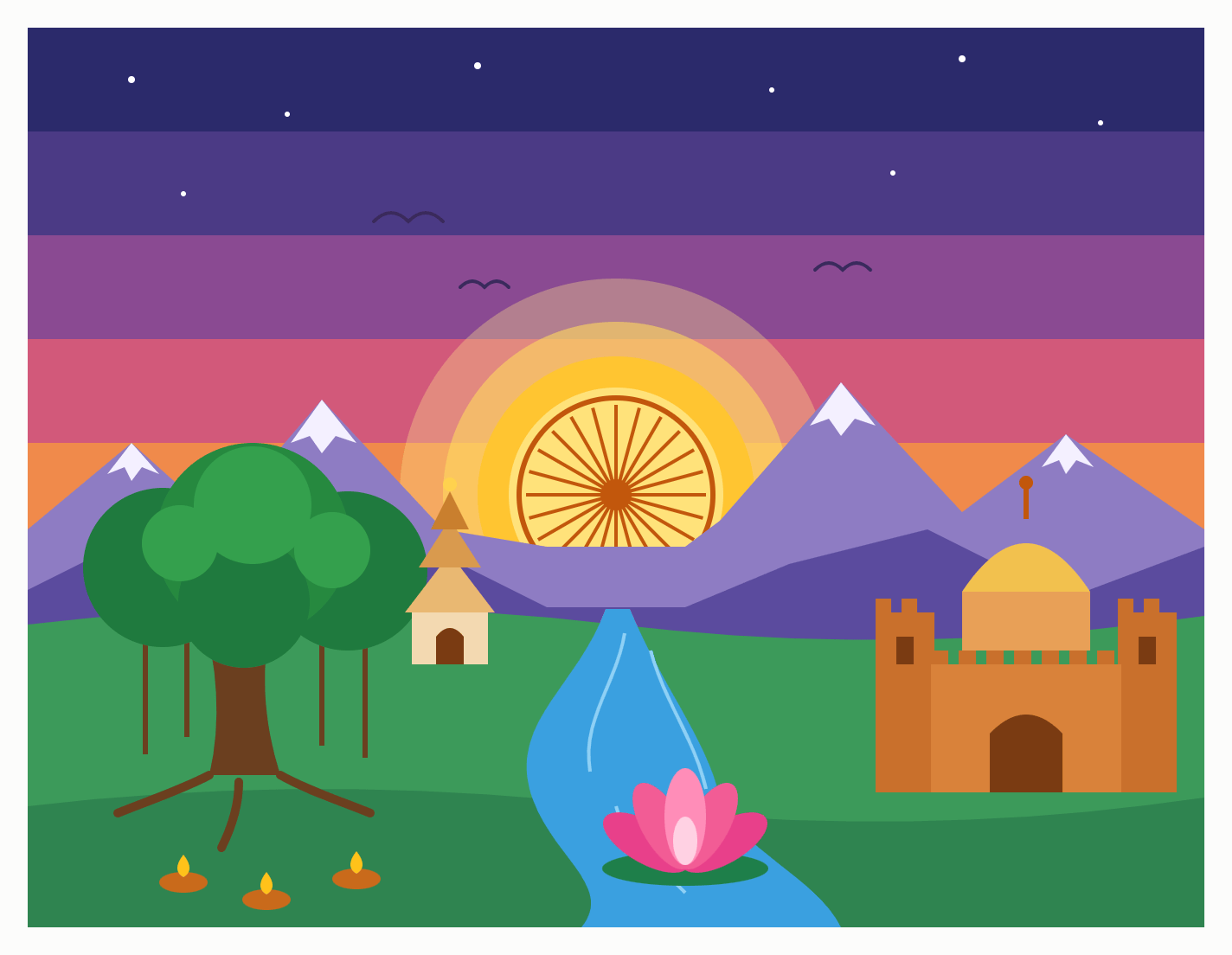
Dharma connects Rashtra and Rajya. Dharma here does not mean religion in narrow sense of worship or belief. It means moral order, duty and right conduct that holds society together. Rajya must follow Dharma, and Rashtra expresses Dharma. When ruler acts according to Dharma, Rajya and Rashtra move together. When ruler acts against Dharma, tension appears.
Real Life Examples of Rashtra and Rajya
Chandragupta Maurya and Chanakya
Chanakya did not create Rashtra. He understood that Bharat already existed as cultural and geographical reality, but it was divided under many small Rajyas and exposed to foreign invasion after Alexander’s campaign. His project was to build a strong Rajya that could protect and unify this Rashtra. This shows both concepts clearly. Rashtra was already there, and Rajya was the instrument.
Chhatrapati Shivaji Maharaj
Shivaji Maharaj established Hindavi Swarajya in seventeenth century at a time when Mughal and Sultanate Rajyas dominated most of Bharat. He built administration, navy, forts and revenue system, which is Rajya building. Yet his coronation at Raigad in 1674 was conducted with Vedic rites by Pandit Gaga Bhatt, and he spoke of protecting dharma, cows, Brahmins and temples along with all subjects. Here a new Rajya was made to serve an older Rashtra.
Survival under British Rule
British Rajya controlled Bharat for nearly two centuries. It changed laws, education and economy. Still, Rashtra did not disappear. Festivals like Ganeshotsav, made public by Lokmanya Tilak, Vande Mataram sung from Bankim Chandra Chatterjee’s Anandamath, and Swami Vivekananda’s speeches kept Rashtriya consciousness alive. Freedom movement was in essence an effort to bring Rajya in line with Rashtra.
Integration of Princely States
In 1947, there were around 565 princely states. Sardar Vallabhbhai Patel, with V. P. Menon, persuaded most to join Union of India, and used firm measures in cases like Hyderabad and Junagadh. His work was about building one Rajya for people who already felt as one Rashtra. Same Somnath temple he asked to be rebuilt after independence became a symbol of Rashtra’s resilience.
Partition of 1947
Partition shows that Rajya boundaries can change dramatically. Lines were drawn at Punjab and Bengal and new states came up. Yet shared culture, food, music, language and family ties across borders continued. Many people on both sides still feel this inner link. This example is used by thinkers to show that political borders do not fully define nationhood.
Constitution and Its Spirit
Constitution of India adopted in 1950 is a foundational document of Rajya. It sets up Parliament, courts and executive, and guarantees rights. Many Bharatiya thinkers see in it values that match Rashtra, such as plurality and justice, while some argue that its structure follows Western models too closely. Placing of images from Ramayana, Mahabharata and Vedic period in original Constitution pages, drawn by artists of Shantiniketan under Nandalal Bose, is often cited as sign of Rashtra’s presence in Rajya’s founding document.
Emergency of 1975 to 1977
During Emergency, Rajya used its power to suspend civil rights and press freedom. Public resistance and eventual electoral defeat in 1977 are cited as example of Rashtra correcting Rajya, an idea close to older view that Rajya is answerable to Dharma and people.
Sengol in New Parliament
In 2023, Sengol, a sceptre linked with Chola tradition of righteous rule, was installed in new Parliament building. Supporters see this as modern Rajya acknowledging old Rashtra values of Rajadharma. Critics ask whether such symbolism is needed in a secular republic. This debate itself shows how question of relation between Rashtra and Rajya remains alive.
Hindu Rashtra and Secular Rajya
Leaders like Atal Bihari Vajpayee used this framework to say that Bharat is a Hindu Rashtra in cultural sense, but state should be non-partisan and treat all citizens equally. V. D. Savarkar and others developed similar thinking. Supporters say this reconciles cultural identity with equal citizenship. Critics argue that using the word Hindu for nationhood can make citizens of other faiths feel excluded, and that Constitution already defines nationhood through equal citizenship. Readers should study both sides.
Other Views and Debates
Not all scholars accept this framework as presented. Some historians say that pre-modern Bharat had strong cultural unity but no single political idea of nation as understood today, and that reading modern nationhood into ancient texts is anachronistic. Dr. B. R. Ambedkar, in his final speech in Constituent Assembly, warned that Bharat was still a nation in making and caste divisions were serious obstacle. Rabindranath Tagore was critical of narrow nationalism and stressed universal humanism. Jawaharlal Nehru in Discovery of India described Bharat as a palimpsest of many layers, where unity came from shared experience over time. Constitutional thinkers stress that citizenship, and not culture or religion, is legal basis of nationhood in Bharat today.
Many writers who support Bharatiya framework in turn reply that these views also accept deep civilisational unity, and that what is needed is better language to describe it than imported words. Sources used for this article include writings from RSS affiliated authors, academic course material from University of Delhi, and articles on Rajya and Rashtra distinction, so reader should also look at other perspectives for balanced understanding.
Conclusion
Bharatiya definition of nation rests on Rashtra, a living cultural and spiritual community bound to land and shared values, expressed through Rashtriyata or nationhood. Western definitions emphasise sovereignty, territory, language and citizenship, and tie nation closely to state. In Bharatiya tradition, Rajya is institution that governs and protects, answerable to Dharma, while Rashtra is deeper identity that outlives every dynasty and government. From Chanakya to Shivaji Maharaj, from Sardar Patel to modern Parliament, examples show how Rajya has repeatedly been built, changed and judged by its service to Rashtra. Whether one fully agrees with this framework or not, it gives a rich way to understand Bharat on its own terms and not only through borrowed categories.