Fix the Roots, Not the Leaves – Pharmaceutical Skill Scarcity

Pharma’s Talent Crisis–Basic Skills Problem

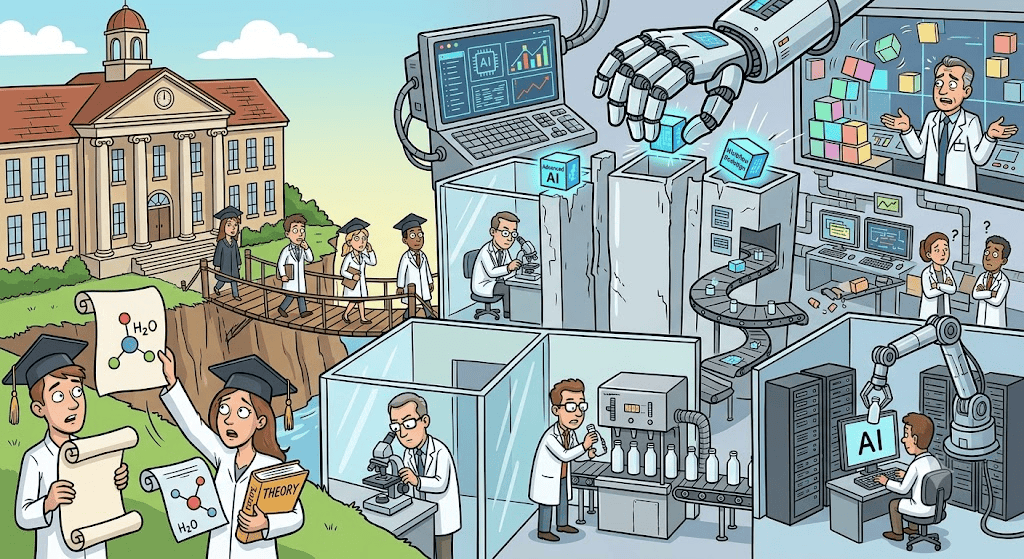
Pharmaceutical industry is consumed by a single narrative, it is facing a crippling talent shortage driven by the rapid rise of artificial intelligence, advanced biologics, and shifting global regulations. Industry reports and corporate leaders frequently point to an acute lack of specialized AI engineers and computational experts. The prescribed solutions are equally grand, focusing on massive technology investments and complete organizational overhauls.

However, blaming the talent crunch on a missing class of high-tech specialists oversimplifies a far more fundamental reality. The crisis in the pharmaceutical labour pool is not primarily about advanced algorithms or organizational charts. It is rooted in a severe deficit of basic scientific and analytical skills among fresh talent, compounded by outdated university curricula, superficial corporate training programs, and hyper-siloed organizational structures.

Outdated University Curricula

The baseline skill gap begins in higher education. Pharmacy and life sciences curricula at most universities remain heavily theoretical, relying on rote memorization and memory-based examinations centred on legacy textbook concepts. While the modern industry has shifted toward complex biologics and digital quality control, fresh graduates continue to leave academia with little to no exposure to commercial-scale manufacturing realities.

Moreover, academic institutions rarely teach critical regulatory frameworks like Good Manufacturing Practices (GMP) or Good Laboratory Practices (GLP). Graduates arrive on the factory floor or in research labs without understanding data integrity, electronic batch records, or audit trails, areas where a single documentation error can invalidate an entire clinical trial. Combined with a lack of training in basic data hygiene and practical troubleshooting, entry-level candidates frequently lack the foundational discipline required for modern life sciences work.

Hyper-Specialization and Structural Silos

Pharma companies themselves are also heavily to blame for deepening this crisis. For decades, the industry has compartmentalized its workforce into narrow, highly specialized silos. Organizations systematically cultivate talent optimized for narrower and narrower job specifications, creating wet-lab scientists, regulatory writers, or clinical trial managers who operate entirely in isolation.

This hyper-specialization creates a severe blind spot, individual experts often have no clue how adjacent functions operate. A biologist may design a molecule without understanding regulatory submission requirements, while a data scientist builds predictive models without grasping basic wet-lab constraints. By actively breeding single-track specialists, pharma companies have systematically destroyed cross-functional baseline literacy, making interdisciplinary collaboration nearly impossible when new technologies arrive.

Corporate Skilling Programs

Faced with unprepared and siloed recruits, pharmaceutical companies often point fingers at external talent pipelines while ignoring the flaws in their own internal upskilling efforts. However, a major part of the failure stems from a fundamental disconnect in role and capability: pharmaceutical corporations are in the business of developing and manufacturing Active Pharmaceutical Ingredients (APIs), generics, biosimilars, vaccines, OTC products, and novel therapeutics. They are drug developers and commercial manufacturers, and not, and should not be expected to be, experts in pedagogy or foundational education.

When businesses attempt to act as primary educators, their internal training programs inevitably devolve into superficial, tool-focused workshops designed to teach specific software or immediate task execution quickly. These programs fail because corporate instructional design lacks the pedagogical rigor required to build deep cognitive capabilities from the ground up. Attempting to layer complex AI tools onto a workforce lacking solid functional grounding cannot succeed when short-term corporate training is substituted for true foundational learning. Rather than investing in rigorous instruction around core problem-solving, basic data interpretation, and cross-functional processes, businesses run short-term courses on the latest digital platforms. Upskilling cannot succeed when the underlying scientific and operational foundation is shaky.

Fix Flawed Fundamentals

The prevailing argument that pharma needs total operational redesign assumes that the workforce possesses the basic competence needed to execute within new structures. Connecting R&D, manufacturing, and regulatory teams inside integrated operating environments sounds promising on paper. However, if the individuals inside these connected structures struggle with basic data analysis, lack broad process awareness, and remain trapped in specialized mindsets, structural realignment merely speeds up the transmission of basic errors across the entire value chain.

The pharmaceutical sector must move past the rhetoric of an “AI skill deficit” and look closer at its foundational pipeline. Until universities modernize their practical labs and integrate regulatory standards, and until pharmaceutical firms break down hyper-specialized silos to prioritize broad functional rigour, deploying advanced technology will do little to solve the industry’s real productivity challenges.
Parama Ekadashi: Gateway to Prosperity & Liberation

शान्ताकारं भुजगशयनं पद्मनाभं सुरेशं
विश्वाधारं गगनसदृशं मेघवर्णं शुभाङ्गम् ।
लक्ष्मीकान्तं कमलनयनं योगिभिर्ध्यानगम्यं
वन्दे विष्णुं भवभयहरं सर्वलोकैकनाथम् ॥

Parama Ekadashi occurs during Krishna Paksha (dark fortnight) of Adhika Masa (intercalary extra month), also known as Purushottama Masa. Since Adhika Masa comes once in roughly three years, this sacred day carries rare and immense spiritual potency. Devotees dedicate this unique occasion to worship Bhagawan Narayana form of Bhagawan Vishnu to eliminate deep poverty, wash away heavy karmic sins, obtain material abundance, and achieve ultimate spiritual liberation.

Meaning and Significance of Parama Ekadashi

In Sanskrit, Parama means supreme, ultimate, or highest. Therefore, Parama Ekadashi translates to 11th day that grants supreme spiritual merit and ultimate liberation.

Human life often suffers due to poverty, financial hardship, and consequences of past unrighteous deeds. Observing fast on Parama Ekadashi during Adhika, also called Purushottam Masa with pure devotion serves as ultimate spiritual remedy to dissolve severe karmic obstacles. Scriptures mention that sincere devotion on this day pleases Shri Hari deeply, granting wealth, prosperity, removal of scarcity, and residence in Vaikuntha Dham.

Legend associated with Parama Ekadashi

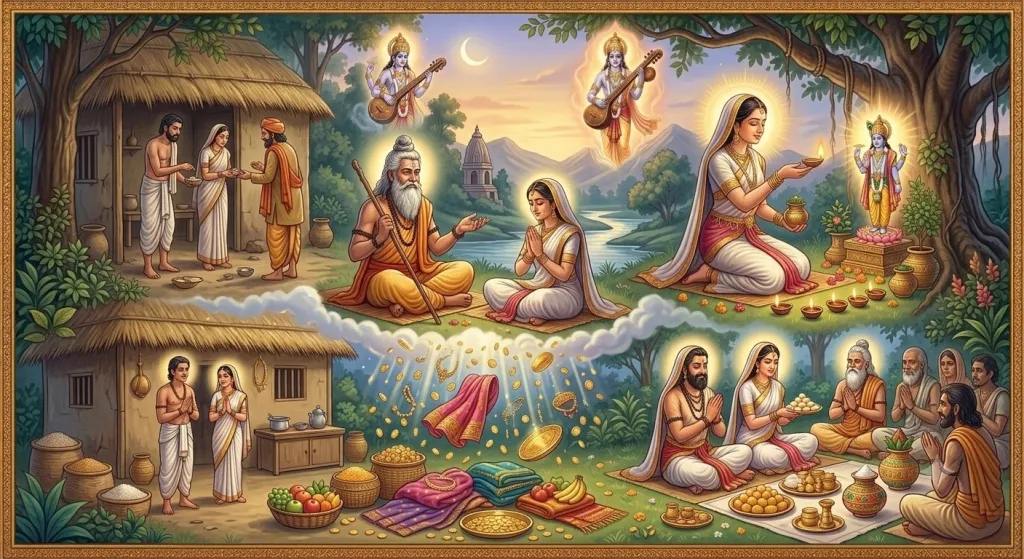
Scriptures describe sacred story narrated by Bhagawan Krishna to King Yudhishthira, involving pious Brahmin named Sumedha and his devoted wife Pavitra who lived in Kampilya city. Sumedha was extremely virtuous, but due to severe past karma, he suffered from extreme poverty and lacked even daily food. Despite deep starvation, couple remained strictly truthful and devoted to Bhagawan Vishnu.

One day, Sumedha expressed desire to leave house and travel to distant lands to earn livelihood. Pavitra humbly advised husband that wealth comes only through past good karma and charity. She suggested staying home and trusting Shri Hari grace instead of wandering aimlessly.

During Adhika Masa, holy Sage Kaundinya visited humble hut of Sumedha. Brahmin couple welcomed sage with deep respect and served him water despite having no food. Moved by their devotion and dire poverty, Sage Kaundinya instructed couple to observe strict fast on Krishna Paksha Ekadashi of Adhika Masa, known as Parama Ekadashi. Sage explained that observing Pancharatri fast starting from Parama Ekadashi for five continuous days destroys all poverty and grants divine wealth.

Sumedha and Pavitra strictly followed advice of Sage Kaundinya and observed Parama Ekadashi fast along with Pancharatri vows with total faith. By divine grace of Bhagawan Vishnu and immense spiritual merit of fast, royal prince arrived at their door soon after, gifting them grand house, land, cattle, and abundant wealth. Couple lived happily in prosperity, performed charity, and eventually attained Moksha.

Rituals to be performed on Parama Ekadashi

Devotee must wake up early in morning during Brahma Muhurta and take ritual bath using clean water without using soap, shampoo, or such cosmetic products.

Puja area should be cleaned thoroughly and idol or photo of Bhagawan Vishnu, specifically Bhagawan Narayana form alongside Maata Lakshmi, should be placed respectfully.

Light ghee lamp, offer fresh yellow flowers, sandalwood paste, incense, sweets, and Tulsi leaves to Bhagwan Vishnu.

Chant Vishnu Sahasranama, Hare Krishna Mahamantra, or Om Namo Bhagavate Vasudevaya continuously throughout day.

Listen to or read Parama Ekadashi Katha with family members in peaceful state of mind.

Offer your respects to parents and other elders, especially Guru, seeking their heartfelt blessings on this sacred morning.

Observe fast during entire day according to individual health capacity. Healthy individuals can observe strict fast without water or taking only water. Devotees seeking special merit can observe Pancharatri fast for five days starting from Ekadashi till Dwadashi or Purnima. Milk, curd, and fruits can be consumed if complete fasting is difficult due to health reasons. Rice, wheat, barley, lentils, pulses, and all food grains must be avoided strictly. Heavy spices, regular salt, garlic, onion, tea, coffee, outside processed food, and alcohol must be strictly avoided.

Perform evening Aarti with devotion, light lamps, offer special Naivedya to Bhagwan Vishnu, donate food, clothes, and gold or brass items to deserving Brahmins or needy people, and maintain noble thoughts, avoiding anger, backbiting, falsehood, or harsh speech.

Break fast next day on Dwadashi tithi during scheduled Parana time. Fast should be broken after sunrise once Hari Vasara period concludes. Offer naivedya to Bhagwan Vishnu, perform short prayer, and break fast by consuming prasada, water, or fruits before eating regular food.

PS: Article re-formatted into blocks and Header Image changed. Updated link to Adhika Masa Article (which is written later)

Sovereignty in the Era of Amrit Kaal: A Tribute to India’s Steadfast Leadership

In modern political history June 10 2026 marks an extraordinary milestone for India. On this day Prime Minister Narendra Modi officially completes 4399 consecutive days in office. This surpasses the record of first Prime Minister of India Jawaharlal Nehru who served 4398 consecutive days following the first general election. This achievement formally establishes Narendra Modi as the longest serving continuously elected Prime Minister of India. What makes this historic milestone truly remarkable is not just the sheer length of tenure but the fierce multi layered resistance it overcame. Entering its thirteenth year this era stands as a testament to transformative domestic governance a reshaped global footprint and a resolute defense of the sovereignty of India against sophisticated external and internal attempts at regime change.

Shri Ram Janmabhumi Temple Inauguration – 500 years of waiting from 1528-2024

Domestic Transformation – Welfare, Wealth and Infrastructure

At the core of the governance model of the Prime Minister is a structural overhaul of how public welfare and infrastructure are delivered. This philosophy focuses on development for all citizens. Moving away from historically leaky middleman heavy distribution systems his administration built a completely new template for governance. By leveraging bank accounts biometric identification and mobile connectivity the government implemented direct benefit transfers. This structurally clean system lifted over 200 million citizens out of multidimensional poverty. It also saturated basic needs through mega campaigns like the Jal Jeevan Mission for piped tap water and Ayushman Bharat for universal healthcare. Additionally the indigenous Unified Payments Interface fundamentally transformed the global conversation around financial technology. By normalizing zero cost digital transactions from street vendors to conglomerates India transformed from a cash heavy shadow economy into a formalized data rich global leader. At the same time massive capital expenditure re engineered the physical landscape. The rapid expansion of national highways high speed Vande Bharat trains and a doubling of operational airports under the UDAN scheme seamlessly unified regional economies.

Historic Strides in Poverty Alleviation

This target driven welfare mechanism yielded the most monumental decline in poverty ever recorded in the democratic history of the nation. According to comprehensive data from NITI Aayog verified by international development organizations over 248 million individuals successfully broke out of multidimensional poverty during this tenure. The national headcount poverty ratio experienced a steep fall from over 29 percent down to approximately 11 percent. By shifting the metrics of state support away from simple cash handouts and focusing instead on asset creation the government systematically resolved deep structural deprivations across health education and living standards. The massive expansion of rural housing clean energy distribution and fortified nutrition initiatives ensured that families could sustainably transition into the formalized economy. This monumental reduction has allowed India to track well ahead of its global sustainable development targets proving that scaled state execution can successfully eliminate acute historical deprivation.

Financial and Economic Milestones

Beyond individual digital transactions the administration completely overhauled the financial framework of India. The introduction of the Goods and Services Tax dismantled a confusing web of local consumption taxes to create a unified one nation one tax market. This significantly expanded the tax base of the country. To spur domestic production the government launched the Production Linked Incentive scheme attracting massive global and domestic investments across key sectors like electronics and pharmaceuticals. This helped push the startup ecosystem from under 400 firms in 2014 to over 230000 by 2026 generating millions of jobs and fostering innovation in tier two and tier three cities. Simultaneously opening sensitive areas like space and defense to private participation accelerated high technology growth turning India into an export hub and transitioning it into the fifth largest economy in the world.

Expansion of Higher Institutes of Learning

This comprehensive national upgrade extended directly into the domain of higher education where the administration executed a massive scale transformation of elite institutions. To meet the demands of a rapidly growing technology and healthcare economy the government systematically expanded the footprint of premier national institutes. The number of Indian Institutes of Technology grew from 16 in 2014 to 23 across the country while the network of Indian Institutes of Management expanded from 13 to 21 to nurture world class business leadership. Most notably the All India Institutes of Medical Sciences network tripled from just 7 legacy institutions prior to 2014 to over 22 approved and functional medical campuses bringing specialized tertiary healthcare and advanced research directly to historically underserved states. Coupled with the modernization of 31 National Institutes of Technology and a surge in Indian Institutes of Information Technology this infrastructure democratization ensured that the highest standards of technical managerial and medical learning became accessible to millions of aspiring youths outside conventional metropolitan hubs.

Crisis Management Navigating the Pandemic and Geopolitical Wars

Perhaps the ultimate test of the economic and administrative acumen of this administration came during the twin black swan events of the 2020s. These events were the COVID 19 pandemic and the subsequent global supply chain crises triggered by international conflicts. While major Western economies faltered under runaway inflation and aggressive printing of money PM Modi implemented a highly calibrated fiscal strategy. Domestically the Pradhan Mantri Garib Kalyan Anna Yojana provided a critical food security lifeline to over 800 million citizens to prevent mass destitution. Meanwhile indigenous manufacturing delivered over 2 billion vaccine doses via the digital CoWIN platform. As the pandemic gave way to global economic shocks from the Russia Ukraine war and subsequent Middle East tensions India refused to succumb to external energy dictates. By securing independent crude oil channels and maintaining disciplined fiscal deficits the administration protected domestic retail markets from catastrophic price shocks. As a result international bodies like the World Bank and IMF consistently recognize India as the fastest growing major economy in the world booking a robust GDP expansion of over 7.5 percent even as global markets stagnate.

Legislative Breakthroughs and National Reorganization

The political grammar of India was fundamentally rewritten through bold legislative measures that addressed long standing constitutional anomalies. The parliament executed the historic abrogation of Article 370 stripping the former state of Jammu and Kashmir of its special autonomous status and integrating it completely into the constitutional framework of India. This move unlocked economic opportunities and restored institutional stability to the region. In a massive step forward for social justice the administration criminalized the practice of instant triple talaq securing equal rights and legal protection for married Muslim women. Furthermore the enactment of the Citizenship Amendment Act provided a clear legal pathway to citizenship for persecuted religious minorities from neighboring countries demonstrating a firm commitment to humanitarian values.

Socio Cultural and Religious Renaissance

The tenure has witnessed a deep psychological and cultural shift revitalizing national pride and international appreciation for the civilizational heritage of India. The worldwide adoption of International Yoga Day by the United Nations marked a historic high point for Indian cultural diplomacy. Domestically this renaissance is anchored in the restoration of ancient heritage sites. The landmark construction and consecration of the grand Ram Mandir in Ayodhya stands as a symbol of cultural rejuvenation for millions worldwide alongside massive upgrades to the Kashi Vishwanath and Mahakal corridors. This period also saw a complete democratisation of opportunity across education and research. The number of prestigious Indian Institutes of Technology grew from 16 to 23 while All India Institutes of Medical Sciences expanded from 7 to 23 ensuring that high quality healthcare and technical education reach every corner of the country.

Kashi Vishwanath Dham Corridor Punarnirman

Global Autonomy and the Voice of the Global South

Under the leadership of PM Modi the foreign policy of India pivoted from a traditional stance of non alignment to acting as a Vishwa Mitra which means a friend of the world. This represents a nation confident enough to secure its own strategic autonomy while shaping global consensus. Leaders worldwide have noted that under this leadership India has evolved as a leading voice on global matters. This global profile was permanently cemented during the G20 Presidency of India where New Delhi successfully championed the inclusion of the African Union as a permanent member. By balancing deep strategic alliances with the West while firmly executing independent choices India proved that its foreign policy is dictated solely by national interest. These choices included securing discounted Russian oil and standing resolute during Himalayan border disputes.

Weathering the Storm Standing Firm Against Global Pressures

The longevity of this tenure is inseparable from its resilience against coordinated domestic and geopolitical friction points. To his supporters the ability of the Prime Minister to withstand pressure from external actors global billionaires and deep state narratives is a defining feature of his leadership. Throughout the last decade India has been subjected to intense scrutiny via Western mainstream media international non governmental organizations and global freedom indexes. When influential global figures like billionaire George Soros openly stated desires to see a political change in India New Delhi pushed back aggressively. The external affairs ministry characterized such interventions as the viewpoints of old rich opinionated and dangerous individuals who still believe their preferred narratives should dictate global outcomes. The ability of the administration to dismiss these external pressures has been hailed by supporters as a triumph for true sovereign democracy. The battle has similarly played out in the global financial arena. A short selling report targeting major Indian infrastructure in early 2023 was widely interpreted by the ruling party and its base as a calculated financial strike designed to trigger economic panic stall infrastructure growth and precipitate a domestic political crisis. The subsequent clean slates from regulators and the complete recovery of the market demonstrated that the economic foundations of India were robust enough to survive targeted external shocks.

Ultimate Shield and a Permanent Seat at the Global High Table

Ultimately the most potent countermeasure to foreign interference elite narratives or coordinated opposition coalitions has been the Indian voter. Despite highly polarized political climates and mass protest movements the electorate has repeatedly delivered consecutive mandates at the ballot box. This historic milestone of 4399 continuous days reflects what colleagues describe as the life of a dedicated leader who focuses on duty without pause.

This journey has fundamentally altered how the world interacts with New Delhi. India has transitioned from being a reluctant invitee to occupying a permanent seat at the global high table. This arrival has been achieved entirely on the terms of the nation. By maintaining a strict policy of neutrality in a deeply fractured world and refusing to join competing military blocks India has proved that true strength lies in independent decision making. As India drives toward its target of a developed India by 2047 the enduring tenure of Narendra Modi stands as the institutional anchor for the contemporary rise of the nation. It remains completely unshaken by external forces balanced neutrally amidst global conflicts and entirely validated by the democratic will and absolute sovereignty of 1.4 billion people.

Collective Expression of Patriotic Gratitude

As this historic milestone is realized millions of patriots across the length and breadth of the nation stand united in deep emotional gratitude for a life poured completely into the service of the motherland. For generations citizens yearned to see a leadership that combined civilizational pride with modern scientific ambition and this tenure has actualized that collective dream. The unmatchable dedication of a leader who works without a single day of leave has transformed national self doubt into absolute confidence. This expression of profound thankfulness from the core of the citizenry recognizes that every reform executed every border protected and every heritage site restored was driven by a deep love for the nation. For this relentless dedication to restoring the glory of the country patriots everywhere offer their deepest salutations and heartfelt gratitude to a leader who has redefined the destiny of Bharat Mata.