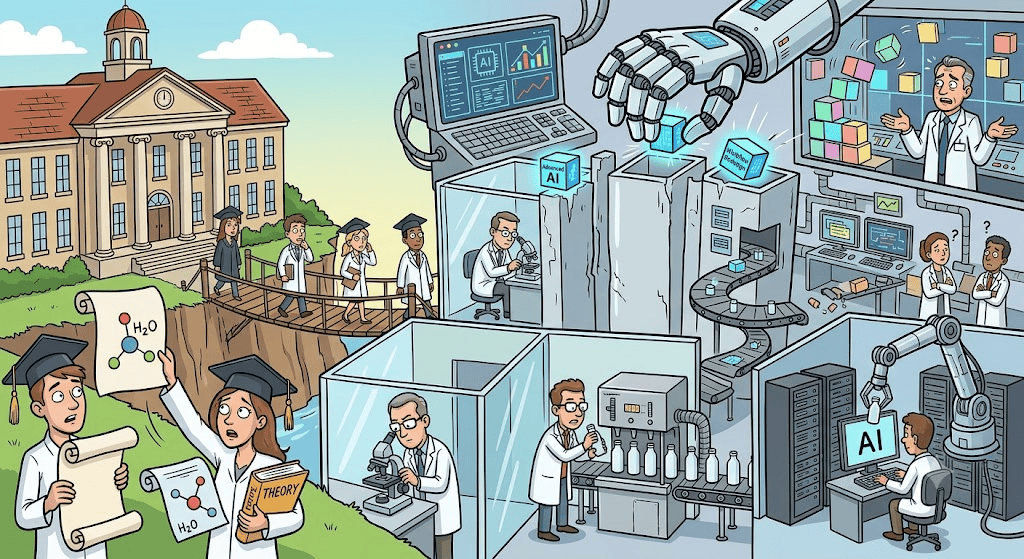
Pharma’s Talent Crisis–Basic Skills Problem
Pharmaceutical industry is consumed by a single narrative, it is facing a crippling talent shortage driven by the rapid rise of artificial intelligence, advanced biologics, and shifting global regulations. Industry reports and corporate leaders frequently point to an acute lack of specialized AI engineers and computational experts. The prescribed solutions are equally grand, focusing on massive technology investments and complete organizational overhauls.
However, blaming the talent crunch on a missing class of high-tech specialists oversimplifies a far more fundamental reality. The crisis in the pharmaceutical labour pool is not primarily about advanced algorithms or organizational charts. It is rooted in a severe deficit of basic scientific and analytical skills among fresh talent, compounded by outdated university curricula, superficial corporate training programs, and hyper-siloed organizational structures.
Outdated University Curricula
The baseline skill gap begins in higher education. Pharmacy and life sciences curricula at most universities remain heavily theoretical, relying on rote memorization and memory-based examinations centred on legacy textbook concepts. While the modern industry has shifted toward complex biologics and digital quality control, fresh graduates continue to leave academia with little to no exposure to commercial-scale manufacturing realities.
Moreover, academic institutions rarely teach critical regulatory frameworks like Good Manufacturing Practices (GMP) or Good Laboratory Practices (GLP). Graduates arrive on the factory floor or in research labs without understanding data integrity, electronic batch records, or audit trails, areas where a single documentation error can invalidate an entire clinical trial. Combined with a lack of training in basic data hygiene and practical troubleshooting, entry-level candidates frequently lack the foundational discipline required for modern life sciences work.
Hyper-Specialization and Structural Silos
Pharma companies themselves are also heavily to blame for deepening this crisis. For decades, the industry has compartmentalized its workforce into narrow, highly specialized silos. Organizations systematically cultivate talent optimized for narrower and narrower job specifications, creating wet-lab scientists, regulatory writers, or clinical trial managers who operate entirely in isolation.
This hyper-specialization creates a severe blind spot, individual experts often have no clue how adjacent functions operate. A biologist may design a molecule without understanding regulatory submission requirements, while a data scientist builds predictive models without grasping basic wet-lab constraints. By actively breeding single-track specialists, pharma companies have systematically destroyed cross-functional baseline literacy, making interdisciplinary collaboration nearly impossible when new technologies arrive.
Corporate Skilling Programs
Faced with unprepared and siloed recruits, pharmaceutical companies often point fingers at external talent pipelines while ignoring the flaws in their own internal upskilling efforts. However, a major part of the failure stems from a fundamental disconnect in role and capability: pharmaceutical corporations are in the business of developing and manufacturing Active Pharmaceutical Ingredients (APIs), generics, biosimilars, vaccines, OTC products, and novel therapeutics. They are drug developers and commercial manufacturers, and not, and should not be expected to be, experts in pedagogy or foundational education.
When businesses attempt to act as primary educators, their internal training programs inevitably devolve into superficial, tool-focused workshops designed to teach specific software or immediate task execution quickly. These programs fail because corporate instructional design lacks the pedagogical rigor required to build deep cognitive capabilities from the ground up. Attempting to layer complex AI tools onto a workforce lacking solid functional grounding cannot succeed when short-term corporate training is substituted for true foundational learning. Rather than investing in rigorous instruction around core problem-solving, basic data interpretation, and cross-functional processes, businesses run short-term courses on the latest digital platforms. Upskilling cannot succeed when the underlying scientific and operational foundation is shaky.
Fix Flawed Fundamentals
The prevailing argument that pharma needs total operational redesign assumes that the workforce possesses the basic competence needed to execute within new structures. Connecting R&D, manufacturing, and regulatory teams inside integrated operating environments sounds promising on paper. However, if the individuals inside these connected structures struggle with basic data analysis, lack broad process awareness, and remain trapped in specialized mindsets, structural realignment merely speeds up the transmission of basic errors across the entire value chain.
The pharmaceutical sector must move past the rhetoric of an “AI skill deficit” and look closer at its foundational pipeline. Until universities modernize their practical labs and integrate regulatory standards, and until pharmaceutical firms break down hyper-specialized silos to prioritize broad functional rigour, deploying advanced technology will do little to solve the industry’s real productivity challenges.