Stipends, Stigma, and Structure: Why NAPS Applications Hit a 6-Year Low

Applications generated under the National Apprenticeship Promotion Scheme (NAPS) plunged to a six-year low in 2025 despite employers continuing to offer apprenticeship opportunities, according to data from the scheme’s public dashboard. 
The number of applications generated fell to 401,560 in 2025, the lowest since 2019. Applications had peaked at 4.28 million in 2022 before declining to 2.97 million in 2023 and 2.53 million in 2024. The latest figure is more than 90 per cent below the 2022 peak.

Global and Indian Apprenticeship Decline

Headlines in Business Standard screamed louder than the loudest Deepavali Firecracker. Apprenticeship applications under the National Apprenticeship Promotion Scheme (NAPS) in India have hit a six-year low of just over 4 lakh, reflecting a broader global shift in how early-career paths are viewed. While organizations continue to post opportunities on government portals, actual candidate demand has plummeted significantly. This downward trend highlights a systemic disconnect between the current structure of vocational training and the immediate financial, professional, and cultural needs of young job seekers.

Pic Courtesy: Gemini

Aspirational Deficit Among Youth

A fundamental roadblock is the complete lack of aspirational value associated with technical and vocational training among modern Indian youth. For decades, the societal narrative has tightly coupled career success and white-collar prestige exclusively with engineering, management, or traditional professional degrees. Apprenticeships are widely misperceived as a last-resort fallback for academic underachievers or low-income segments, carrying a heavy social stigma. Because these programs fail to offer the visible social mobility, corporate lifestyle allure, or digital-age prestige that Gen Z candidates actively seek, the youth naturally distance themselves from blue-collar or shop-floor training pathways.

Structural Bottlenecks within the NAPS Framework

Beyond individual candidate hesitation, NAPS suffers from rigid operational design flaws that stifle its effectiveness. The scheme enforces standardized, inflexible curriculum templates that fail to adapt to rapid technological disruptions like artificial intelligence and automation. This curriculum lag means candidates often invest months learning outdated industrial practices that bear little relevance to modern factory floors or corporate workplaces. Additionally, the scheme lacks robust, independent quality auditing mechanisms to monitor training execution. This absence of accountability allows substandard training centers to operate freely, diminishing the actual educational value delivered to the candidate.

Reimbursement Delays and Industry Hesitation

Furthermore, financial friction within the NAPS administrative pipeline severely dampens stakeholder enthusiasm. The mechanisms through which the government reimburses partial stipends to participating companies are plagued by bureaucratic red tape and prolonged processing timelines. For small-scale employers operating on tight liquidity, delayed payouts turn a supposedly incentivized scheme into a financial strain. This cash flow bottleneck, combined with complex onboarding compliances, actively discourages thousands of potential employers from participating, thereby shrinking the overall pool of quality opportunities available to youth.

Core Financial Disconnect

The primary barrier to enrollment is that fixed stipends have failed to keep pace with inflation and the rising cost of living. Apprenticeship pay frequently falls below local minimum wages. When young workers relocate from smaller towns to major industrial or Tier-1 hubs to take up these roles, the compensation fails to cover basic food, transport, and rent. Without built-in accommodation or travel support, pursuing an apprenticeship becomes financially unviable for lower-income applicants who must instead prioritize immediate, higher-paying retail or service work.

Deepening Exploitation and Dead-End Pathways

High dropout rates and declining completion metrics—which have fallen to 25.47% according to NITI Aayog—point to severe structural issues within corporate programs. Many candidates exit early after realizing that employers utilize them as low-cost, temporary workforce replacements rather than providing high-quality skill training. This frustration is compounded by long, complex corporate application processes, a general lack of career clarity, and the absence of a structured, guaranteed pathway translating the temporary training contract into a stable, full-time salaried job.

Cultural Bias and Alternative Skill Channels

Traditional academic paths and government exam preparation still hold massive social equity and prestige over vocational routes. Many parents and schools continue to push formal university degrees, causing youth to choose underemployment while studying for public sector exams rather than accepting a corporate apprenticeship. Simultaneously, the younger generation is turning to flexible alternative channels like short-term certifications, bootcamps, freelance networks, and creator-economy gigs, which offer rapid revenue without binding them to a rigid multi-year physical training contract.

Regional Gaps and Administrative Friction

Apprenticeship opportunities are highly concentrated, with just ten states accounting for over 80% of all engagements, leaving youth in regions like the North East or central India with few local choices. Micro, Small, and Medium Enterprises (MSMEs) widely avoid the ecosystem due to cumbersome regulatory compliance. Furthermore, digital fragmentation across separate platforms, such as NAPS for general trades and NATS for graduates or diploma holders, creates severe administrative friction and confusion for applicants seeking a streamlined process.

Overhaul Blueprint

To reverse this decline, policy frameworks from NITI Aayog suggest consolidating administrative efforts into a unified National Apprenticeship Mission. Reclaiming applicant trust requires repositioning these programs as prestigious, financially viable alternatives to traditional university education. This turnaround depends on significantly boosting stipend adequacy, offering formal social security or insurance, and actively funding travel and accommodation support for marginalized candidates.

Credentials vs. Capability

For many decades, National Institute of Skills held holy grail status for manufacturing industry. It was not place of air-conditioned comfort. It was dusty, loud, relentless powerhouse. Students lived by simple code: 8 AM to 6 PM, six days week, exactly two weeks of vacation year. Schedule mirrored brutal reality of industry. By graduation, hands were calloused, muscle memory flawless, confidence unbreakable. Graduates did not just understand machines; they spoke their language.

Then came modernization wave. New management took over, looking to boost enrollment and cut costs. Board looked at grueling schedule and saw inefficiency, not excellence. Within months, curriculum was overhauled. Workshop hours were cut by half. Lectures on digital manufacturing theory replaced grease-monkey time. Standard academic vacations and long holidays were introduced to keep students relaxed. Shiny new marketing brochures boldly claimed: Industry Ready from Day 1. Veteran instructors shook heads. One cannot learn weight of hammer from PowerPoint slide.

True test came during annual campus placement drive. KV Steel, legacy manufacturing giant and oldest recruiter, arrived with challenge instead of interview panel. Plant Head Raghav, gruff alumnus, led top ten students, all straight-A theorists from new batch, to malfunctioning, vibrating automated hydraulic press. Raghav ordered them to fix choking pressure valve and dead digital sensor.

Students jumped into action. They opened tablets, cited fluid mechanics formulas, debated thermodynamic properties of hydraulic oil, and spent two hours drawing digital schematics. But when Raghav handed them wrench, they hesitated. Hands were soft. They did not know how much torque to apply without snapping bolt. They could not feel vibration of machine to diagnose internal friction. They had all knowledge, but zero skin in game. They were paralyzed.

Raghav looked at row of silent students and sighed. This was tragedy of new curriculum; it confused credentials with capability. Vast, treacherous gulf exists between basic literacy and true mastery. Literacy is merely ability to read manual. It does not mean one has education, which teaches how to think critically about text. Yet, even education remains static without active learning, messy process of trial and error. Over time, learning crystallizes into knowledge, intellectual bank of facts and formulas. But knowledge alone is hollow. Only through thousands of hours of sweat, failure, and repetition does knowledge mature into wisdom, instinctual, unwritten understanding of when and how to apply what you know. Students had been given shortcut to knowledge, but they were entirely bankrupt of wisdom.

Sweat of Capability vs Comfort of Credentials

Sensing disaster, old workshop assistant, barely year from retirement, stepped forward. He did not know latest textbook jargon. But he had spent thirty years working old institute schedule. He did not look at screen. He simply placed bare, calloused palm against vibrating metal hull of press. He listened to pitch of whine. With three swift, practiced movements of heavy spanner, honed by thousands of hours of repetition, he bled valve, adjusted tension, and machine purred back to life. Total time taken was four minutes.

Raghav turned to stunning but helpless students. Knowledge tells you what machine does, Raghav said, wiping stray drop of oil from face. But only hours on shop floor give instinct to make it work. You have been trained to think, but you have not been trained to work. Institute had traded sweat of capability for comfort of credentials. In real world, credentials do not fix broken engines.

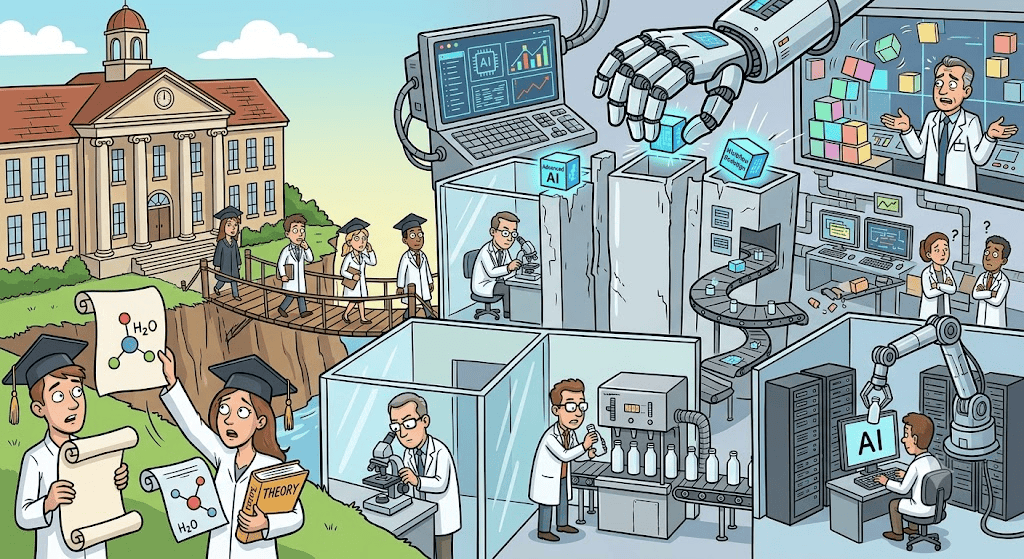
Fix the Roots, Not the Leaves – Pharmaceutical Skill Scarcity

Pharma’s Talent Crisis–Basic Skills Problem

Pharmaceutical industry is consumed by a single narrative, it is facing a crippling talent shortage driven by the rapid rise of artificial intelligence, advanced biologics, and shifting global regulations. Industry reports and corporate leaders frequently point to an acute lack of specialized AI engineers and computational experts. The prescribed solutions are equally grand, focusing on massive technology investments and complete organizational overhauls.

However, blaming the talent crunch on a missing class of high-tech specialists oversimplifies a far more fundamental reality. The crisis in the pharmaceutical labour pool is not primarily about advanced algorithms or organizational charts. It is rooted in a severe deficit of basic scientific and analytical skills among fresh talent, compounded by outdated university curricula, superficial corporate training programs, and hyper-siloed organizational structures.

Outdated University Curricula

The baseline skill gap begins in higher education. Pharmacy and life sciences curricula at most universities remain heavily theoretical, relying on rote memorization and memory-based examinations centred on legacy textbook concepts. While the modern industry has shifted toward complex biologics and digital quality control, fresh graduates continue to leave academia with little to no exposure to commercial-scale manufacturing realities.

Moreover, academic institutions rarely teach critical regulatory frameworks like Good Manufacturing Practices (GMP) or Good Laboratory Practices (GLP). Graduates arrive on the factory floor or in research labs without understanding data integrity, electronic batch records, or audit trails, areas where a single documentation error can invalidate an entire clinical trial. Combined with a lack of training in basic data hygiene and practical troubleshooting, entry-level candidates frequently lack the foundational discipline required for modern life sciences work.

Hyper-Specialization and Structural Silos

Pharma companies themselves are also heavily to blame for deepening this crisis. For decades, the industry has compartmentalized its workforce into narrow, highly specialized silos. Organizations systematically cultivate talent optimized for narrower and narrower job specifications, creating wet-lab scientists, regulatory writers, or clinical trial managers who operate entirely in isolation.

This hyper-specialization creates a severe blind spot, individual experts often have no clue how adjacent functions operate. A biologist may design a molecule without understanding regulatory submission requirements, while a data scientist builds predictive models without grasping basic wet-lab constraints. By actively breeding single-track specialists, pharma companies have systematically destroyed cross-functional baseline literacy, making interdisciplinary collaboration nearly impossible when new technologies arrive.

Corporate Skilling Programs

Faced with unprepared and siloed recruits, pharmaceutical companies often point fingers at external talent pipelines while ignoring the flaws in their own internal upskilling efforts. However, a major part of the failure stems from a fundamental disconnect in role and capability: pharmaceutical corporations are in the business of developing and manufacturing Active Pharmaceutical Ingredients (APIs), generics, biosimilars, vaccines, OTC products, and novel therapeutics. They are drug developers and commercial manufacturers, and not, and should not be expected to be, experts in pedagogy or foundational education.

When businesses attempt to act as primary educators, their internal training programs inevitably devolve into superficial, tool-focused workshops designed to teach specific software or immediate task execution quickly. These programs fail because corporate instructional design lacks the pedagogical rigor required to build deep cognitive capabilities from the ground up. Attempting to layer complex AI tools onto a workforce lacking solid functional grounding cannot succeed when short-term corporate training is substituted for true foundational learning. Rather than investing in rigorous instruction around core problem-solving, basic data interpretation, and cross-functional processes, businesses run short-term courses on the latest digital platforms. Upskilling cannot succeed when the underlying scientific and operational foundation is shaky.

Fix Flawed Fundamentals

The prevailing argument that pharma needs total operational redesign assumes that the workforce possesses the basic competence needed to execute within new structures. Connecting R&D, manufacturing, and regulatory teams inside integrated operating environments sounds promising on paper. However, if the individuals inside these connected structures struggle with basic data analysis, lack broad process awareness, and remain trapped in specialized mindsets, structural realignment merely speeds up the transmission of basic errors across the entire value chain.

The pharmaceutical sector must move past the rhetoric of an “AI skill deficit” and look closer at its foundational pipeline. Until universities modernize their practical labs and integrate regulatory standards, and until pharmaceutical firms break down hyper-specialized silos to prioritize broad functional rigour, deploying advanced technology will do little to solve the industry’s real productivity challenges.