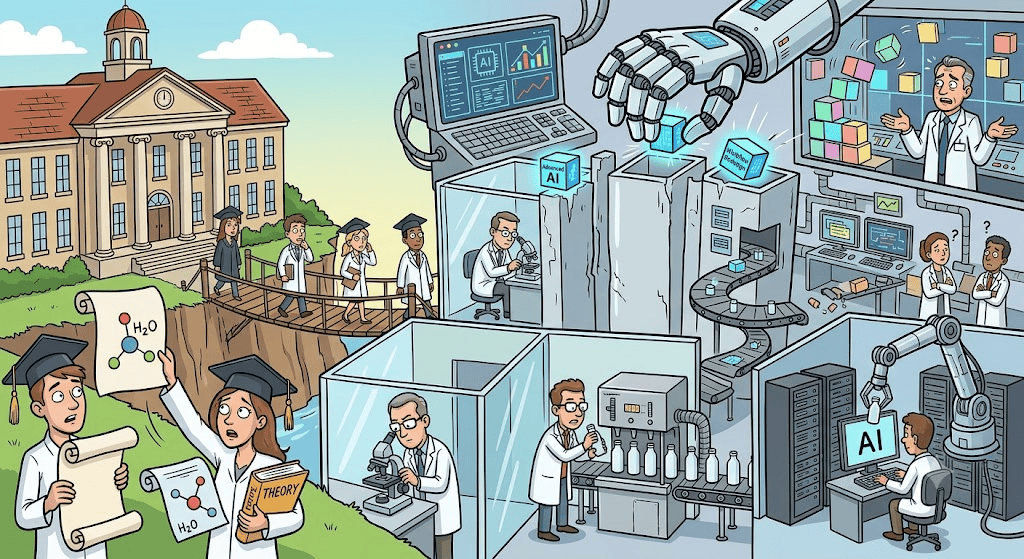
For many decades, National Institute of Skills held holy grail status for manufacturing industry. It was not place of air-conditioned comfort. It was dusty, loud, relentless powerhouse. Students lived by simple code: 8 AM to 6 PM, six days week, exactly two weeks of vacation year. Schedule mirrored brutal reality of industry. By graduation, hands were calloused, muscle memory flawless, confidence unbreakable. Graduates did not just understand machines; they spoke their language.
Then came modernization wave. New management took over, looking to boost enrollment and cut costs. Board looked at grueling schedule and saw inefficiency, not excellence. Within months, curriculum was overhauled. Workshop hours were cut by half. Lectures on digital manufacturing theory replaced grease-monkey time. Standard academic vacations and long holidays were introduced to keep students relaxed. Shiny new marketing brochures boldly claimed: Industry Ready from Day 1. Veteran instructors shook heads. One cannot learn weight of hammer from PowerPoint slide.
True test came during annual campus placement drive. KV Steel, legacy manufacturing giant and oldest recruiter, arrived with challenge instead of interview panel. Plant Head Raghav, gruff alumnus, led top ten students, all straight-A theorists from new batch, to malfunctioning, vibrating automated hydraulic press. Raghav ordered them to fix choking pressure valve and dead digital sensor.
Students jumped into action. They opened tablets, cited fluid mechanics formulas, debated thermodynamic properties of hydraulic oil, and spent two hours drawing digital schematics. But when Raghav handed them wrench, they hesitated. Hands were soft. They did not know how much torque to apply without snapping bolt. They could not feel vibration of machine to diagnose internal friction. They had all knowledge, but zero skin in game. They were paralyzed.
Raghav looked at row of silent students and sighed. This was tragedy of new curriculum; it confused credentials with capability. Vast, treacherous gulf exists between basic literacy and true mastery. Literacy is merely ability to read manual. It does not mean one has education, which teaches how to think critically about text. Yet, even education remains static without active learning, messy process of trial and error. Over time, learning crystallizes into knowledge, intellectual bank of facts and formulas. But knowledge alone is hollow. Only through thousands of hours of sweat, failure, and repetition does knowledge mature into wisdom, instinctual, unwritten understanding of when and how to apply what you know. Students had been given shortcut to knowledge, but they were entirely bankrupt of wisdom.
Sweat of Capability vs Comfort of Credentials
Sensing disaster, old workshop assistant, barely year from retirement, stepped forward. He did not know latest textbook jargon. But he had spent thirty years working old institute schedule. He did not look at screen. He simply placed bare, calloused palm against vibrating metal hull of press. He listened to pitch of whine. With three swift, practiced movements of heavy spanner, honed by thousands of hours of repetition, he bled valve, adjusted tension, and machine purred back to life. Total time taken was four minutes.
Raghav turned to stunning but helpless students. Knowledge tells you what machine does, Raghav said, wiping stray drop of oil from face. But only hours on shop floor give instinct to make it work. You have been trained to think, but you have not been trained to work. Institute had traded sweat of capability for comfort of credentials. In real world, credentials do not fix broken engines.
Pharmaceutical industry is consumed by a single narrative, it is facing a crippling talent shortage driven by the rapid rise of artificial intelligence, advanced biologics, and shifting global regulations. Industry reports and corporate leaders frequently point to an acute lack of specialized AI engineers and computational experts. The prescribed solutions are equally grand, focusing on massive technology investments and complete organizational overhauls.
However, blaming the talent crunch on a missing class of high-tech specialists oversimplifies a far more fundamental reality. The crisis in the pharmaceutical labour pool is not primarily about advanced algorithms or organizational charts. It is rooted in a severe deficit of basic scientific and analytical skills among fresh talent, compounded by outdated university curricula, superficial corporate training programs, and hyper-siloed organizational structures.
Outdated University Curricula
The baseline skill gap begins in higher education. Pharmacy and life sciences curricula at most universities remain heavily theoretical, relying on rote memorization and memory-based examinations centred on legacy textbook concepts. While the modern industry has shifted toward complex biologics and digital quality control, fresh graduates continue to leave academia with little to no exposure to commercial-scale manufacturing realities.
Moreover, academic institutions rarely teach critical regulatory frameworks like Good Manufacturing Practices (GMP) or Good Laboratory Practices (GLP). Graduates arrive on the factory floor or in research labs without understanding data integrity, electronic batch records, or audit trails, areas where a single documentation error can invalidate an entire clinical trial. Combined with a lack of training in basic data hygiene and practical troubleshooting, entry-level candidates frequently lack the foundational discipline required for modern life sciences work.
Hyper-Specialization and Structural Silos
Pharma companies themselves are also heavily to blame for deepening this crisis. For decades, the industry has compartmentalized its workforce into narrow, highly specialized silos. Organizations systematically cultivate talent optimized for narrower and narrower job specifications, creating wet-lab scientists, regulatory writers, or clinical trial managers who operate entirely in isolation.
This hyper-specialization creates a severe blind spot, individual experts often have no clue how adjacent functions operate. A biologist may design a molecule without understanding regulatory submission requirements, while a data scientist builds predictive models without grasping basic wet-lab constraints. By actively breeding single-track specialists, pharma companies have systematically destroyed cross-functional baseline literacy, making interdisciplinary collaboration nearly impossible when new technologies arrive.
Corporate Skilling Programs
Faced with unprepared and siloed recruits, pharmaceutical companies often point fingers at external talent pipelines while ignoring the flaws in their own internal upskilling efforts. However, a major part of the failure stems from a fundamental disconnect in role and capability: pharmaceutical corporations are in the business of developing and manufacturing Active Pharmaceutical Ingredients (APIs), generics, biosimilars, vaccines, OTC products, and novel therapeutics. They are drug developers and commercial manufacturers, and not, and should not be expected to be, experts in pedagogy or foundational education.
When businesses attempt to act as primary educators, their internal training programs inevitably devolve into superficial, tool-focused workshops designed to teach specific software or immediate task execution quickly. These programs fail because corporate instructional design lacks the pedagogical rigor required to build deep cognitive capabilities from the ground up. Attempting to layer complex AI tools onto a workforce lacking solid functional grounding cannot succeed when short-term corporate training is substituted for true foundational learning. Rather than investing in rigorous instruction around core problem-solving, basic data interpretation, and cross-functional processes, businesses run short-term courses on the latest digital platforms. Upskilling cannot succeed when the underlying scientific and operational foundation is shaky.
Fix Flawed Fundamentals
The prevailing argument that pharma needs total operational redesign assumes that the workforce possesses the basic competence needed to execute within new structures. Connecting R&D, manufacturing, and regulatory teams inside integrated operating environments sounds promising on paper. However, if the individuals inside these connected structures struggle with basic data analysis, lack broad process awareness, and remain trapped in specialized mindsets, structural realignment merely speeds up the transmission of basic errors across the entire value chain.
The pharmaceutical sector must move past the rhetoric of an “AI skill deficit” and look closer at its foundational pipeline. Until universities modernize their practical labs and integrate regulatory standards, and until pharmaceutical firms break down hyper-specialized silos to prioritize broad functional rigour, deploying advanced technology will do little to solve the industry’s real productivity challenges.
This is presented as a constructive observation of the PM-SETU (Pradhan Mantri Skilling and Employability Transformation through Upgraded ITIs) scheme. While it is admittedly early days since launch, the significantly slow pace of implementation is deeply worrisome, and extensive discussions with various ground-level stakeholders fail to inspire confidence regarding long-term execution. (Current status of PM-SETU implementation towards the end of this article)
The scheme was originally designed to completely revamp vocational training across India by restructuring 1,000 Government ITIs into a Hub-and-Spoke model comprising 200 Hubs and 800 Spokes. The core objective was to switch from a rigid government-led training style to an industry-managed system where Anchor Industry Partners (AIP) hold a 51% stake in a Special Purpose Vehicle to run the clusters, while government funds up to 83% of the costs. However, rollout has hit significant roadbumps and progress is moving much slower than acceptable. The scheme remains stuck firmly in pre-implementation and tendering stages as states struggle to finalize Requests for Proposals from corporate entities. Beneath this sluggishness lie deep, structural defects in scheme design.
Bureaucratic Friction and Administrative Gridlock
The 51:49 public-private partnership structure sounds good on paper, but it creates intense administrative gridlock. Corporate agility is consistently bottlenecked by traditional, slow-moving government approval cycles. State governments have had to frequently ask the Ministry of Skill Development for clarifications on how to frame agreements, creating massive administrative drag that stalls ground-level execution.
Non-Standardized Portability and Localized Syllabi
Because each Anchor Industry Partner customizes curriculum to fit its own specific factory needs, a syllabus created in Karnataka might differ completely from one in Haryana. If these customized courses do not align perfectly with the National Skill Qualification Framework, student certificates lose value if graduates move out of that specific industrial cluster, severely limiting interstate labour mobility.
Dual Competence Requirements for the Oversight Body
A major institutional weakness is lack of a specialized governance structure capable of managing this transition. An oversight body tasked with managing a massive transformation like PM-SETU cannot function merely as an auditing entity or a bureaucratic ledger-keeper. Because the public-private structure of Special Purpose Vehicles relies on complex escrow accounts and performance-linked milestones, oversight body requires deep financial competence to track milestone-based disbursements, audit asset monetization strategies, and verify whether valuations attached to corporate contributions are fair.
Equally vital is domain delivery competence. The governance framework must include professionals from emerging technical sectors capable of evaluating pedagogical quality, monitoring technology lifecycles, and ensuring that customized curricula maintain alignment with the National Skill Qualification Framework. Without this dual expertise of financial stewardship and deep vocational understanding, the oversight mechanism risks reducing its function to checking boxes rather than ensuring genuine instructional quality and wage-verified placements.
Critical Deficit in Trainer Ecosystems and Pedagogical Gaps
The most severe operational bottleneck threatening PM-SETU is acute non-availability of qualified trainers, a crisis that extends all the way up to master trainers responsible for training other instructors. Installing advanced robotic arms, automation kits, and CNC machines is entirely redundant without personnel capable of teaching students how to operate them. India faces a massive structural deficit in instructors who understand modern technologies like EV maintenance, AI-driven logistics, and smart manufacturing.
This human resource vacuum cannot be solved simply by importing personnel from factory floors. While industry experts possess deep technical knowledge, they frequently lack the vital pedagogical skills required to manage classrooms, design curricula, and break down complex industrial concepts for adolescent learners. Teaching is an entirely different capability set than manufacturing. Conversely, existing ITI faculty lack exposure to modern automation, leaving a massive gap between industrial reality and classroom instruction. The Training-of-Trainers framework within PM-SETU is lagging far behind infrastructure targets, creating a situation where high-tech labs sit idle because there is a total absence of individuals who can both operate the technology and teach it effectively.
Corporate Dilemma and Capitalist Paradox
The reliance on private companies to co-invest and manage these ITI clusters has exposed a fundamental capitalist paradox where Anchor Industry Partners face zero incentive to spend corporate resources to act as public charity, especially if it risks creating talent pipelines for direct rivals. Because ITI graduates are free agents, Anchor Industry Partners cannot legally force them to stay. A competitor who spent zero rupees on training can simply offer these newly skilled graduates slightly higher salaries and steal them away, forcing the investing company to subsidize its competitor’s HR department. Furthermore, teaching cutting-edge Industry 4.0 skills requires exposing internal operational workflows and proprietary tools, creating massive intellectual property risks regarding leakage to rivals. Finding top-tier industrial partners willing to invest heavily in remote, rural Spoke ITIs is also incredibly difficult, as most industrial giants remain concentrated around major manufacturing zones.
Strategic Perks Designed to Attract Private Investment
To convince Anchor Industry Partners to take these risks, the scheme pitches specific operational advantages. While companies cannot legally lock students in, they get exclusive, year-round access through on-the-job training inside corporate facilities. By graduation, these students are fully integrated into company culture and machinery, requiring zero onboarding time. Additionally, major corporations rely on hundreds of Micro, Small, and Medium Enterprise vendors. By managing a PM-SETU hub, an Anchor Industry Partner can train youth who will work for their supply chain vendors, which directly raises component quality and reduces defect rates. Finally, setting up a state-of-the-art training center independently requires 100% private funding, whereas PM-SETU provides up to 83% government funding for capital expenditure, allowing companies to build high-tech training ecosystems for a fraction of market price.
Policy Revisions Required to Accelerate Progress
To get PM-SETU back on track, government needs to implement structural course corrections that address both administrative delays and corporate anxieties. The Ministry should allow Anchor Industries to sign reasonable, legally binding apprenticeship-to-hire contracts where students agree to work for the partner firm for 18 to 24 months post-graduation in exchange for subsidized education. To deter poaching, competing firms hiring a graduate within two years of graduation should be mandated to pay training clawback fees directly to the original investing Anchor Industry Partner.
To resolve the teaching crisis, the government must collaborate with central universities and corporate partners to launch specialized pedagogical diplomas for engineers, transforming industry experts into certified educators. Funding must be aggressively diverted into mandatory corporate training stints for existing ITI faculty. To solve regional disparity, government should offer higher fiscal incentives or tax breaks for companies managing remote Spoke ITIs. Furthermore, the Ministry must mandate a core 70% standardized syllabus aligned with national frameworks, confining industry-specific training to the remaining 30% to ensure certificate portability. Finally, state-level single-window clearance channels must be created to fast-track corporate entity formation, and funding milestones should be strictly tied to actual graduate placement wages rather than mere enrollment numbers.
Several state governments have moved swiftly into the active bidding phase with substantial financial outlays. Haryana has issued an RFP for the Chhara ITI Cluster Upgradation in Jhajjar with a massive project outlay of ₹241 Crore, alongside onboarding project monitoring consultancies. Rajasthan’s Directorate of Technical Education has aligned its tenders with a similar ₹241 Crore per cluster framework, utilizing a structured funding split where the state and center cover 83% of costs, leaving a mandatory 17% (approximately ₹41 Crore) for the winning industry bidder. In the northeast, Assam has invited bids for the Guwahati Cluster, comprising ITI Guwahati as the hub and four surrounding spokes with an estimated project value of ₹281 Crore. Meanwhile, Andhra Pradesh has released highly localized, cluster-specific RFPs targeting key hubs like Kurnool, Dhone, Nellore, and Vijayawada to establish specialized training ecosystems.
Cluster Management and Upgradation Mandates
The technical and financial mandates embedded within these state tenders reflect a uniform strategy to decentralize ITI governance and future-proof the curriculum. Winning bidders across states like Odisha, Uttar Pradesh, Uttarakhand, and Tripura are required to establish a Section 8 non-profit Special Purpose Vehicle (SPV), maintaining a 51% industry stake against a 49% government share to ensure operational autonomy. Furthermore, the RFPs strictly bind the selected partners to upgrade infrastructure and introduce the DGT’s newly curated, future-ready courses. This ensures that the upgraded clusters move away from legacy trades and pivot aggressively toward high-demand sectors, including artificial intelligence programming, drone technology, green hydrogen production, semiconductor manufacturing, and 5G infrastructure.
Onboarding Status of Anchor Industry Partners (AIP)
The rollout of the ₹60,000-crore PM-SETU scheme has officially transitioned from the bidding phase to execution, with Andhra Pradesh becoming the first state in India to onboard an Anchor Industry Partner. This milestone was formalized by the Ministry of Skill Development and Entrepreneurship (MSDE) during the third National Steering Committee meeting.
While AM/NS India is the first to achieve final, formal clearance to begin operations, several other major industry leaders are heavily engaged in the final stages of the selection process. Companies like Hindustan Aeronautics Limited (HAL), Hero MotoCorp, Bajaj Auto, and ITC Limited have actively submitted proposals. With 12 states having already closed or nearing the closure of their initial Request for Proposal (RFP) timelines, the central ministry expects a wave of additional AIP onboardings and cluster approvals to be cleared in the coming months.
References
Ministry of Skill Development and Entrepreneurship (MSDE) Parliamentary Replies: Unstarred Question responses in both the Lok Sabha (Question No. 4939 & 5928) and the Rajya Sabha (Question No. 3794) answered in March 2026.
Press Information Bureau (PIB) Delhi: The Ministry reiterated these exact numbers in official government press releases titled “Operationalisation of PM–SETU” and “ITI Upgradation Under PM SETU”, issued by the Press Information Bureau.