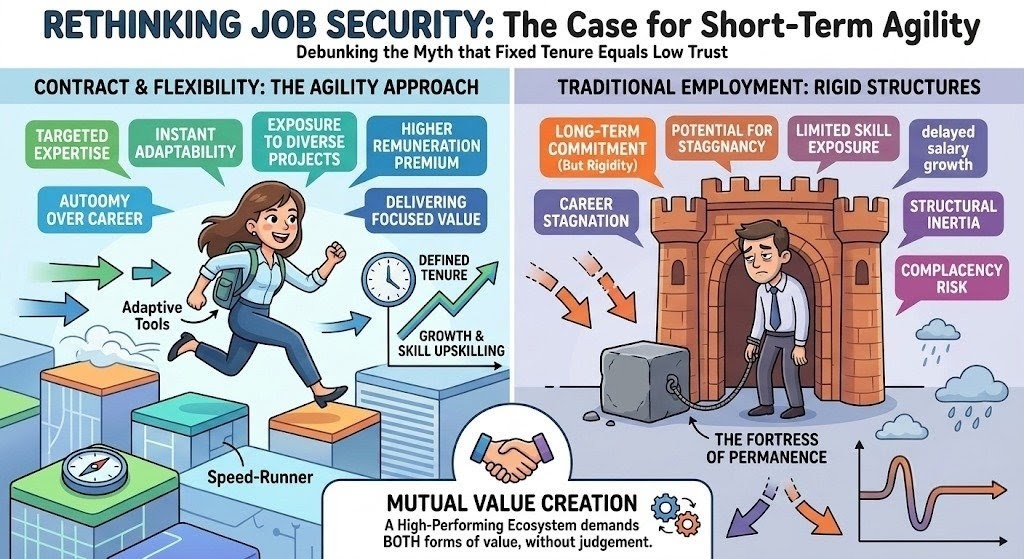
Recent discussions on various platforms have once again brought Short Term Contract employment back into the spotlight. Seeing yet another post questioning whether fixed tenure leadership roles signal a lack of trust or stability triggered a deeper look into how modern workforce strategy actually operates. While traditional views heavily favor permanent roles, practical realities show why contract engagements make complete strategic sense.
Employment Contract Dynamics
At the end of the day, every employment relationship rests on a contract. The debate around Short Term Contracts usually stems from a basic misunderstanding that fixed tenure equals low trust. In reality, all job agreements set clear boundaries, expectations, and terms between employer and employee.
Short Term Contracts give organizations the agility they need to pivot fast. Bringing talent onboard via contracts is not about doubting capabilities. It is simply about bringing in target expertise for specific phases, adapting quickly to project shifts, and running lean operations without extra baggage.
Agility and Market Adaptability
Modern organizations operate in fast-moving environments where skill needs change overnight. Rigid structures make quick changes almost impossible. Short Term Contracts give teams the freedom to dial expertise up or down based on immediate priorities without overburdening system capacity.
Strategic Cost Management and Mutual Benefits
Contract hiring keeps institutional spending tight by removing long-term overheads like permanent benefits, pension liabilities, and constant retraining costs. For professionals, contract roles usually come with higher upfront pay to balance out fixed tenure. This setup offers direct financial rewards, exposure to diverse projects, and complete freedom over career moves.
Pitfalls of Long Term Contracts
While permanent employment offers comfort, it comes with real risks for both sides. For organizations, permanent commitments lead to structural rigidity, making it tough to move budgets or revamp teams when markets shift. Over time, permanent setups can foster complacency, making underperformance difficult and expensive to fix due to legal loops.
For employees, long term positions can easily cause career stagnation and outdated skills. Staying inside one system for years reduces exposure to new technologies, fresh methodologies, and market-rate pay bumps. Professionals often miss out on the faster pay growth that comes with stepping back into the open market.
Value Creation and Expertise
Short Term Contracts naturally attract seasoned experts who thrive on delivering results within set timelines. Treating contract roles as somehow inferior misses the big picture on how modern high-performing organizations actually stay competitive.
It’s also crucial to acknowledge that a ‘short-term’ contract is often far from final for the right individual. We frequently see cases where high-performing, skill-agile professionals, who consistently add value and adapt to new challenges, receive successive renewals. I know of numerous examples in the industry, of Fixed Term Contract employees who have had their tenure extended repeatedly, remaining in dedicated service for close to 15 years or more. In these instances, the contract structure provides the organization with flexibility, but the employee’s indispensable skill set ensures long-term mutual commitment and professional stability.
