Sesame & Soul: The Merit of Shattila Ekadashi

Shattila Ekadashi is a powerful day of purification dedicated to Bhagwan Vishnu. The name itself reveals its essence: Shat (six) and Tila (Ellu in Kannada or sesame). It emphasizes the use of sesame seeds in six specific ways to cleanse sins and attract prosperity. This Ekadashi is unique because it focuses on karmic cleansing. According to the Padma Purana, observing this fast helps a person break free from poverty—not just financial, but also spiritual and mental. It is believed that for every sesame seed you donate on this day, you earn a thousand years of peace in the celestial realms.

In Hindu tradition, Ekadashi is not just a date on the calendar; she is a divine goddess and the personification of the 11th lunar day. Ekadashi is a Shakti (divine energy) who manifested from Bhagwan Vishnu’s own body. She is the embodiment of penance and purity, often depicted as a beautiful maiden equipped with divine weapons.

Ekadashi Vrata Set-up

The story traces back to the Satya Yuga and involves a fierce demon named Mura (or Murdanav). Mura had defeated the Devas (gods) and seized control of the heavens. Terrified, the gods turned to Bhagwan Vishnu for protection. Vishnu fought Mura for 1,000 celestial years. To change his strategy and draw the demon out, Vishnu traveled to a cave in the Himalayas called Himavati and entered a deep meditative sleep (Yog Nidra). Mura entered the cave and raised his sword to kill the sleeping Bhagwan. At that exact moment, a luminous woman emerged from Vishnu’s 11th sense (the mind/intellect). The demon was mesmerized by her beauty and challenged her. She agreed to marry him only if he could defeat her in battle. During their duel, she eventually beheaded Mura, saving Vishnu and the universe. When Vishnu woke up, he was pleased with her valor. He named her Ekadashi (since she appeared on the 11th day) and granted her a boon. She asked that anyone who fasts on her day be cleansed of their greatest sins and granted spiritual liberation (Moksha).

“Ekadashi” literally means eleven. The fast is meant to gain control over Eleven Senses: 5 sense organs or Jnanendriyas through which we perceive and comprehend the world around us : Ears (Shrotra): For hearing (Sound); Skin (Tvak): For touching (Feel); Eyes (Chakshu): For seeing (Sight); Tongue (Rasana): For tasting (Flavor); Nose (Ghrana): For smelling (Scent). 5 action organs or Karmendriyas through which we interact and respond to the world around us: Mouth/Speech (Vak): For speaking and communicating; Hands (Pani): For grasping, creating, and handling; Feet (Pada): For movement and locomotion; Excretory Organ (Payu): For elimination and cleansing; Reproductive Organ (Upastha): For procreation and generation and Finally, Mind (the 11th sense). The mind is considered the “Master Sense.” It coordinates all the other ten. For example, Without the mind’s focus, the eyes may see but the brain won’t register and so on.

Detaching from 5 Sense + 5 Action + 1 Mind (Ekadashi Organs)

It is said that the Papa Purusha (personification of sin) has no place to hide from Ekadashi’s power, so he takes shelter in grains on this day. This is why devotees strictly avoid rice and wheat during the fast.

The Legend behind Shattila Ekadashi

The legend of Shattila Ekadashi is a powerful lesson on the balance between personal devotion and social compassion. It is primarily found in the Bhavishyottara Purana as a conversation between Bhagwan Krishna and Narada Muni. Long ago, there lived a Brahmin woman who was an extraordinary devotee of Bhagwan Vishnu. She spent her entire life observing strict fasts, performing complex rituals, and maintaining deep celibacy. Her devotion was so intense that her body became frail and her soul incredibly pure. However, she had one major flaw: she never gave anything in charity. Despite her wealth, she never offered food to a hungry person, a Brahmin, or a monk.

Bhagwan Vishnu decided to teach her the value of Daana (charity). He descended to Earth disguised as a wandering beggar (Sanyasi) and approached her door for alms. The woman, annoyed by the interruption to her prayers, initially refused. When the beggar persisted, she lost her temper. Instead of giving him food, she picked up a lump of dry mud and dropped it into his begging bowl. Bhagwan Vishnu quietly accepted the alms and returned to his abode, Vaikuntha.

When the woman eventually died, she was granted a place in Vaikuntha because of her lifelong devotion. She was given a magnificent, gold-studded palace and a beautiful mango tree. However, when she entered the palace, she was shocked to find it completely empty. There was no furniture, no wealth, and most importantly, no food. She began to starve in the middle of her own paradise.

She prayed to Bhagwan Vishnu, asking why her devotion led to such a barren existence. The Bhagwan replied: “You received a palace because you were devoted, but since you only gave mud as charity on Earth, your home here is filled with nothing but that same mud.” He told her that soon, the wives of the demigods would visit her. He instructed her not to open the door until they explained the significance of Shattila Ekadashi. The woman followed his advice. When the celestial ladies arrived, she kept the door shut until they revealed the secret of the “Shattila or Six Sesame Seeds” ritual. She then observed the Shattila Ekadashi fast with full faith and donated sesame seeds as prescribed. And Lo!!! Her palace instantly filled with grains, wealth, and comforts. She understood that while fasting purifies the self, charity sustains the universe.

Miserly Woman & Bhagwan Vishnu

Takeaways

The legend emphasizes that spiritual merit is two-fold:
Vrata (Fasting): Purifies your internal character and body.
Daan (Charity): Secures your external abundance and supports others. THIS IS MOST IMPORTANT
It is pertinent to remember that one without the other is considered incomplete in the eyes of the Divine. Spiritual growth is incomplete without compassion and charity.

The Shat-Tila Rituals

Devotees use sesame seeds in six ways to gain maximum spiritual merit:

  1. Bathing: Mixing sesame seeds in bathwater.
  2. Paste: Applying sesame paste (ubtan) on the body.
  3. Havan: Offering seeds into the sacred fire.
  4. Libation: Offering water with seeds to ancestors (Tarpan).
  5. Eating: Consuming sesame-based food (like Ellunde or til-laddu).
  6. Charity: Donating seeds to the needy.

Procedures and Rituals for Puja

Preparation for Abhishekha

To observe Shattila Ekadashi at home, the focus is on simplicity and the sacred use of sesame seeds. Since it falls on January 14 this year (2026), we can easily integrate these steps into our morning routine.

  • Bath: Add a few black sesame seeds to your bathing water. This is believed to cleanse your aura.
  • Sankalpa (Intention): While bathing, make a mental resolve (Sankalpa) to observe the fast with devotion and kindness.
  • Clean your puja space and place an image or idol of Bhagwan Vishnu (or Krishna).
  • Light a Deepa (lamp) using ghee.
  • Offer yellow flowers, as yellow is the color most dear to Vishnu.
  • Abhisheka: If you have a small idol, perform a symbolic bath with water mixed with sesame seeds.
  • Naivedya: Offer sweets or dishes made of sesame, such as Ellunde or Til-Laddu or Til-Chakli.
  • Ensure the food that we offer as Naivedya (or that one we consume), is free of onion or garlic.
  • Recite the Vishnu Sahasranama (1000 names of Vishnu) or simply chant: Om Namo Bhagavate Vasudevaya
  • Read or listen to the Shattila Ekadashi Vrat Katha (the story of the stingy woman explained earlier) to remind yourself of the importance of charity
  • Daana or Charity (Most Important) Before sunset, set aside some sesame seeds, warm clothes, or food to give to someone in need. In the Indian context, donating Ellu-Bella or Til-Gur (sesame and jaggery) is considered highly auspicious on this day.
  • Parana (Breaking the Fast): Maintain the fast throughout the day. You can have fruits and milk if a full waterless fast is too difficult,
  • Break the fast the next morning after sunrise by taking a small portion of the Ellu or sesame seeds you offered to the Bhagwan.

Summary for 2026

In 2026, Shattila Ekadashi falls on Wednesday, January 14, coinciding with the auspicious period of Makar Sankranti.

Parana (Fast Breaking): January 15, between 07:15 AM and 09:20 AM.
Mantra: Vishnu Sahasranama or Om Namo Bhagavate Vasudevaya.
Vrata Date: January 14, 2026.

Since this Ekadashi falls on Makar Sankranti day, the spiritual benefits of donating sesame seeds are considered Akshaya (everlasting). Even a small donation goes a long way.
Amalaki Ekadashi: Grace Through Gooseberry Tree Worship

सशङ्खचक्रं सकिरीटकुण्डलं सपीतवस्त्रं सरसीरुहेक्षणम् ।
सहारवक्ष:स्थलशोभिकौस्तुभश्रियं नमामि विष्णुं शिरसा चतुर्भुजम् ॥

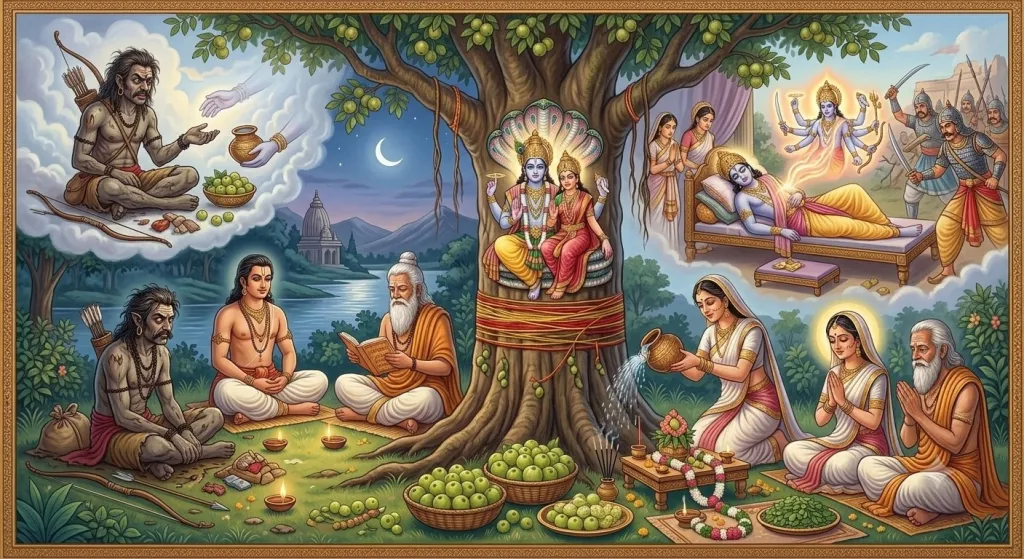
Amalaki Ekadashi occurs during Shukla Paksha (waxing phase of moon) of Phalguna month (February-March). It falls during vibrant atmosphere of Holi festival, marking arrival of spring season. Devotees dedicate this sacred day to worship Bhagawan Vishnu along with sacred Amalaki tree (Indian Gooseberry or Amla), seeking good health, removal of past sins, and ultimate spiritual liberation.

Meaning and Significance of Amalaki Ekadashi

In Sanskrit, Amalaki refers to Amla tree, while Ekadashi means 11th lunar day. Therefore, Amalaki Ekadashi translates to 11th day where sacred Amla tree is worshiped as manifestation of Bhagawan Vishnu.

Human life often suffers due to health issues, spiritual darkness, and karmic burdens. Observing fast on Amalaki Ekadashi with pure devotion cleanses physical body and mind. Scriptures mention that Bhagawan Vishnu and Maata Lakshmi reside permanently in sacred Amla tree. Worshiping this divine tree on Amalaki Ekadashi grants merit equal to donating thousand cows, bestows sound health, removes accumulated sins, and ensures residence in Vaikuntha.

Legend associated with Amalaki Ekadashi

Scriptures describe sacred story narrated by Sage Vasishtha to King Mandhata, involving pious King Chaitraratha who ruled prosperous kingdom of Vaidisha. King Chaitraratha was noble ruler, and all citizens in his kingdom were devoted to Bhagawan Vishnu. Every year, king and subjects observed all Ekadashi fasts with deep faith.

On Shukla Paksha Ekadashi of Phalguna month, King Chaitraratha along with subjects visited holy temple on riverbank where majestic Amalaki tree stood. They established sacred Kalash near tree, offered flowers, incense, sandalwood paste, and kept night vigil (Jagaran), singing devotional hymns in praise of Bhagawan Vishnu.

During night, hunter who was cruel, sinful, and survived by killing forest animals reached temple compound while searching for food. Hunter was extremely hungry and exhausted. Seeing large gathering of devotees praying before Amalaki tree, hunter sat quietly in corner of temple and watched whole night worship without eating anything. Unknowingly, hunter observed complete fast and kept night vigil on Amalaki Ekadashi.

Years later, hunter died and got reborn as powerful King Vasuratha in next life due to spiritual merit earned from watching Amalaki Ekadashi rituals. One day, King Vasuratha lost his way in dense forest while hunting and fell asleep under tree due to tiredness. Tribal bandits spotted sleeping king and tried to kill him with weapons. However, divine radiant energy emerged from body of King Vasuratha and destroyed all wicked bandits. When king woke up, heavenly voice informed him that divine protection was granted to him because of observing Amalaki Ekadashi in his previous life as hunter. King Vasuratha ruled righteously for long time and eventually attained Moksha.

Rituals to be performed on Amalaki Ekadashi

Devotee must wake up early in morning during Brahma Muhurta and take ritual bath using clean water without using soap, shampoo, or such cosmetic products.

Puja area should be cleaned thoroughly and idol or photo of Bhagawan Vishnu should be placed respectfully.

Visit Amalaki tree if available nearby, clean area around tree, establish sacred Kalash, and wrap clean cloth around trunk. Light ghee lamp, offer fresh yellow flowers, sandalwood paste, incense, Amla fruits, and Tulsi leaves to Bhagwan Vishnu and sacred tree.

Chant Vishnu Sahasranama, Hare Krishna Mahamantra, or Om Namo Bhagavate Vasudevaya continuously throughout day.

Listen to or read Amalaki Ekadashi Katha with family members in peaceful state of mind.

Offer your respects to parents and other elders, especially Guru, seeking their heartfelt blessings on this sacred morning.

Observe fast during entire day according to individual health capacity. Healthy individuals can observe strict fast without water or taking only water. Milk, curd, and fruits can be consumed if complete fasting is difficult due to health reasons. Rice, wheat, barley, lentils, pulses, and all food grains must be avoided strictly. Heavy spices, regular salt, garlic, onion, tea, coffee, outside processed food, and alcohol must be strictly avoided.

Perform evening Aarti with devotion, offer special Naivedya, donate Amla fruits, clothes, or food to Brahmin or needy person, and maintain noble thoughts, avoiding anger, backbiting, falsehood, or harsh speech.

Break fast next day on Dwadashi tithi during scheduled Parana time. Fast should be broken after sunrise once Hari Vasara period concludes. Offer naivedya to Bhagwan Vishnu, perform short prayer, and break fast by consuming prasada, water, or fruits before eating regular food.

PS: Article re-formatted into blocks and Header Image changed

Vijaya Ekadashi: Shri Rama Path to Conquering Evil

Vijaya Ekadashi occurs during Krishna Paksha (dark fortnight) of Phalguna month (February-March) according to Amanta calendar or Magha month according to Purnimanta calendar. It is sacred occasion coming just before Maha Shivaratri, dedicated to worshiping Lord Ramachandra incarnation of Bhagawan Vishnu. Devotees observe this fast to achieve victory over difficult circumstances, conquer internal enemies, wash away past sins, and secure spiritual progress.

Meaning and Significance of Vijaya Ekadashi

In Sanskrit, Vijaya means supreme victory, triumph, or success over formidable obstacles. Therefore, Vijaya Ekadashi translates to 11th day that grants victory in all noble and righteous endeavors.

Human life frequently encounters difficult challenges, spiritual doubts, and heavy karmic burdens. Observing fast on Vijaya Ekadashi with total faith generates divine power to overcome insurmountable difficulties. Scriptures mention that sincere devotion on this day grants success in difficult tasks, purifies subtle body from past sins, bestows peace of mind, and guides devotee towards ultimate liberation or Moksha.

Legend associated with Vijaya Ekadashi

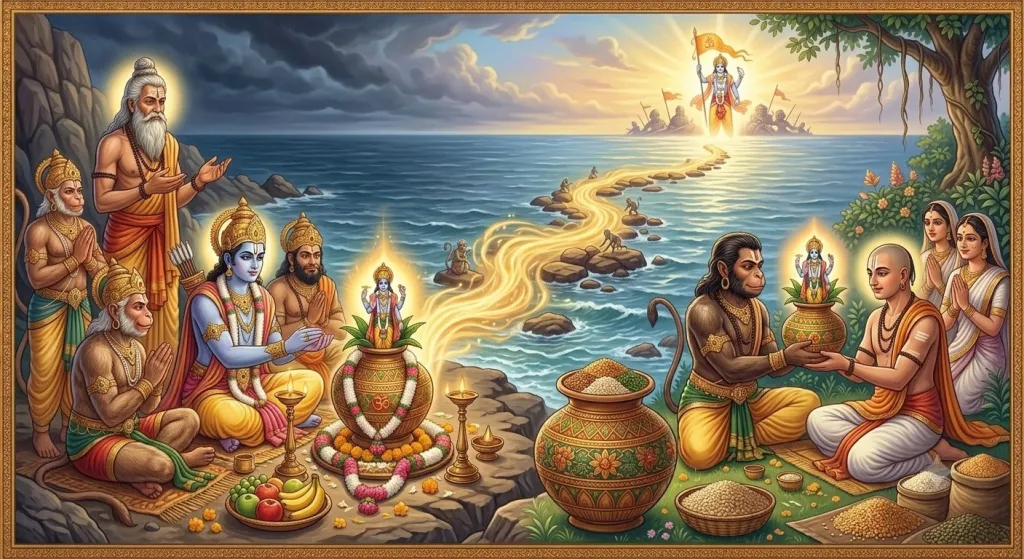
Scriptures describe sacred story narrated by Brahma to Sage Narada, involving Shri Ramachandra during Treta Yuga. When Devi Sita was abducted by demon king Ravana, Shri Rama along with brother Lakshmana and Vanara army reached shores of vast ocean, searching for way to reach Lanka.

Facing vast roaring ocean, Shri Rama asked Lakshmana for guidance on how army could cross deep waters. Lakshmana reminded Shri Rama about great Sage Bakadalabhya, who lived in ashram nearby. Shri Rama visited ashram of Sage Bakadalabhya and asked for spiritual remedy to cross ocean and conquer evil demon Ravana.

Sage Bakadalabhya instructed Shri Rama to observe fast on Krishna Paksha Ekadashi of Phalguna month, known as Vijaya Ekadashi, along with his commanders and army. Sage explained complete ritual, instructing to establish golden or brass pot filled with water and seven grains, place image of Bhagawan Vishnu on top, and observe strict fast with continuous devotion.

Shri Rama strictly observed Vijaya Ekadashi fast along with Lakshmana and entire Vanara army following holy instructions. By divine merit and spiritual energy of Vijaya Ekadashi fast, way was made across ocean, bridge Ram Setu was constructed successfully, and Shri Rama defeated Ravana in grand battle, rescuing Devi Sita and establishing Dharma.

Rituals to be performed on Vijaya Ekadashi

Devotee must wake up early in morning during Brahma Muhurta and take ritual bath using clean water without using soap, shampoo, or such cosmetic products.

Puja area should be cleaned thoroughly and sacred Kalash (pot filled with water, covered with leaves and coconut) should be established. Place idol or photo of Bhagawan Vishnu or Shri Rama on top or near Kalash respectfully.

Light ghee lamp, offer fresh yellow flowers, sandalwood paste, incense, seven grains (Saptadhanya), and Tulsi leaves to Bhagwan Vishnu.

Chant Vishnu Sahasranama, Hare Krishna Mahamantra, Ram Raksha Stotram, or Om Namo Bhagavate Vasudevaya continuously throughout day.

Listen to or read Vijaya Ekadashi Katha with family members in peaceful state of mind.

Offer your respects to parents and other elders, especially Guru, seeking their heartfelt blessings on this sacred morning.

Observe fast during entire day according to individual health capacity. Healthy individuals can observe strict fast without water or taking only water. Milk, curd, and fruits can be consumed if complete fasting is difficult due to health reasons. Rice, wheat, barley, lentils, pulses, and all food grains must be avoided strictly. Heavy spices, regular salt, garlic, onion, tea, coffee, outside processed food, and alcohol must be strictly avoided.

Perform evening Aarti with devotion, offer special Naivedya to Bhagwan Vishnu, donate water pot or grains to deserving Brahmin or needy person, and maintain noble thoughts, avoiding anger, backbiting, falsehood, or harsh speech.

Break fast next day on Dwadashi tithi during scheduled Parana time. Fast should be broken after sunrise once Hari Vasara period concludes. Offer naivedya to Bhagwan Vishnu, perform short prayer, and break fast by consuming prasada, water, or fruits before eating regular food.