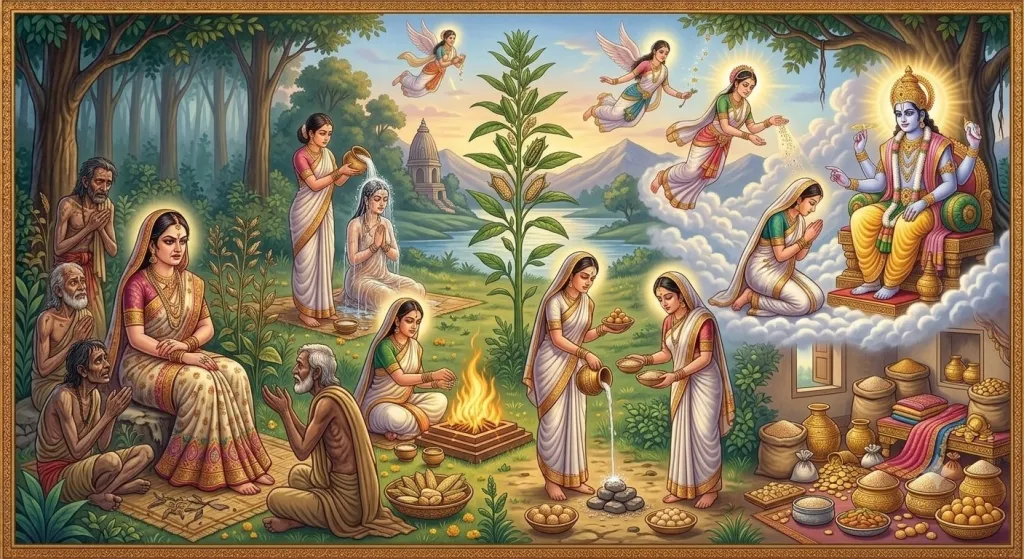
Shattila Ekadashi is a powerful day of purification dedicated to Bhagwan Vishnu. The name itself reveals its essence: Shat (six) and Tila (Ellu in Kannada or sesame). It emphasizes the use of sesame seeds in six specific ways to cleanse sins and attract prosperity. This Ekadashi is unique because it focuses on karmic cleansing. According to the Padma Purana, observing this fast helps a person break free from poverty—not just financial, but also spiritual and mental. It is believed that for every sesame seed you donate on this day, you earn a thousand years of peace in the celestial realms.
In Hindu tradition, Ekadashi is not just a date on the calendar; she is a divine goddess and the personification of the 11th lunar day. Ekadashi is a Shakti (divine energy) who manifested from Bhagwan Vishnu’s own body. She is the embodiment of penance and purity, often depicted as a beautiful maiden equipped with divine weapons.

The story traces back to the Satya Yuga and involves a fierce demon named Mura (or Murdanav). Mura had defeated the Devas (gods) and seized control of the heavens. Terrified, the gods turned to Bhagwan Vishnu for protection. Vishnu fought Mura for 1,000 celestial years. To change his strategy and draw the demon out, Vishnu traveled to a cave in the Himalayas called Himavati and entered a deep meditative sleep (Yog Nidra). Mura entered the cave and raised his sword to kill the sleeping Bhagwan. At that exact moment, a luminous woman emerged from Vishnu’s 11th sense (the mind/intellect). The demon was mesmerized by her beauty and challenged her. She agreed to marry him only if he could defeat her in battle. During their duel, she eventually beheaded Mura, saving Vishnu and the universe. When Vishnu woke up, he was pleased with her valor. He named her Ekadashi (since she appeared on the 11th day) and granted her a boon. She asked that anyone who fasts on her day be cleansed of their greatest sins and granted spiritual liberation (Moksha).
“Ekadashi” literally means eleven. The fast is meant to gain control over Eleven Senses: 5 sense organs or Jnanendriyas through which we perceive and comprehend the world around us : Ears (Shrotra): For hearing (Sound); Skin (Tvak): For touching (Feel); Eyes (Chakshu): For seeing (Sight); Tongue (Rasana): For tasting (Flavor); Nose (Ghrana): For smelling (Scent). 5 action organs or Karmendriyas through which we interact and respond to the world around us: Mouth/Speech (Vak): For speaking and communicating; Hands (Pani): For grasping, creating, and handling; Feet (Pada): For movement and locomotion; Excretory Organ (Payu): For elimination and cleansing; Reproductive Organ (Upastha): For procreation and generation and Finally, Mind (the 11th sense). The mind is considered the “Master Sense.” It coordinates all the other ten. For example, Without the mind’s focus, the eyes may see but the brain won’t register and so on.

It is said that the Papa Purusha (personification of sin) has no place to hide from Ekadashi’s power, so he takes shelter in grains on this day. This is why devotees strictly avoid rice and wheat during the fast.
The Legend behind Shattila Ekadashi
The legend of Shattila Ekadashi is a powerful lesson on the balance between personal devotion and social compassion. It is primarily found in the Bhavishyottara Purana as a conversation between Bhagwan Krishna and Narada Muni. Long ago, there lived a Brahmin woman who was an extraordinary devotee of Bhagwan Vishnu. She spent her entire life observing strict fasts, performing complex rituals, and maintaining deep celibacy. Her devotion was so intense that her body became frail and her soul incredibly pure. However, she had one major flaw: she never gave anything in charity. Despite her wealth, she never offered food to a hungry person, a Brahmin, or a monk.
Bhagwan Vishnu decided to teach her the value of Daana (charity). He descended to Earth disguised as a wandering beggar (Sanyasi) and approached her door for alms. The woman, annoyed by the interruption to her prayers, initially refused. When the beggar persisted, she lost her temper. Instead of giving him food, she picked up a lump of dry mud and dropped it into his begging bowl. Bhagwan Vishnu quietly accepted the alms and returned to his abode, Vaikuntha.
When the woman eventually died, she was granted a place in Vaikuntha because of her lifelong devotion. She was given a magnificent, gold-studded palace and a beautiful mango tree. However, when she entered the palace, she was shocked to find it completely empty. There was no furniture, no wealth, and most importantly, no food. She began to starve in the middle of her own paradise.
She prayed to Bhagwan Vishnu, asking why her devotion led to such a barren existence. The Bhagwan replied: “You received a palace because you were devoted, but since you only gave mud as charity on Earth, your home here is filled with nothing but that same mud.” He told her that soon, the wives of the demigods would visit her. He instructed her not to open the door until they explained the significance of Shattila Ekadashi. The woman followed his advice. When the celestial ladies arrived, she kept the door shut until they revealed the secret of the “Shattila or Six Sesame Seeds” ritual. She then observed the Shattila Ekadashi fast with full faith and donated sesame seeds as prescribed. And Lo!!! Her palace instantly filled with grains, wealth, and comforts. She understood that while fasting purifies the self, charity sustains the universe.

Takeaways
The legend emphasizes that spiritual merit is two-fold:
Vrata (Fasting): Purifies your internal character and body.
Daan (Charity): Secures your external abundance and supports others. THIS IS MOST IMPORTANT
It is pertinent to remember that one without the other is considered incomplete in the eyes of the Divine. Spiritual growth is incomplete without compassion and charity.
The Shat-Tila Rituals
Devotees use sesame seeds in six ways to gain maximum spiritual merit:
- Bathing: Mixing sesame seeds in bathwater.
- Paste: Applying sesame paste (ubtan) on the body.
- Havan: Offering seeds into the sacred fire.
- Libation: Offering water with seeds to ancestors (Tarpan).
- Eating: Consuming sesame-based food (like Ellunde or til-laddu).
- Charity: Donating seeds to the needy.
Procedures and Rituals for Puja

To observe Shattila Ekadashi at home, the focus is on simplicity and the sacred use of sesame seeds. Since it falls on January 14 this year (2026), we can easily integrate these steps into our morning routine.
- Bath: Add a few black sesame seeds to your bathing water. This is believed to cleanse your aura.
- Sankalpa (Intention): While bathing, make a mental resolve (Sankalpa) to observe the fast with devotion and kindness.
- Clean your puja space and place an image or idol of Bhagwan Vishnu (or Krishna).
- Light a Deepa (lamp) using ghee.
- Offer yellow flowers, as yellow is the color most dear to Vishnu.
- Abhisheka: If you have a small idol, perform a symbolic bath with water mixed with sesame seeds.
- Naivedya: Offer sweets or dishes made of sesame, such as Ellunde or Til-Laddu or Til-Chakli.
- Ensure the food that we offer as Naivedya (or that one we consume), is free of onion or garlic.
- Recite the Vishnu Sahasranama (1000 names of Vishnu) or simply chant: Om Namo Bhagavate Vasudevaya
- Read or listen to the Shattila Ekadashi Vrat Katha (the story of the stingy woman explained earlier) to remind yourself of the importance of charity
- Daana or Charity (Most Important) Before sunset, set aside some sesame seeds, warm clothes, or food to give to someone in need. In the Indian context, donating Ellu-Bella or Til-Gur (sesame and jaggery) is considered highly auspicious on this day.
- Parana (Breaking the Fast): Maintain the fast throughout the day. You can have fruits and milk if a full waterless fast is too difficult,
- Break the fast the next morning after sunrise by taking a small portion of the Ellu or sesame seeds you offered to the Bhagwan.
Summary for 2026
In 2026, Shattila Ekadashi falls on Wednesday, January 14, coinciding with the auspicious period of Makar Sankranti.
Parana (Fast Breaking): January 15, between 07:15 AM and 09:20 AM.
Mantra: Vishnu Sahasranama or Om Namo Bhagavate Vasudevaya.
Vrata Date: January 14, 2026.
Since this Ekadashi falls on Makar Sankranti day, the spiritual benefits of donating sesame seeds are considered Akshaya (everlasting). Even a small donation goes a long way.