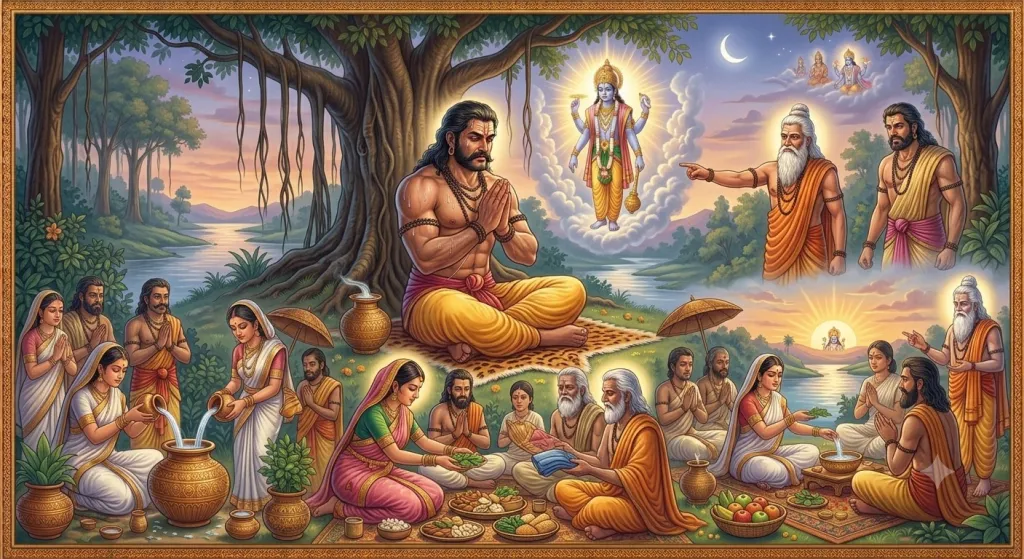
Nirjala Ekadashi: Unlocking Merit of All Ekadashis

यस्य स्मरणमात्रेण जन्मसंसारबन्धनात् ।
विमुच्यते नमस्तस्मै विष्णवे प्रभविष्णवे ॥

Nirjala Ekadashi occurs during Shukla Paksha (waxing phase of moon) of Jyeshtha month (May-June). It is considered most rigorous, spiritually rewarding, and supreme among all twenty four Ekadashis observed in year. Devotees dedicate this day to worship Bhagawan Vishnu with complete self-control, abstaining strictly from food and even single drop of water throughout fast duration.

Meaning and Significance of Nirjala Ekadashi

Understanding name itself reveals supreme nature of this sacred day. In Sanskrit, Nir means without and Jala means water. Therefore, Nirjala Ekadashi translates to 11th day observed completely without water. It is also popularly known as Bhima Ekadashi or Pandava Ekadashi.

Observing fast without water during hot summer month of Jyeshtha tests physical endurance, mental strength, and spiritual determination. Scriptures state that observing Nirjala Ekadashi fast sincerely grants benefits equal to observing all twenty four Ekadashis of year combined. It cleanses accumulated sins, purifies mind, grants good health, prosperity, and ensures path towards ultimate liberation or Moksha.

Legend associated with Nirjala Ekadashi

Scriptures describe sacred story narrated by Maharishi Ved Vyasa to second Pandava brother Bhimasena. While all other Pandava brothers Yudhishthira, Arjuna, Nakula, Sahadeva, and their wife Draupadi observed every Ekadashi fast strictly, Bhima faced great difficulty. Bhima possessed immensely powerful appetite driven by fire of Vrikadhara in his stomach, making it impossible for him to control hunger or fast twice every month.

Feeling distressed that he was missing out on spiritual blessings, Bhima approached Maharishi Vyasa seeking solution. Bhima humbly expressed his inability to control hunger twenty four times year, but expressed deep wish to attain benefits of Ekadashi fasts and reach Vaikuntha.

Maharishi Ved Vyasa advised Bhima to observe single, strict fast on Nirjala Ekadashi in Shukla Paksha of Jyeshtha month. Maharishi explained that on this specific day, devotee must refrain from consuming food and even single drop of water from sunrise of Ekadashi until sunrise of Dwadashi. Sage assured Bhima that by observing this tough penance with devotion to Bhagawan Vishnu, he would obtain complete merit of all twenty four Ekadashis of year.

Bhima accepted advice of Maharishi Vyasa and observed fast with utmost dedication. Due to intense heat and hunger, Bhima collapsed during fast, but by divine grace of Bhagawan Vishnu and guidance of Vyasa, he completed fast successfully. Thus, this sacred day came to be known as Bhima Ekadashi.

Rituals to be performed on Nirjala Ekadashi

Devotee must wake up early in morning during Brahma Muhurta and take ritual bath in clean water.

Puja area should be cleaned thoroughly and idol or photo of Bhagawan Vishnu, along with Goddess Lakshmi, should be placed respectfully.

Light ghee lamp, offer fresh yellow flowers, sandalwood paste, incense, Tulsi leaves, and seasonal fruits like melons to Bhagwan Vishnu.

Chant Vishnu Sahasranama, Hare Krishna Mahamantra, or Om Namo Bhagavate Vasudevaya continuously throughout day.

Listen to or read Nirjala Ekadashi Katha with family members in peaceful state of mind.

Observe strict fast without consuming any food or water for entire twenty four hour period, starting from sunrise of Ekadashi to sunrise of Dwadashi. Healthy individuals should refrain from even drinking water. Elderly people, children, or individuals with medical conditions can consume water, milk, or fruits according to capability. Food grains like rice, wheat, barley, lentils, and pulses must be strictly avoided. Heavy spices, regular salt, garlic, onion, tea, coffee, and alcohol must be avoided completely.

Perform charity on this day by donating pots filled with clean drinking water, hand fans, clothes, food, and umbrellas to needy people or Brahmins.

Perform evening Aarti with devotion and maintain noble thoughts, avoiding anger, backbiting, falsehood, or harsh speech.

Break fast next day on Dwadashi tithi during scheduled Parana time. Fast should be broken after sunrise once Hari Vasara period concludes. Offer water, clothes, and naivedya to Bhagwan Vishnu, perform short prayer, offer water to thirsty people, and break fast by consuming water, prasada, or fruits before eating regular food.

PS: Article re-formatted into blocks and change of Header Image

I have written another article on the same subject. You can read it here

Nirajala Ekadashi – Clear as Pure Water

Among 24 Ekadashis (11th day of Lunar Months) in the Hindu calendar, some of them are considered extremely important. Nirjala Ekadashi is one among them. It is observed on the 11th day (Ekadashi) of the Jyeshta Maasa (Month) in the Shukla Paksha (Waxing Phase of the moon). Nirjala Ekadashi is also known as Bhimasena Ekadashi, Pandava Ekadashi and Bhima Ekadashi. Like all Ekadashis, this Ekadashi is dedicated to worship of Bhagwan Vishnu.

Om Namo Narayana

The Legend

The belief is that observing Nirajala Ekadashi Vrata (Nirjala – Without Water) reaps the benefits of observing all the 24 Ekadashi Vratas. Nirjala Upavasa Vrata is fasting where complete stringent fasting is observed, without consuming Water. This makes it even more taxing on the human body subjecting it to real penance as going waterless duing Jyeshta month (peak summer) is only for the strong-willed and true devotee. The legend has it that Bheemasena, the 2nd among the 5 Pandava brothers, who is a voracious eater, could not resist eating and hence never observe Ekadashi Upavasa while everyone else in the family were religiously going about fasting and other rituals related to it. He feels guilty that he is dishonouring Bhagwan Vishnu by not observing Ekadashi vrata and approaches Maharshi Veda Vyasa. He pleads “Everyone observes Ekadashi Vrata, but please tell me how to do it without fasting” Maharshi Veda Vyasa then advises him – just for a day in the whole year, on Jyeshta Shukla Ekadashi observe Upavasa without any Food and not even having a drop of water. If you do that, I bless you that benefits of observing all 24 Ekadashis will be bestowed on you. This will be true to every devotee who observes Nirajal Ekadashi”

Bhima with Maharshi Ved Vyasa
Pic Courtesy: https://indiachezmoi.wordpress.com/2014/06/09/bhima-ekadashi/

It is pertitnent to note, Upavasa is not just about Fasting. Upavasa according to Charak Samhita, is giving up of anger etc. (grief, greed etc.) and following of truthfulness. It is said that “complete dissociation from sinful acts, association of virtuousness and/or good qualities or person of good qualities should be known as upavasa not just the emaciation of the body

Beliefs

It is believed Tulsi should not be picked on any Ekadashi, but since it is essential part of worship of Bhagwan Vishnu, a necessity on Ekadashi it is usually picked the previous day. Tulsi plants are also not watered on Ekadashi. It is because Tulsi, an ardent devotee of Vishnu will be observing Upavasa and also meditating and we are not to disturb Her during this time.

Vrat and Pooja Vidhana

  • Wake up early in the morning and have a water-only bath (no use of any shampoo or soap or any other such cosmetic products).
  • Ensure you don’t commit any act hereone that can be considered impure (in deed or thought)
  • Offer Puja to Bhagwan Vishnu and also pay your respects to Parents and other Elders, especially Guru
  • Chant Vishnu Sahasranama, Shri Rama Raksha Stotra, and Aranya Kanda of Srimad Ramayana
  • Do not consume any food, not even a drop of water (except for Achamya during Sandhya Vandane)
  • Continue the fasting until next day (Dwadashi) and do the Parana (breaking of fast at sunrise, ensure it is Dwadashi tithi)

Aum Namo Narayanaya

Copied and reproduced verbatim for wider reach within the owner’s circle. The section details association with Gayatri Janmotsava.

If there are any objections, the Content owner may revert to me for Attribution or take down

Gayatri Janmotsav is a very significant festival in India. Since Vedas are central to Hinduism, and Gayatri Janmotsav celebrates the birth of Goddess Gayatri, the mother Vedas, so Gayatri Jayanti has come to acquire a lot of importance. Goddess Gayatri is worshipped as Veda Mata or the mother of Vedas, Dev Mata and Vishwa Mata.

It is believed that the Goddess appeared in the form of knowledge on Shukla Paksha Ekadashi in the month of Jyeshtha. This day is also known as Nirjala Ekadashi. The knowledge which She represented was shared by Sage Vishwamitra to the world, leading to the elimination of ignorance.

According to Atharvaveda, Maa Gayatri has the power of age, life, fame, and wealth. She is also known as Panchmukhi in Sanatana Dharma. It means that the universe is made up of five elements i.e. Earth, Light, Water, Air, and Sky. One can consider Mother Gayatri as a form of life force that exists in every human being. Hence, it is the reason that Goddess Gayatri is considered the core of all power.

Maa Gayatri is characterised by five heads and ten hands with each head representing the Pancha Tattvas i.e. Prithvi, Agni, Jal, Vayu and Akash. When you see Her picture, you will see Her seated on a lotus and holding ten different items in each of Her hand such as Shankha (conch) Chakra (discus), Kamal (lotus), Varada (a mudra), Abhaya (another mudra), Kasha (a whip), Ankush (a sharpened weapon with a pointed hook), Ujjwala (a utensil), Rudraksha Mala and a Gada (mace).

On this day, Sage Vishwamitra first uttered Gayatri Mantra. Some people also believe that Goddess Gayatri, the Mother of Vedas, appeared on the earth on this day. Devi Gayatri bestowed Her devotees with all spiritual and worldly happiness.

It is believed that chanting the Gayatri Mantra relieves the devotees from miseries and hardships of life and frees the individual from all the sins. It is supposed to end all suffering and fill our lives with joy and happiness. On the occasion of Gayatri Janmotsav, devotees celebrate the day by chanting the Gayatri Mantra.

Gayatri Mantra:
ॐ भूर्भुवः स्वः तत्सवितुर्वरेण्यं
भर्गो देवस्य धीमहि धियो यो नः प्रचोदयात्।