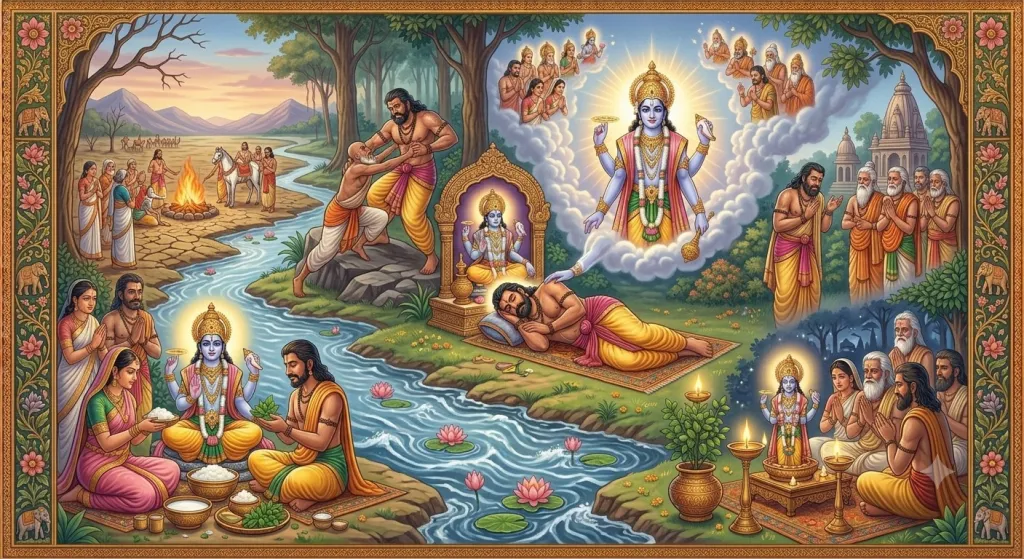
Muni Narada on his rounds around the Universe arrived in Dwaraka to meet Bhagwan Krishna and sang His Glory. It was Ganesha Chaturthi and Narada tells Krishna about significance of the day and why no one should see the moon on that day.

Narada visits Krishna
Pic Source: http://bhagavatham.blogspot.com/2012/12/65-bhagavatha-narada-visits-krishna.html
Curse of the Moon & Mithya Dosha
It was late night and Ganesha was returning to Kailasa after a sumptuous feast hosted by Kubera, the God of Riches and considered the richest among all Gods.

Kubera – God of Wealth
Pic Source and for more details : https://www.templepurohit.com/hindu-gods-and-deities/lord-kubera-hindu-gods-and-deities/
Ganesha had eaten a lot of his favourite sweet, the Modakas and was returning on his Vahana (mount), Mooshika (Mouse). It was a Pournami (Full moon night) and the moon shone in the night in his resplendest best – in spotless white. Ganesha and his mouse were trudging along and suddenly a snake appeared in their path. Since mouse is considered prey of snakes, it was frightened and rushed aside for safety. Ganesha falls down on to the Ground and his stomach broke open, and all the modakas he had eaten rolled out. Ganesha stuffed all the Modakas back, picked the snakes and tied it around the stomach to pack it in. Embarrassingly He looked for his vahana, mouse and saw Moon laughing at His predicament. The moon, having witnessed the entire episode could not control his laughter which made Ganesha seethe in anger. He broke one of His tusks and flung it at the moon creating a crater on it and curses that he would never be a complete sphere any more and keeps getting disfigured. Thus we find the moon has a crater which we can see even from the Earth and it waxes and wanes every fortnight. He also curses that anyone who sees the Moon will attract Mithya Dosha (defamation by false accusations) Moon becomes repentant and pleads with Ganesh to redeem him from the curse. Ganesha says, the curse once delivered cannot be retrieved but reduce the effects. He then says no one should see the moon on on Ganesh Chaturthi.
Bhagwan Krishna, the dutiful King that He was, immediately makes a proclamation to this effect and lets all His subjects know the ill-effects of seeing the moon. Narada Muni then leaves the place and goes back to Vaikunta. Unfortunately for Krishna, while milking Gomata, He sees reflection of the moon in the Milk bowl. No one is spared of the curse and has to undergo the consequences, even if it were Bhagwan Krishna.
The Legend of Symantaka Mani – Marriage of Krishna & Satyabhama
Prasenjit, nobleman of of Yadava Kula (same as Bhagwan Krishna) and Satrajit were brothers. Prasenjit also was uncle of Satyabhama, wife of Bhagwan Krishna. Satrajit was a devotee of Surya (Sun God). Pleased with his unwavering Devotion, Surya gifted Satrajit a ruby jewel called Syamantak Mani. It belonged originally to Surya, who wore it around his neck. It was said that whichever land possessed this jewel would never encounter any calamities such as droughts, floods, earthquakes or famines, and would always be full of prosperity and plenitude. Wherever the jewel remained, it would produce for the keeper eight bhāras (an ancient measure of weight and translating about ~77 kgs) of gold daily. It was also the source of the brilliant appearance of Surya.
Satrajit was walking along the sea shore, praying ardently, when Surya appeared before him. Seeing Him fiery form, Satrajit asked him to appear in a less blinding form, so that he could see him clearly. Surya took Syamantaka mani off his neck, and Satrajit saw him an ordinary looking dwarf form of Surya When Surya offered him a boon, and he asked for the jewel which Surya promptly gifts him as a boon.

Surya gifting Syamantaka Mani to Satrajit
Pic Source: https://www.sunosunati.com/story/syamantak-mani-ki-katha
Satrajit threaded Syamanta Mani and wearing it around his neck returned to Dvaraka. He was dazzling in such splendour that subjects there mistook him for Surya. Krishna requested him to present the jewel to Ugrasena, the supreme leader of the Yadavas and rightfully and more entitled as a King, but Satrajit refuses to do so and presents it to Prasenjit instead.
Once, Prasenjit went to the jungle for hunting wearing the jewel and a lion killed Prasenjit and took away the jewel. This lion in turn was confronted by Jambavan (Devotee of Shri Rama and King of bears). Jambavan finally wins the fight with the lion and takes away the Syamantaka Mani.
When Prasenjit did not return from the jungle his brother Satrajit was worried and there was a grapevine among people that Shri Krishna was eyeing the Symantaka Mani and accused Krishna of killing Prasenjit for stealing the jewel. To prove his innocence, Shri Krishna went to the jungle. Krishna traces the trail and finds Prasenjit’s body with tell tale signs of being killed by Lion and then follows the trail of Lion and finds another spot where Lion lies dead. He further follows the trail and comes at the door of Jambavan’s cave. He peeps into find children of Jambavan playing with the Symantaka Mani. Jambvan confronts Krishna and both fight for 28 days after which Jambvan was defeated. He then realised that Krishna was his Ishta Bhagwan Shri Rama’s form and penitently gives Krishna the jewel and also his daughter Jambavati in marriage.

Jambavan returning the Syamantaka Mani and Offering Jambavati as Krishna’s wife
Picture Source: http://sarayutoayodhya.blogspot.com/2014/03/syamantaka-mani.html
Krishna returns to Dwaraka and hands the jewel over to Satrajit, who also regrets making false accusation. He offers Krishna the Symantaka Mani and also his daughter Satyabhama in marriage. Krishna accepted Satyabhama as His wife but did not accept the jewel. Krishna washed the stain off His reputation.

Symantaka Mani (Believed to be Kohinoor now – first looted by Allaudin Khilji & then stolen by British)
This story goes on to prove that irrespective of who you are, you have to bear consequences of actions that you perform. Even if you are Shri Krishna who was falsely accused of Murder and theft.
Sighting of Moon on Ganesh Chaturthi – Remedy
If you accidentally (or deliberately) see the moon on Ganesh Chaturthi, chant the following mantra
Simhah Prasenamavadhitsimho Jambavata Hatah।
Sukumaraka Marodistava Hyesha Syamantakah॥
Then read/listen to the Symantaka Mani Story (as elucidated above) and worship Shri Ganesha sincerely. He will bless you and ensure that you do not become of victim of Mithya Dosha
Note: The Story is compiled from various sources (both online and offline). All credits to original authors for the content and also for the pictures used in this article.
One of the critical source was this Kannada song – a legendary song sung by Shri PB Srinivas and a a must play in Karnataka and Kannadiga homes and Pandals on Ganesh Chaturthi. Listening to this song is a remedy from Mithya Dosha due to sighting of moon on Ganesh Chaturthi
Jai Ganesha