International Day of Yoga – The Background

Dignitaries Light the Lamp to get the Summit Going – Deepam Karoti Kalyanam

It was a chilly wintry Sunday morning on 4th December 2011, when prominent Yogis of Bharat and some from abroad assembled in the picturesque, The Art of Living International Ashram, in Bengaluru for the 1st day of Yoga: A Science for World Peace, organised jointly by The Art of Living, Swami Vivekananda Yoga Anusandhana Samsthana (S-VYASA) and Portuguese Yoga Confedaration under the leadership of Pujya Gurudev Sri Sri Ravi Shankar ji.

Distinguished Dignitaries on the stage
Luminaries on Stage and Click by the Author from the Audience

For an ordinary seeker like me, it was goosebump moments just to be in the presence of virtual who’s who of the Yoga World. Imagine the energy exuded from the stage above when you have Yoga Shiromani Padma Vibhushan Shri Bellur Krishnamachar Sundararaja Iyengar (Popularly known as BKS), Padma Bhushan Sri Sri Sri Balagangadharnath Swamiji of Adi Chunchanagiri Mutt, Swami Paramatmananda-General Secretary of Hindu Dharma Acharya Sabha, Swami Baba Ramdev of Patanjali Yogpeeth, Yogarshi Subodh Tiwari of Keivalyadhama Yoga Institute, Padmashri Dr. Nagendra – Chancellor S-VYASA, Karpadi Siddalingeshwara Swamiji of Yogavana Betta, Jagat Guru Amrta Suryananda Maha Raj-President of Portuguese Yoga Confederation, Dr. Ramesh Bijlani of Aurobindo Ashram, Swami Radanath of ISKCON and others

News item – Deccan Herald – 5th December 2011
Note the pen in Pujya Gurudev Sri Sri’s hands (scroll down to the end why I mentioned specifically)

Yogis and delegates deliberated over a period of 2 days to evolve plans to standardize yoga education while allowing the flexibility for innovations and classical contributions of Yoga Gurus and Yoga Schools. It was felt by the delegates that the standardisation is a must to ensure consistency of delivery, evaluation and improving practice and teaching of Yoga, which then can become an objective tool for value-based education and a catalyst for social transformation and facilitate the use of yoga as a performance enhancer and stress buster..

Yoga today has become an integral part of wellness strategy and agnostic to race, nationality and ethnicity. In recent years, medical researchers are exploring therapeutic benefits of yoga. There are compelling evidences to use yoga as a lifestyle intervention for stress and lifestyle related psychosomatic diseases. Presentations during the summit, on basic research on yoga has also made out that yoga facilitates scholastic and occupational performance in children and adults respectively.

On the 1st day of the summit, Shri BKS Iyengar moved the following proclamation (see picture below for the exact resolution)

Shri BKS Iyengar ji Addressing the Delegates and moving the Proclamation
Proclamation – International Yoga Summit – 4th December 2011 – Art of Living, Bengaluru, India

On the 2nd and final day of the summit, the resolution of Proclamation was adopted by all delegates and participants

Reading out the Proclamation passed by the Participants

Amazing and mind-boggling display of Hatha Yoga to a very advanced levels were part of the two day conference.

Yogasana Puja by Delegate from Portugues Yoga Confederation
Advance Hatha Yoga Demonstration during Satsang in Amphi Theatre, Art of Living, International Centre, Bengaluru

The UN Resolution

In his opening address of the 69th session(click on the link for full text) of the General Assembly, Hon’ble Prime Minister Narendra Modi mooted the proposal saying, “Yoga is an invaluable gift from our ancient tradition. Yoga embodies unity of mind and body, thought and action, a holistic approach that is valuable to our health and our well-being. Yoga is not just about exercise; it is a way to discover the sense of oneness with yourself, the world and the nature.

With the above address of Prime Ministet as background, on December 11th 2014, United Nations and the UNESCO resolved to observe June 21st as International Day of Yoga, and the resolution was passed by the UN General Assembly with a whopping majority of 175 Countries, the biggest majority for any of the resolutions in the History of United Nations.

As the resolution notes, “the importance of individuals and populations making healthier choices and following lifestyle patterns that foster good health.” In this regard, the World Health Organization has also urged its member states to help their citizens reduce physical inactivity, which is among the top ten leading causes of death worldwide, and a key risk factor for non-communicable diseases, such as cardiovascular diseases, cancer and diabetes.

As United Nations says, Yoga is an ancient physical, mental and spiritual practice that originated in India. The word ‘yoga’ derives from Sanskrit and means to join or to unite, symbolizing the union of body and consciousness.

Today it is practiced in various forms around the world and continues to grow in popularity. No denying Yoga is very much Hindu system (which inherently is Secular) and Sanatana Dharma’s faith agnostic contribution to Humanity

International Day of Yoga-2023

Hon’ble Prime Minister Narendra Modi to lead International Day of Yoga 2023 celebrations in the United Nations

It is also yet another proud moment for India this year as Hon’ble Prime Minister Narendra Modi would be leading the sessions on 9th International Day of Yoga celebrations(The Link works at the time of writing this article), hosted by our Permanent Mission to the United Nations from 6:30 pm IST (9:00am EST) on 21st June 2023. You can watch it live on Youtube

Representational Image

A Prized Possession

Something personal related to the International Yoga Summit, International Day of Yoga is my prized possession which is now framed and preserved for posterity. It was my pen that used by all the Yogis, to sign the proclamation on 4th December 2011. Grateful to Shri Vinay Tadimalla ji, then Secretary to Pujya Gurudev Sri Sri Ravi Shankar ji, while giving me the pen, told me “you would be desperately wanting this pen back and here it is”.

The most Precious Possession

Some random Clicks of International Day of Yoga, over the years that I have been part of (either leading on stage or as participant)

Shantiniketan Layout, Arekere in 2016, shared by a Participant

Navaratri – Sanctity in Motion: Garbha Rituals, Legends, and Hindu Identity

Garbha – Reverence of Maata Durga in Various Forms

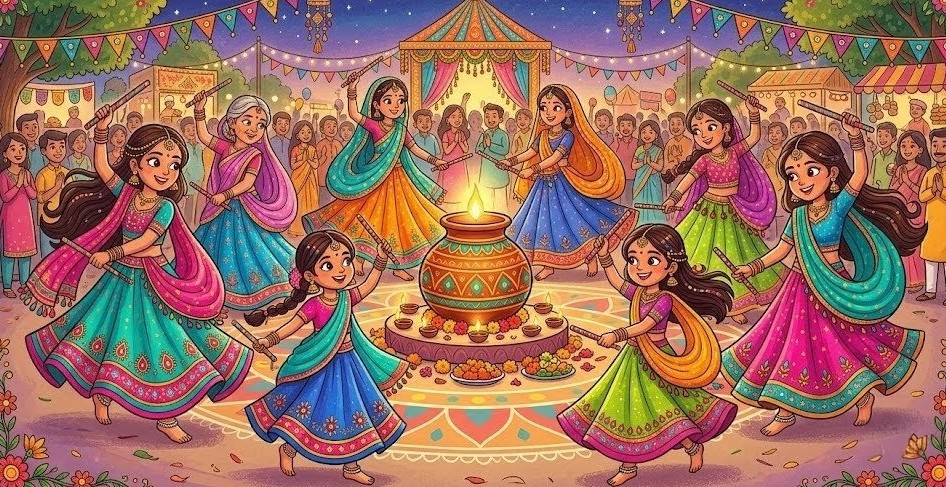
Navaratri festival stands as grand sacred celebration dedicated to Divine Mother in her various glorious manifestations. Among many devotional practices observed across Bharat during nine holy nights, Garba holds central place as spiritual movement filled with profound devotion, rhythm, and cosmic symbolism. Though widely recognized today as vibrant folk dance, Garba is fundamentally sacred Hindu ritual centered around adoration of Jagatjanani Sri Durga Devi. Navaratri Garbha, the lamp inside earthen pot symbolizes the divine light or soul within the human body, while the circular dance represents the eternal cycle of life – an integral belief of Sanatana Dharma.

Garba honors the divine feminine energy (Shakti or Maa Durga), highlighting creation, protection, and transformation  The dance celebrates the womb as a sacred space, linking the human body to the cosmic source of life. The participation of women in Garba symbolizes the living power of motherhood, compassion, and courage, while the lamp signifies the spark of Maata Durga within every individual

Garbha-Origin and Etymology

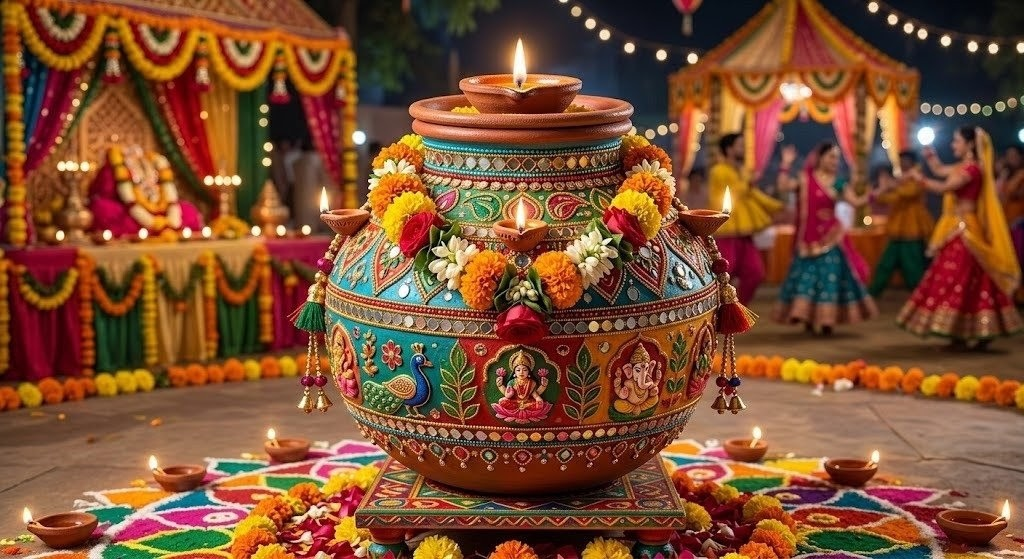
Word Garba originates directly from ancient Sanskrit root term Garbha, which translates to womb or innermost vessel of life. Deeply rooted in Shakta traditions, worship revolves around sacred earthen vessel filled with perforated holes called Garbho or Garbha Deep. Inside this perforated clay pot, small oil lamp is lit, glowing continuously throughout nine auspicious nights of Navaratri. The light emerging through the holes symbolizes how inner consciousness manifests through action, speech, and conduct, reflecting the sacred presence of the soul in the physical form

Garbha Pot (or Kalash)

Earthen pot symbolizes human physical body formed out of five basic elements of nature, while small holes represent nine gateways or senses of human vessel. Flame lit inside represents Atman, eternal soul or divine spark residing within every living being. By moving in circular formations around this lit pot, devotees acknowledge presence of Supreme Mother Sri Adi Parashakti as ultimate source of life, creation, and consciousness. Dancers moving in circular formations around Garbha Deep, mirrors the cyclical nature of life – birth, growth, death, and rebirth.

Legends & Scriptural Foundations

Legends detailed in sacred texts like Sri Devi Mahatmyam and Sri Devi Bhagavatam explain spiritual foundation of Navaratri celebrations. As per sacred lore, demon Mahishasura caused widespread chaos across all three worlds after receiving boon that no man, Deva, or earthly creature could defeat him. To protect cosmic order and uphold Dharma, Trimurti consisting of Bhagavan Sri Brahma, Bhagavan Sri Vishnu, and Bhagavan Sri Shiva pooled their supreme cosmic energies, giving rise to Bhagavati Sri Durga Devi.

Equipped with celestial weapons bestowed by Bhagavan Sri Vishnu, Bhagavan Sri Shiva, Bhagavan Sri Indra, and other deities, Mahadevi fought Mahishasura and his demon army for nine full days and nights. On tenth day, celebrated as Vijayadashami, Mahadevi vanquished demon and restored cosmic peace. Garba ritual dance represents blissful cosmic celebration of victory of Dharma over Adharma, divine light over darkness, and spiritual wisdom over ignorance.

Core Rituals and Symbolic Movements

Performing Garba involves specific ritual procedures that carry deep Vedantic philosophy. Before any dance movement begins, sacred Sthapana of Kalash or Garbha Deep takes place alongside holy picture or consecrated idol of Sri Durga Devi. Devotees perform Arati, offer fresh flowers, and light sacred lamp to invoke grace and presence of Divine Mother.

Dance itself is performed in concentric circles around central sanctum containing Garbha Deep or idol of Divine Mother. Circular movement carries profound spiritual meaning. As devotees move in continuous circles, they remember cycle of Samsara, representing continuous birth, life, death, and rebirth across universe.

Only central point containing Garbha Deep remains fixed, stationary, and unchanging, symbolizing Nirguna Brahman or eternal unmanifest Truth. Humans and cosmic bodies may move through endless cycles of existence, but Supreme Mother remains eternal unchanging anchor. Synchronized clapping called Taali rhythmically activates inner energy channels while praising Mahadevi through traditional devotional songs called Garbi.

Regional Variations and Parallel Practices Across Bharat

Devotion to Divine Mother during Navaratri manifests in diverse regional cultural practices across every region of India, sharing same underlying spiritual core as Garba.

Bathukamma in Telangana and Andhra Pradesh

During Navaratri period, women in Telugu lands assemble beautifully arranged floral stacks called Bathukamma, shaped like temple gopuram. They sing traditional devotional hymns praising Sri Maha Gauri Devi and move in graceful circular paths around floral arrangement, echoing core circular movement seen in Garba.

Dhunuchi Naach in West Bengal

In eastern region during Durga Puja celebrations, devotees participate in vibrant Dhunuchi Naach. Devotees hold clay censers filled with burning coconut husk and frankincense, dancing rhythmically before Sri Durga Devi to beats of Dhak drums to invoke divine presence and purify environment.

Kummi and Kolattam in Tamil Nadu

In southern region, women celebrate Navaratri with traditional folk dances like Kummi and Kolattam during Golu celebrations. Dancers form circular groups, clapping hands or striking decorated wooden sticks in rhythm while chanting hymns in praise of Sri Maha Lakshmi Devi, Sri Maha Saraswati Devi, and Sri Parvati Devi.

Bhondla and Tarangamel in Maharashtra and Goa

In western states, Maharashtrian women perform Bhondla or Hadga rituals, dancing in circles around image of Bhagavan Sri Ganesha or elephant symbols during harvest season. Similarly, Goan folk dances celebrate seasonal abundance and invoke protective grace of local Gramadevatas.

Undisputable Hindu Identity

Regardless of modern adaptations or broad community participation, Garba remains fundamentally and undeniably an authentic Hindu ritual deeply rooted in Sanatana Dharma. While its vibrant nature fosters social harmony and cultural togetherness, every aspect of performance, from circular dancing around glowing Garbha Deep to devotional chanting of stotras, is explicitly centered on worship of Jagatjanani Sri Durga. Cultural celebration and social joy are natural expressions of this devotional gathering, but foundation remains sacred Hindu practice. No contemporary reinterpretation or secular narrative can dilute or alter historical truth that Garba is, at its core, spiritual expression of Hindu faith and devotion to Divine Mother.

UNESCO Intangible Cultural Heritage Recognition

In December 2023, UNESCO officially inscribed Garba of Gujarat on Representative List of Intangible Cultural Heritage of Humanity. International body recognized Garba not merely as artistic performance, but as living ancient tradition that fosters social inclusivity, community togetherness, and artistic heritage across generations.

UNESCO highlighted that ritual brings community together, preserving ancient oral knowledge, traditional music, and specialized artisanal craftsmanship involved in creating decorative clay vessels. Global recognition highlights enduring relevance of Indian spiritual heritage on world stage.