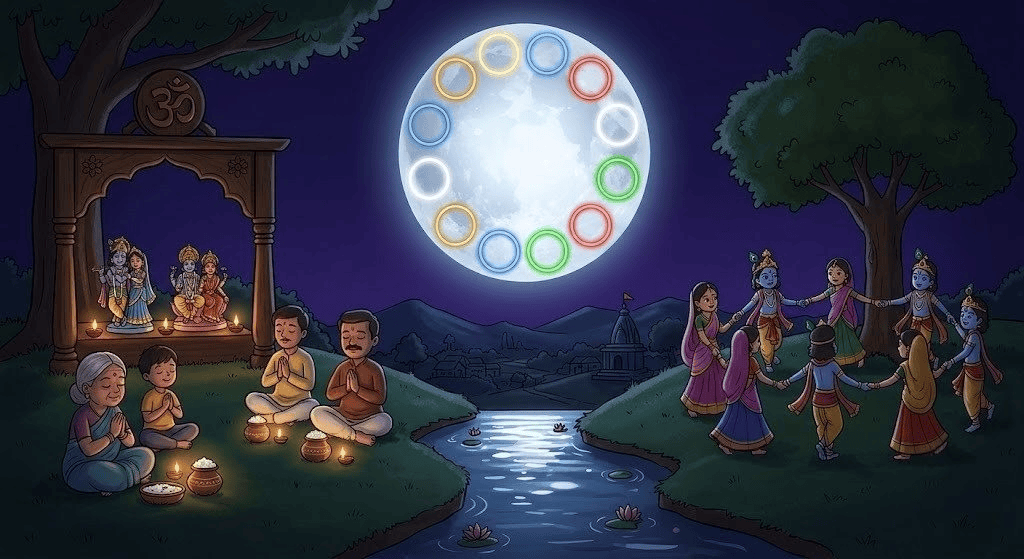
Hunnime or Poornima is the day of Full moon, And the full moon night of Sharad ritu (season) is Sharad Purnima. It officially marks beginning of the Winter Season and end of Monsoon (rain). Sharad Poornima, also known as Kojagiri Poornima or Raas Poornima thus marks transition from monsoon season to crisp winter nights. Full moon shines with unmatched radiance and stays closest to earth during this night. Ancient tradition calls this sacred night celebration of divine awakening, love, spiritual growth, and health. On this occasion, devotees observe fasts, offer early morning prayers to Bhagwan Surya, and spend evening singing devotional hymns under open sky.
Understanding Science And Mystery Of Sixteen Kalas
Moon possesses sixteen different phases called kalas (explained in detail later in this article). Counting days from amavasya to poornima equals sixteen steps. Movement from zero to full moon symbolizes journey from nothingness to complete spiritual fullness. On Sharad Poornima, moon manifests all sixteen kalas simultaneously, creating unique energy field across universe.
Pujya Gurudev Sri Sri Ravi Shankar ji explains that kala measures unit of power or degree to which one has blossomed or progressed spiritually. Ancient wisdom states that prana or life force in stone equals one kala, while water element has two kalas. Fire element carries three kalas, air element holds four kalas, and space or akash possesses five kalas. Plants and trees possess six kalas, animals have seven kalas, and regular human beings have eight kalas.
Extraordinary souls carry greater number of kalas. Parashurama held nine kalas, while Bhagwan Rama held twelve kalas. Bhagwan Hanuman possessed fourteen kalas, enabling Him to render strength and assistance to Bhagwan Rama. Devi Mata remains Shodashakala, possessing all sixteen divine attributes without any lack. Bhagwan Krishna stands as Purna Avatar carrying complete sixteen kalas. Moonlight on the night of Sharad Poornima carries healing rays and pours divine elixir known as amrutha upon earth. Exposing body and mind to these rays after due spiritual preparation helps individual blossom well. Since each of the 16 Kalas signify 16 qualities, exposing ourselves after due preparation of our mind and body, makes us a perfect human being. Moon is at closest distance tonight and hence will be the brightest
Verbatim reproduction of the part of talk by Pujya Gurudev Sri Sri Ravi Shankar ji of The Art of Living on the significance of Kala.
Kala usually refers to the extent by which the moon waxes (or wanes) in one day. Moon possesses 16 different Kalas (different phases of the Moon). You can observe this from one Amavasya(No-moon day) to the next Purnima (Full moon day). So if you count the number of days from one Amavasya to the next Purnima, it turns out to be 16. And the transition from No-Moon to the Full Moon also symbolizes moving from Zero (nothingness) to Fullness.
Kala is a unit of measure of one’s power, or by what degree one has blossomed or progressed. So, someone may be like a half-moon, someone else may have reached to three quarters of the moon and so on. This was a means of measurement in the ancient days.
In those days, it was said that the life or Prana in a stone is equal to one Kala, the water element is said to have two Kalas. Fire has three Kalas, Vayu (Air element) has four, and the Space or Akash has five. Plants and trees are said to have six Kalas. Animals have seven Kalas. Human beings have eight Kalas.
If it is an extraordinary human being then he is said to have nine Kalas. It is said that Parashurama (one of the ten avatars of Vishnu) had nine Kalas. They say Rama has 12 Kalas. Hanuman is greater than Him in this regard and is said to have 14 Kalas. That is why he could help Rama. Only a person who is stronger than us can help us.
The Devi (Mother Divine) is called Shodashakala (The One with all 16 Divine qualities or attributes). It means that she possess all divine and noble qualities, and lacks nothing.
Krishna too is said to have all 16 Kalas, which is why He is called as the Solah Kala sampurna or the Purna Avataar.
To have all 16 Kalas means to possess all the 16 qualities or signs attributed to the total blossoming and manifestation of Divinity.
Why It Is Called Raas Poornima
This holy night carries deep association with divine play or Raas Leela performed by Bhagwan Krishna alongside Sri Radharani and Gopis in sacred groves of Vrindavan. According to scriptures, Bhagwan Krishna played soulful tunes on flute under enchanting full moon of Sharad ritu. Hearing divine music, Gopis abandoned worldly thoughts and merged into cosmic celebration.
Through spiritual power, Bhagwan Krishna expanded Himself into multiple forms so that every Gopi felt His personal presence beside her. Dance of Raas symbolizes ultimate union of individual soul with Supreme Consciousness. Because this pious cosmic dance took place on this particular night, festival earned timeless title of Raas Poornima.
Spiritual Vigil Of Kojagiri
Word Kojagiri originates from traditional Sanskrit query Ko jagarti, which translates to who is awake. Sacred belief dictates that Mata Lakshmi travels across skies tonight searching for souls who remain awake and spiritually active. Staying awake on Kojagiri Poornima means far more than merely resisting sleep; it signifies remaining innerly alert through upavasa, dhyana, and jagarane. Devotees engage in continuous prayers, bhajans, and meditation so that Mata Lakshmi finds them vigilant and showers abundant blessings.


Festival holds special meaning for both unmarried individuals seeking noble life partners and married couples praying for long, blissful journey together. Worship is dedicated to Divine couples including Radha-Krishna, Parvati-Shiva, Lakshmi-Narayana, and so on.
Traditions, Prasada, And Celebrations
Traditional food items prepared on this day feature white color, symbolizing purity and moonlight. Preparations include authentic coconut rice (not the Sanjeev Kapoor types, but typical and real South Indian Coconut Rice), milk payasa, curd rice, and coconut burfi. Families dress in clean white attire for night celebrations and gather on open terraces.
Food items left under direct moonlight absorb divine amrutha and energetic rays emitted by moon. Devotees partake in this charged prasada either during midnight terrace dinner or next morning. Atmosphere remains filled with joy, music, and divine reflection under silver beams of full moon.
Some regions leave all these overnight in the moon and have it as prasada in the morning.
Here is wishing all the readers a Happy Sharad Hunnime or Sharad Purnima. May Maate Lakshmi bestow Her choicest blessings on you and all your near ones.
Prayers that all unmarried looking for a partner to be blessed with a great one and those married for long, blissful journey of togethernes
Concept of Sixteen Kalas
In Vedic cosmology and Tantric traditions, moon is considered sovereign of mind, emotions, prana, and subtle energy. Word kala refers to digit, phase, or unit of measurement.
While astronomy observes lunar phases as changing shadows cast across moon, Vedic philosophy views these phases as sixteen distinct dimensions of divine energy. Fifteen kalas wax and wane across fifteen lunar days (tithis) of fortnight, while sixteenth kala remains unchangeable, eternal, and transcendental.
| No. | Name Of Kala | Meaning & Quality | Reigning Deity (Shodasha Nitya) |
| 1 | Amrita | Nectar of immortality; divine flow | Maha Tripura Sundari (Supreme Para Shakti) |
| 2 | Manada | Bestower of honor, dignity, and respect | Kameshvari Nitya |
| 3 | Poosha | Nourishment, growth, and feeding | Bhagamalini Nitya |
| 4 | Tushti | Contentment, satisfaction, and inner peace | Nityaklinna Nitya |
| 5 | Pushti | Vital strength, flourishing, and abundance | Bherunda Nitya |
| 6 | Rati | Delight, love, and aesthetic appreciation | Vanhivasini Nitya |
| 7 | Dhriti | Firmness, patience, and resolve | Maha Vajresvari Nitya |
| 8 | Shashini | Coolness, tranquility, and soft radiance | Shivadooti Nitya |
| 9 | Chandrika | Bright moonlight; clarity of perception | Twarita Nitya |
| 10 | Kanta | Charm, grace, and inner splendor | Kulasundari Nitya |
| 11 | Jyotsna | Illumination and brilliance of intellect | Nitya Nitya |
| 12 | Shree | Wealth, auspiciousness, and spiritual glory | Neelapataka Nitya |
| 13 | Preeti | Affection, joy, and divine love | Vijaya Nitya |
| 14 | Angada | Strength, structural integrity, and vitality | Sarvamangala Nitya |
| 15 | Purna | Completeness and fullness of expression | Jwalamalini Nitya |
| 16 | Poornamrita | Supreme nectar beyond time; absolute awareness | Chidroopa / Chitra Nitya |
Key Sacred Connections
Panchadasakshari Mantra Connection
Core mantra of Srikula Shaktism is the 15-lettered Panchadasakshari Mantra:
Ka E I La Hreem – Ha Sa Ka Ha La Hreem – Sa Ka La Hreem
Each of the 15 visible Nityas presides over one syllable of this sacred mantra. 16th Nitya (Tripura Sundari) embodies the unuttered 16th syllable (Shodashakshari).
Sri Chakra Integration
In the Sri Yantra (Sri Chakra), the 15 Nitya Devis reside in the central triangle surrounding the central bindu. They form an inner guard protecting Goddess Tripura Sundari, who rests at the absolute center (Bindu).
Cosmic Order & Tithi Worship
In Tantric practice, devotees recite the specific Nitya Devi mantra corresponding to the Tithi (lunar day) of that given date. During the Waxing Phase (Shukla Paksha), worship moves from Kameshwari to Chitra. During the Waning Phase (Krishna Paksha), the order reverses.
Significance Of Sixteen Kalas
Measure Of Spiritual Evolution
In ancient Indian philosophy, kalas serve as units measuring manifestation of consciousness. In inanimate objects like stones, prana exists at one kala level. Water has two, fire three, air four, and space five. Plants carry six kalas, while animals possess seven.
Average human consciousness operates at eight kalas. Spiritual practices like sadhana, pranayama, and dhyana allow human beings to expand awareness beyond eight kalas, evolving toward complete perfection.
Avataras And Degree Of Incarnation
Avatars of Bhagwan Vishnu are classified according to number of kalas manifested during their earthly Leela:
- Parashurama: Manifested 9 Kalas.
- Bhagwan Rama: Manifested 12 Kalas (Dwadasha Kala). Bhagwan Rama lived within bounds of human rules (Maryada Purushottama).
- Bhagwan Hanuman: Manifested 14 Kalas, giving Him extraordinary spiritual strength to serve Supreme Purpose.
- Bhagwan Krishna: Manifested all 16 Kalas (Shodasha Kala Sampoorna or Purna Avatar). He acted with total omniscience, detachment, mastery over life, and divine play.
Connection With Mind And Health On Sharad Poornima
On Sharad Poornima, earth, moon, and sun align such that moon reflects light with maximum potency. Mind (manas) is closely connected to lunar energy.
When all sixteen kalas shine forth together on this night, moonlight is believed to emit therapeutic vibrations and drop subtle nectar (amrutha). Keeping milk or rice pudding (kheer/payasam) under moonlight allows dish to absorb these soothing rays, providing vitality and peace when consumed.