Note: This was originally composed and posted on 24th April 2012. Republished for brevity and updated with recent pictures.
Akshaya Tritiya is celebrated on the 3rd day of Hindu Month Vaishaka during the waxing phase of the moon (Shukla Paksha Tritiya of Vaishakha). It has always been considered an auspicious time for new beginnings.
Gandhalepana of Brundavana in Mantralayam
Ahalyā draupadi sita tārā mandodari tathā pañcakanyā smarenityaṃ mahapātaka nāśanaṃ
Remembering five maidens -Ahalya, Draupadi, Sita, Tara and Mandodari Destroys the greatest of sins
Akshaya Tritiya is the day when one of the Panchakanyas, Mandodari, wife of Ravana was created out of Sandal paste from Bhagwan Vishnu’s body. Legend has it that Ravana a staunch devotee of Bhagwan Shiva was enamoured when he saw Maa Parvati and sought her from Shiva. Every compassionate Bhakta Priya Shiva consents to this. The entire universe would be out of balance and in jeopardy when Maa Shakti is Separated for Shuddh Chaitanya Shiva. The Devas approach Bhagwan Vishnu for a solution and he immediately removes Sandal paste from his body and creates an exact look-alike of Maa Parvati. She is then handed over as Maa Parvati to Ravana who marries her subsequently. It is important to know that Mandodari, a Panchakanya was a pious and righteous lady, though married to Ravana. It was despite her repeated advise and pleas that Ravana conducted himself in Adharmic way. Some scriptures also refers to her as Mother of Maa Sita.
This is one of the reasons why Vigrahas of most temples Gandhalepana (Covering or Sandal Paste) on Akshaya Tritiya day.
Day of Giving
Other Significant happenings associated with Akshaya Tritiya
Lord Ganesha and Ved Vyasa strated writing the epic Mahabharata on this day. This day is also celebrated as the birth anniversary of Lord Parashurama, the sixth incarnation of Lord Vishnu. It was on Akshaya Tritiya that Goddess Annapurna was born and the day when Lord Krishna bestowed wealth and monetary gains on his poor friend Sudama who had come to him seeking help.
Krishna & Sudhama Pic Courtesy: Amar Chitra Katha
According to the Mahabharata, on this day Lord Krishna presented the ‘akshaya patra’ to Draupadi who accompanied Pandavas while on their exile. He blessed them with this bowl that would continue to produce unlimited amount of food that would never leave them hungry.
On this day, the River Ganges descended from the heaven on earth and also the day when Kubera worshipped Goddess Lakshmi and thus was assigned the job of being the treasurer of Gods.
Our scriptures bring out that Akshaya Tritiya is the day on which Treta Yuga (Lord Rama’s period) is supposed to have started
Sudhama, Vishwamitra and other great souls performed the Lakshmi Vrat on Akshaya Tritiya and never found any lack in their home/ashram
In Jainism, this day is celebrated to commemorate Lord Adinatha, their first God.
Akshaya Tritiya: Akshaya means that which is infinite or inexhaustible. Obtain this by performing vrath not by buying material wealth. Performing Chants and Penances, Charity, Havana and Homa on Akshaya Tritiya brings inexhaustible wealth to the practitioner.
How is it Celebrated
Worship your Ishta Devata deity on this day by anointing the Vigraha with Sandal paste and observe Upavasa (fast). Tulsi water is sprinkled all around as a symbol of Lord Vishnu. Generally offering Akshata (Vermillioned Rice) to Lord Vishnu during Puja is not allowed. But on Akshaya Tritiya this can be offered.
Donate to the poor, distributing rice, salt, ghee, vegetables, fruits and clothes. Akhaya Tritiya daana, with each of them beneficial to the donor – Jaladaan (with Tamboola), Shayana daana (Mattress), Vastradaana (Clothes), Kumkum (Vermilion), Chandan (Sandal), Narikela(Coconut), Curd, Udakumbha (Water Pot), Padaraksha (footwear), Chatra (Umbrella)
In some parts of the country (especially in the East India), Akshaya Tritiya is the day they begin the Ceremonial Ploughing for the next harvest season. They also perform “halkhata”, opening of new Financial Accounts book.
Chanting Kanakadhara Stotram, composition of Jagadguru Sri Adi Shankaracharya without fail on Akshaya Tritiya. brings tremendous benefits
Those who perform Charity on Akshaya Tritiya day can rest assured that they will always have in abundance to perform it forever
Akshaya Tritiya is very good day for starting any “meaningful” activity. Indulging in charity ensures we always are in position to do it
Elders says till these branded Jewellers and some banks started crass commercialization, while Akshaya Tritiya was actually all about piety and charity
Wishing everyone infinite happiness on this auspicious day of Akshaya Tritiyya. The day is all about Charity (Daan) and buying Gold 🙂
Link for Kanakadhara Stotram Lyrics. This site has almost all works of Jagadguru Adi Shankaracharya
A long pending piece (~2 years to be precise) after me and Devaraja ji was blessed with a Darshan of deities in this amazing devalaya. This temple is situated in Bhargavapuri, Hiremagaluru (of Hiremagaluru Kannan brothers fame) in Chickamagaluru District (about 250kms from Bengaluru). The place is named Bhargavapuri after Bhargava (another name of Parashurama) who is believed to have lived here. Thus the temple is named Bhargavapuri Shri Kodandarama Temple.
It is also believed that Nine Siddhas (Realised souls) meditated along the banks of the Temple pond, called Siddha Pushkarini. A dip here is considered curative and especially a cure and antidote for snake bites. An elderly gentleman has a record of people cured of snake bite effects after taking a dip here.
Whatever I am writing here is as discussed with temple Archakas and other elders from the village (and may not be historically accurate, but please email me at surnell@outlook.in for any corrections to be made for which due credit will be given). Hiremagaluru Kannan ji was travelling on the day we visited and missed his humourous but enlightening sound bytes. His brother Murali conducted the Pooje in Kannada for us. Pooje in Kannada is yet another speciality of this place.
Bhargavapuri Shri Kodandarama Temple is believed to have come into existence as per earliest records in 879 AD. The Garbha Griha (Sanctum Sanctorum) and Sukanasa (The ornamental designs above the doorway to Garbha Griha) are built in Hoysala Architectural style. The rest of the structures appears to be subsequent additions and in Dravidian Architectural Style.
The Moorthies of Sita, Shri Rama and Lakshmana
The above picture of the presiding deity is unique and we were told that it is probably the only temple where Sita maate is on the right of Bhagwan Shri Rama. Usually Lakshmana takes the right side and Sita is on the left. The sthalapurana (or the legend) explains the reason for this unique feature. This can be traced to 17th Chapter of Skanda Purana where a confrontaion between a haughty Parashurama and Shri Rama takes place, when the Divine family were returning from Mithila after the wedding. During this encounter, Shri Rama breaks Parashurama’s bow and dents his pride, thus awakening him from the illusionary undefeatable power that he assumed he had.
He also realises his folly since he missed the Divine Marriage only due to ego and thinking that an ordinary Kshatriya is getting married, he seeks forgiveness and pleads with Shri Rama to give him a Darshana in Kalyana Kola (Grandeur of a Wedding). Ever compassionate Shri Rama grants that wish and asks Sita to stand on His right (that is the Vedic Wedding way) and Lakshmana to His left and blesses him with a Kalyana Kola Darshan as seen in the picture above. Yet another unique feature is absence of Hanuman, understandably since Hanuman meets Shri Rama in Sundarakanda whereas Marriage happens in Balkanda of Ramayana. Since the popular belief is that pooje to this family is not complete with Hanuman included,
Deity on the Hanuman Peetha (Pedestal)
The Idols are amazingly beautiful and enchanting. Shri Rama’s moorti. In shilpashastra and as described exquisitely by Hiremagaluru Kannan – it is in Tribhangi (tri posture) – Face that reflects Shanti (Peace), Hips that reflect Karunya (Compassion) and Knees reflecting Gambheera (Imposing or Seriousness). As can be visualised in the pictures above, the shilpi (sculptor) has done an exceptionally great job carving Shri Rama’s pleasant face. His breadth of His forehead exactly same as length of the nose. It is so perfectly geometrically balanced that if you were to use a compass and draw a circle with tip of the nose as centre, you will get a perfect circle encompassing Shri Rama’s face.
The later century additions are the Navaranga (the rectangular corridor where Bhaktas converge before having Darshana of the Deity – divided into boxes of 3×3 rectangular grid) is believed to have been constructed in 14th Century. Navaranga subsequently is sub-divided into Sabhamantapa (largest part of Navaranga where all cultural activities associated to the temples are carried out and Mukhamantapa (part of the Navaranga earmarked for Public rituals). Both these seem to be an addition around 16th Century as explained by the local experts (brick and mortar construction).
In the prakara are enshrined Vedantacharya, Ramanujacharya, Alvars, a lovely figure of Yoga Narasimha and a 4ft. high Madhava has a unique feature-the upper left hand hold a conch shell, with the tip in the hand, the right hand holds the ‘Chakra’ in an erect posture, unlike the usual horizontal position. On the outer walls of the Garbhagriha also ther are a number (about 30) of carvings, mainly Sri Vishnu and His various forms, Lakshmi, Garuda and Hanuman, Ganapati, etc. as seen in various pictures shared below
Having shared the legend broadly, here are some pictures that we clicked during our teerthayaatre here (will update as and when I get even more inputs during my next visit)
Parashurama seeking forgiveness and blessings of Shri Rama
Shri Rama blessing Parashurama (we can see the temple dwara in the background)
Shri Devaraj ji. My constant companion on Devalaya Yatra
All the above pictures clicked on 9th December 2019
Jai Shri Ram
Sharing more pictures below clicked on 23rd December 2013 (thanks to Smt Sindhu BR)
Another wide angle view of the temple from the side
Temple Main Entrance
Another view tried to capture most of the features here
Vasoori Mala Shrine on the left
The Upadevalayas
Vasoori Samadhi
Visiting Kodungallur Kurumba Bhagavati Kshetram located in Thrissur district of Keralam is a deep spiritual transformation in itself and naturally creates an inner balance for each one of us. This sacred kshetram stands prominently as the primary seat among sixty-four Bhadrakali temples established across Keralam. Stepping into the expansive temple premises shaded by massive ancient banyan trees creates immediate atmosphere of serenity and awe. Air carries sweet fragrance of camphor, crushed jasmine flowers, roasted paddy, and incense. Devotees gather from far and wide to pay homage to Adi Parashakti, who presides here in her formidable yet benevolent form as Sri Kurumba Bhagavati. Walking along the stone paths around the sanctum allows pilgrims to soak in centuries of deep devotional energy and quiet strength.
Article edited to add this Video
The physical layout of Kodungallur Kurumba Bhagavati Kshetram is deeply integrated with the natural surroundings, especially the ancient, expansive banyan tree groves (Vata Vriksha) that canopy the entire temple premises. Over the centuries, temple expansions and stone structures were carefully constructed around these majestic trees without felling or disturbing a single branch. In Shakta traditions and Kerala Tantric worship, old trees are revered as living shrines housing divine spirits, Nagas, and Yakshis. The spreading aerial roots of these banyan trees are believed to absorb and retain cosmic vibrations generated by daily Tantric rites, radiating protective energy across the entire sacred compound. Devotees often perform circumambulations (Pradakshina) around these ancient roots, offering oil lamps and lotus flowers to seek blessings for longevity, peace, and spiritual grounding under the protective shade of Mahadevi.
Sthala Purana and Divine Legends
Sthala Purana of Kodungallur Kurumba Bhagavati Kshetram is deeply woven into ancient Puranic cosmology and local folklore. According to ancient texts, long before the human era, two fierce demon brothers, Daruka and Danavendra, performed extreme penance in Honor of Brahma. Pleased by their austere devotion, Brahma granted Daruka a supreme boon – he could not be slain by any male being, Deva, Asura, human, or wild beast. Empowered by this near-immortality, Daruka conquered all three worlds, deposed Deva ruler Indra, tormented great Rishis, and disrupted cosmic order (Dharma).
When Devas and Maharshis approached Bhagavan Shiva for salvation, Shiva opened his third eye. From the blazing cosmic fire of his divine third eye emerged Mahadevi Bhadrakali, a terrifying and awe-inspiring manifestation of Adi Parashakti, created specifically as a feminine divinity outside the scope of Daruka’s boon. Armed with divine weapons provided by Devas, Mahadevi Bhadrakali descended upon the battlefield. Accompanied by her fierce army and Kali’s ganas, she fought a fierce war against Daruka. After a long struggle, Mahadevi severed the head of demon Daruka, ending his tyranny and restoring cosmic balance.
Following the destruction of Daruka, her wrath and fierce energy remained intense. To appease Mahadevi and channel her protective power for humanity, Maharshi Parashurama, after reclaiming the land of Keralam from the sea, consecrated Her holy presence at Kodungallur. He established Tantric rites and rituals that balance her fierce Shakti with deep compassion for her devotees.
The Tantric rites and spiritual administration of Kodungallur Kurumba Bhagavati Kshetram traditionally involve distinguished Brahmin scholarly lineages, notably held by the Akiraman Kalidasa Bhattathiripad family.
Additionally, unlike standard temples where routine daily worship is conducted by Namboothiri priests, the inner sanctum rituals here are uniquely performed by hereditary priests known as Adikals, maintaining ancient Shakta and Rurujit traditions (more details about this tradition is given later in this article).
Legend of Kannagi and Cheran Senguttuvan
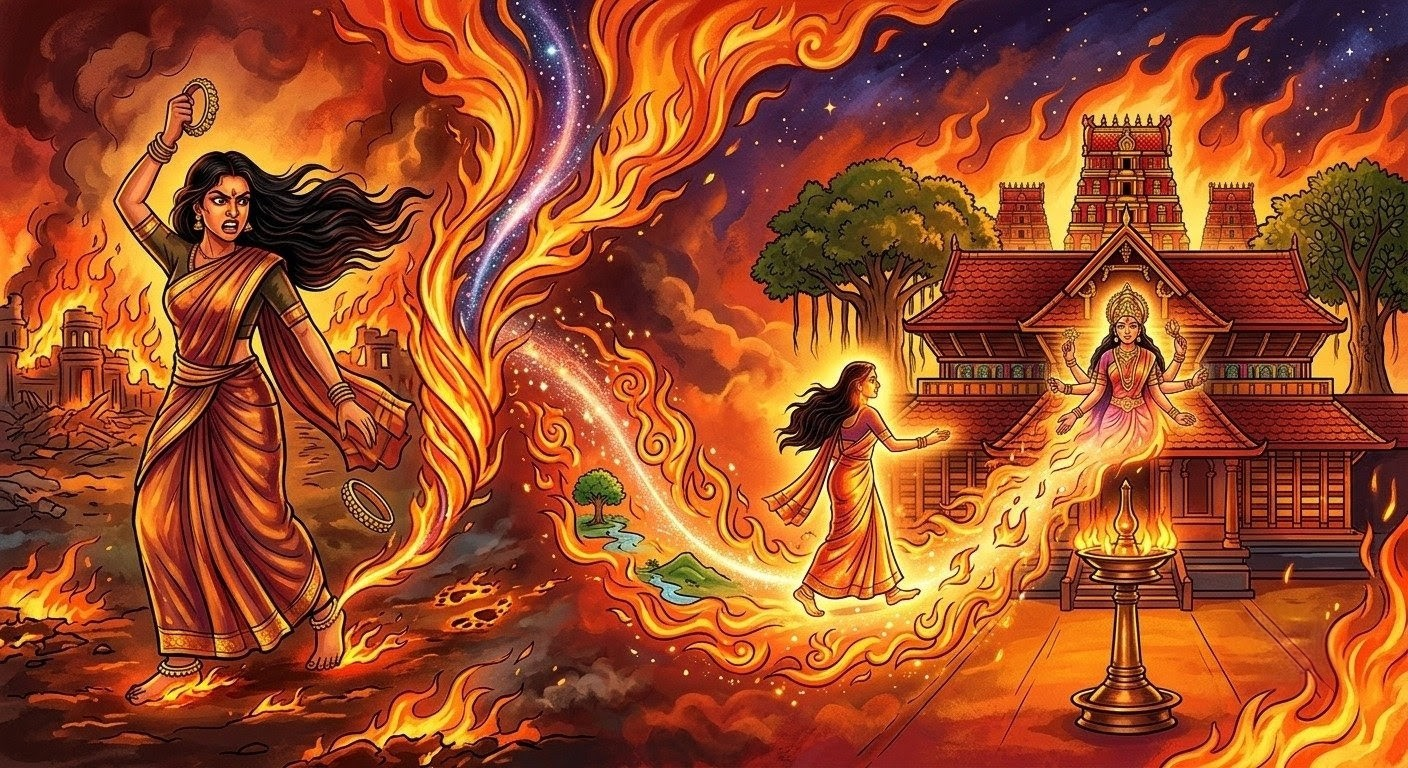
Another major dimension of Sthala Purana connects Kodungallur with classic Tamil epic Silappatikaram. Kannagi, an extraordinarily chaste woman living in Madurai, suffered tragedy when her husband Kovalan was wrongly executed by the Pandyan King under false suspicion of stealing the Queen’s anklet. Proving her husband’s innocence in the royal court by breaking her remaining anklet to reveal diamonds instead of pearls, Kannagi invoked the power of her divine chastity (Pattini) and cursed Madurai, consuming the city in flames.
Kannagi in Her Fiery form
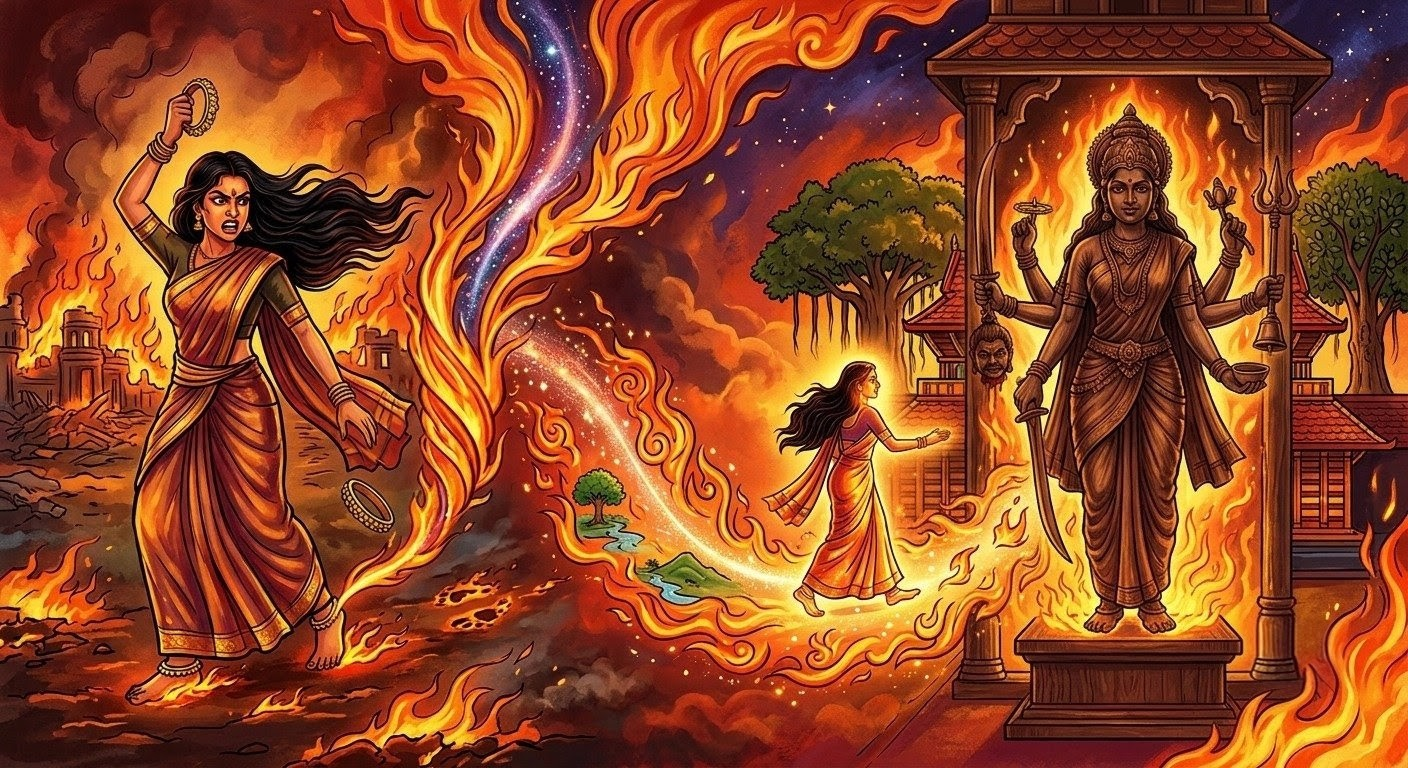
Filled with grief and divine fury, Kannagi walked westward through forests and mountains into the Chera kingdom. Exhausted and divine, she reached the outskirts of Kodungallur, where she sat under a huge tree. There, heavenly chariots descended, and Kannagi absorbed into the cosmic form of Mahadevi.
Merges into Mahadevi in Kodungallur
King Cheran Senguttuvan, sovereign ruler of Chera dynasty, heard reports from forest dwellers about this miraculous ascension. Deeply moved, he led a military expedition north to the Himalayas to bring a sacred stone washed in holy river Ganga. From this sacred stone, King Senguttuvan sculpted a image honoring Kannagi as Pattini Devi (Goddess of Chastity) and consecrated her inside the Kodungallur temple complex, integrating her worship into the existing seat of Mahadevi Bhadrakali.
Understanding Rurujit-Vidhana
Kerala houses numerous Saktheya installations dedicated to Devi in various divine forms. Kali temples across land feature four primary installation styles: Rurujit, Dakshajit, Darikajit, and Mahishajit. These titles stem from Amma Kali conquering mighty demons. Bhagavan Vishnu avatar Sri Parashurama constructed central shrine at Kodungallur, installing Shakthi Devi as Bhagavathi. Kodungallur serves as focal point for all such Kali shrines
Bhadrakali earned title Rurujit by vanquishing demon Ruru. Similarly, victories over Daksha, Darika, and Mahisha yielded remaining three names. Such installations follow Rurujit-Vidhana, rooted in Kashmiri Tantra tradition, showing distinct departure from conventional Kerala Tantra models. Through this worship, Kali represents embodiment of primordial nature.
Temple Layout and Deity Placement
Shrines dedicated to Rurujit follow precise architectural guidelines outlined in ancient text Sesasamuccaya. Scripture designates Bhadrakali as principal deity. Standard temple layout features specific spatial arrangement:
Rurujit Kali:Positioned on southern side, facing north or east.
Sapta Matrukas, Sri Veerabhadra, and Sri Ganesha: Placed on eastern side of Rurujit, facing north.
Kshetrapala: Situated in northeastern corner.
Significance of Saptamatruka
Sapta Matruka group comprises seven divine mother-goddesses, each acting as feminine power or Shakti of principal deities. These divine entities play vital role in Rurujit-Vidhana rituals. Group includes Brahmani representing Shakti of Brahma, Maheshvari representing Shakti of Shiva, Kaumari representing Shakti of Kumara, Vaishnavi representing Shakti of Vishnu, Varahi representing Shakti of Varaha avatar, Indrani representing Shakti of Indra, and Chamunda representing Shakti of Yama.
Anecdotal Stories and Sacred Lore
Over centuries, several local legends and anecdotes have been passed down through generations of pilgrims and temple priests:
Legend of the Royal Sword (Palli Val): Local tradition speaks of the ancient Chera Kings receiving a sacred sword blessed directly by Mahadevi. Whenever kingdom faced threat of foreign invasion or pestilence, the King would pray before Garbhagriha, and the sacred sword would radiate a subtle warmth, symbolizing divine protection over the land.
Healing Miracle of Turmeric: A popular anecdotal story tells of a widespread outbreak of severe fever and skin epidemics across local villages centuries ago. Villagers rushed to the temple gates in despair. The chief priest had a divine dream wherein Mahadevi instructed villagers to smear raw turmeric paste over their bodies and sprinkle turmeric powder across outer walls of the temple courtyard. Overnight, the epidemic subsided completely. Ever since, offering and rubbing raw turmeric along temple walls remains a central practice for immunity and healing.
Story of the Secret Door and Saptamatrikas: A deeply held belief among traditional temple families concerns the eastern secret chamber housing Saptamatrikas. Legend says an over-curious traveler once attempted to peek into the secret chamber during late-night esoteric rituals. Upon looking through a gap in the door, he was blinded by a blinding flash of golden light. He regained vision only after performing forty-one days of intense penance outside the northern gate, establishing strict discipline and reverence regarding the secret chamber.
Oracle and Broken Chains: During the historical Kodungallur Bharani festival, an Oracle (Velichappad) in deep spiritual trance was bound in heavy iron chains by skeptical foreign observers testing the authenticity of the ritual divine possession. As drums sounded and sacred chants reached a crescendo, the Oracle simply raised his arms towards the Garbhagriha, and the heavy iron links snapped like thread, astounding all present.
Architectural Specialties and Unique Layout
Architecture of Kodungallur Bhagavati Kshetram presents a classic example of traditional Keralam style temple design. Spread across several acres, the temple layout follows specific Vastu Shastra principles suited for Tantric deity worship. The structure prominently features tiled sloping roofs, carved wooden pillars, and open granite courtyards that withstand heavy monsoon rains.
Core structure consists of two major sanctums situated inside one central enclosure. Unusually, the principal square sanctum housing Sri Kurumba Bhagavati faces north, a direction closely associated with fierce manifestations and victory over evil forces. Immediately adjacent to this stands another sanctum facing east dedicated to Bhagavan Shiva. This unique arrangement signifies eternal balance between Shiva and Shakti.
Moola vigraha of Mahadevi Bhadrakali is sculpted out of wood from Jackfruit tree (Plavu). Standing over six feet tall, this magnificent image displays Mahadevi with eight hands holding formidable weapons and sacred attributes, including Trishula, sword, shield, bell, bow, arrow, cup of divine drink, and severed head of demon Daruka. The Murti remains perpetually covered with fine silks, traditional ornaments, and thick layers of chanthu (a special herbal paste). Exquisite wooden carvings depicting various deities, mythological scenes, and cosmic motifs adorn the ceilings and inner walls of the Garbhagriha.
Secret Chambers and Subsidiary Shrines
Beyond the primary sanctums, the temple complex houses several important subsidiary shrines that hold deep esoteric significance:
Secret Shrine of Saptamatrikas: In the secret chamber located adjacent to the main sanctum lies a shrine dedicated to Saptamatrikas (Seven Divine Mothers), facing east. Public entry into this chamber remains restricted, and special Tantric rituals are performed here away from public view.
Vasuri Mala Shrine: Located within the outer compound, a special shrine honors Vasuri Mala, a deity associated with protection against smallpox, chickenpox, and other contagious diseases. Devotees offer turmeric and pay respects here to seek immunity and physical healing.
Kshetrapala Shrine: A shrine dedicated to Kshetrapala, guardian deity of the temple premises, sits nearby. Kshetrapala ensures sanctity and protection of the whole sacred ground.Standing prominently in the northeastern courtyard of the temple complex, the dedicated shrine of Kshetrapala serves as an essential guardian pillar in the sacred geography of Kodungallur. Standing towering over twelve feet high, the granite stone idols of Kshetrapala are exceptionally rare for a Devi temple, embodying a fierce, protective aspect associated with divine gatekeepers. According to local temple lore, Kshetrapala was stationed here by Maharshi Parashurama to guard the boundary of the sacred seat, protect the inner Tantric energy of Mahadevi Bhadrakali, and maintain strict discipline within the holy grounds. He is believed to be growing in height year after year. Devotees routinely offer prayers and light oil lamps at this open shrine to seek protection against negative energies, bad omens, and physical harm before entering the main courtyard.
Ganapati Shrine: A dedicated sanctum for Sri Ganapati sits inside the inner courtyard, where devotees seek removal of obstacles before beginning major worship.
Kshetrapalan
Sacred Pond and Unique Ritual Practices
Every ritual practice at Kodungallur Bhagavati Kshetram carries symbolic meaning rooted in ancient traditions:
Pushkarini Pond: Located about fifty meters away from the main complex, the sacred temple pond known as Pushkarini provides holy water for temple rites. According to legend, Mahadevi created this water source by striking her weapon into the earth. Pilgrims sprinkle holy water or take ceremonial bath here before entering inner precincts.
Offering of Turmeric: One of the most noticeable traditions involves offering raw ground turmeric powder. Devotees purchase packet of turmeric and sprinkle it along shrine walls and steps. Turmeric possesses natural antiseptic properties and symbolizes divine aura, protection, and purity.
Kodungallur Bharani Festival: Celebrated annually during Malayalam month Meenam (March–April), this festival is one of the grandest events in Keralam. Thousands of devotees clad in red garments gather at the temple. The festival features dramatic rituals like Kaavu Theendal, where Oracles (Velichappads) run around the temple compound in spiritual trance. Devotees strike temple roof with wooden sticks, a symbolic ritual representing destruction of ego and breaking through spiritual obstacles.
Chandanam Charthu: Special ritual applications of sandal paste and chanthu over the deity mark major days, filling the temple with serene aroma and uplifting spiritual energy.
A pilgrimage to Kodungallur Kurumba Bhagavati Kshetram offers deep connection with ancient traditions, rich architecture, and profound spiritual energy of Mahadevi. The lingering atmosphere of faith and devotion makes this temple visit an unforgettable experience.