Dear Ex-HM and Ex-FM

Here is a story for you. It is a maxi post so be patient before you begin asserting stuff that you never had a clue about. Unlike your earlier assertion on digital payments, don’t rush into claiming something that will end up with egg on the face. Read this patiently and then react. But let me start with a story that reflects the predicament (well! almost. What was there earlier was not even worth the napkin, some hotch potch of an idea that was not even worthy of writing on the napkin). Here we go…
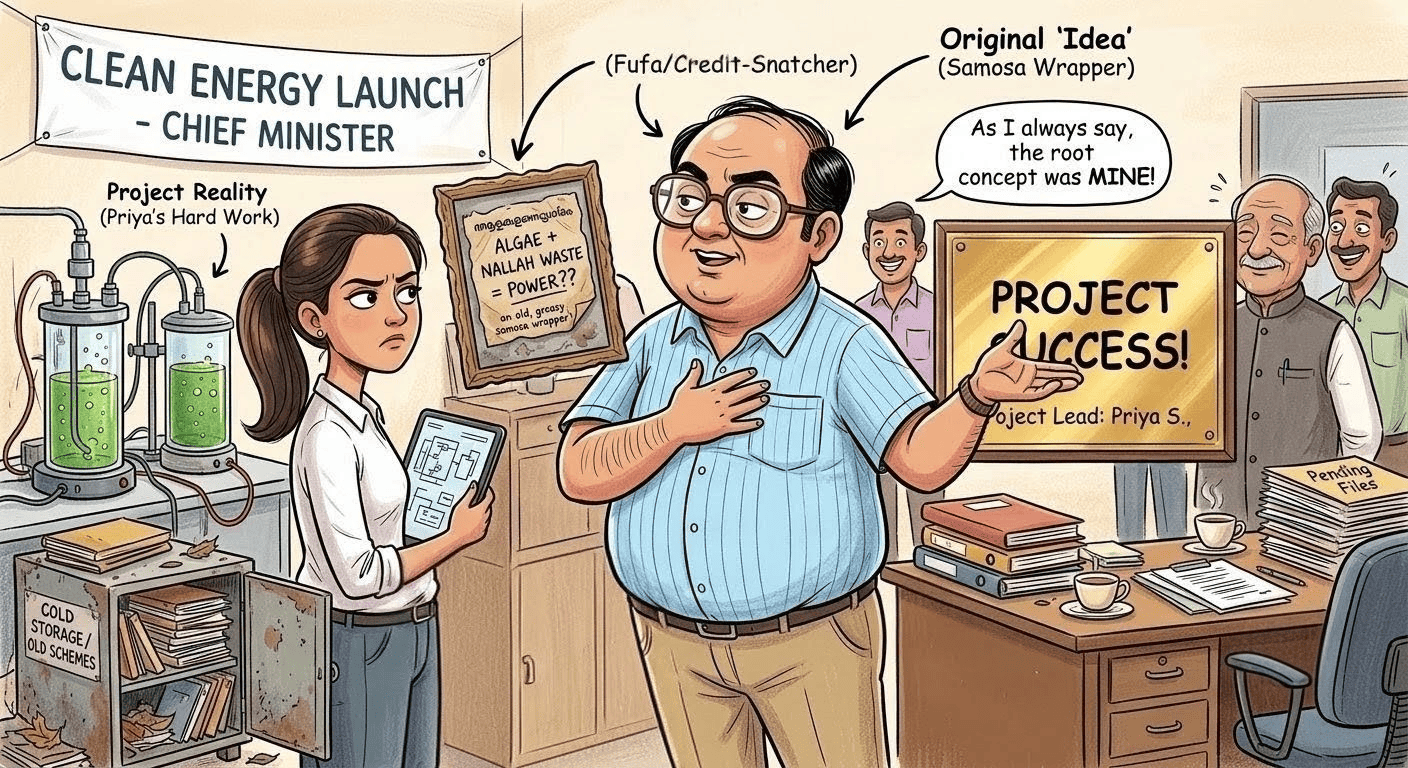
Sharma Ji had a rusting godown of a filing cabinet where brilliant ideas went to collect cobwebs and rat droppings. Tucked right behind “Scheme for Free Bicycle Distribution to Stray Cats” and “Mandatory Samosa Break at 4 PM” was File No. 402: The Green Energy River Grid.
Sharma Ji had written this masterpiece on the back of a samosa wrapper during a rainy afternoon in 2014. It had exactly two bullet points:
- Put kitchen waste in local nallah (drain).
- Algae will eat waste, make 24/7 free electricity for all!
When he brought it up at a department meeting, his boss simply asked, “Sharma Ji, how will algae make electricity?” Sharma Ji blinked, adjusted his glasses, and said, “Sir, that is technical detail. Basic concept is mine.” The file was instantly pushed into cold storage, where it lay untouched for twelve whole years. Sharma Ji didn’t even know if algae was a plant or a type of fish curry.
Then came Priya.
Priya was a brilliant young IIT graduate who had the misfortune of joining Sharma Ji’s office. She didn’t use his samosa wrapper. Instead, she spent four grueling years working 18-hour days, securing government grants, testing bio-reactors, and solving complex chemical formulas to actually create a working bio-energy grid for the city.
The launch was a massive hit. The Chief Minister cut the ribbon, the local TV channels called Priya “The Miracle Daughter of India,” and the office was showered with praise.
That was the exact second Sharma Ji’s memory magically returned.
At the official celebration party, Sharma Ji was walking around with a plate of gulab jamuns like a proud king. He approached a group of senior officers, took a grand bite, and sighed loudly.
“Ah, brother… seeing my old baby finally succeed brings tears to my eyes.”
Priya, who was standing nearby drinking tea, almost choked. “Your baby, Sharma Ji?”
“Arre Priya beta, don’t be shy!” Sharma Ji said, patting her head condescendingly. “You did the labor work very nicely, no doubt. But the original scheme? The vision? I conceptualized it in 2014 only! It was lying in my cold storage waiting for someone to execute.”
“Sharma Ji,” Priya said, her jaw dropping. “Your original scheme was two lines on a oily paper! You wrote ‘make electricity’ with three question marks!”
“Inspiration is always high-level, beta!” Sharma Ji smiled, waving his hand as if physics was a minor inconvenience. “I gave the soul to the project. Okay, fine, I kept the file in cold storage for twelve years, but a true genius knows when the market is ready. You just did the technical implementation of my scheme.”
“Last week you asked me if algae can be cooked with aloo,” Priya deadpanned.
“That was a trick question to test your fundamental knowledge!” Sharma Ji replied without missing a beat.
Before Priya could throw her cup at him, Sharma Ji smoothly walked up to the stage, snatched the microphone from the anchor, and beamed at the audience. “Respected Chief Minister sir, as the original brain behind this scheme, I would like to say just one thing, no old idea dies, it just waits for the junior staff to catch up!”
At the end of the day, Sharma Ji can proudly frame his oily samosa wrapper and parade around the office all he wants, but history and real-world progress doesn’t run on vague, half-baked thoughts stuck in dusty filing cabinets.
Execution Always Trumps the “Idea”
- Ideas Are Free, Execution Costs Sweat: Anyone can draft a two-line “genius” plan over tea, but transforming a wishful thought into a working reality requires grit, technical know-how, and countless hours of trial and error.
- Problem-Solving Happens in the Field: A cold-storage scheme never had to deal with chemical equations, budget limits, or real-world failures. The actual value lies in solving the thousand unexpected problems that arise during implementation.
- Impact Demands Action: An unimplemented idea produces zero electricity, generates zero revenue, and helps zero people. It remains a ghost until someone like Priya comes along to build the machine.
Sharma Ji may hold the mic at the success party, but the crowd always gives true credit to that belongs to the hands that turn the wrench, write the code, and bring the concept to life. Good Ideas (not the ones Sharma ji had written) at best are just the seed; practical implementation is the harvest.
Facts – BSBDA, NPCI and UIDAI
Focussing on three game-changers that CONgress keeps claiming are their ideas. (Go back and read the section – Execution always trumps the idea”)
“No Frills Accounts” (Now Basic Savings Bank Deposit Accounts – BSBDA)
Phase 1: From Inception (2005) until May 2014
- Introduction & Concept: Reserve Bank of India (RBI) introduced “No-Frills Accounts” in November 2005 to promote financial inclusion for low-income sections, requiring little to no minimum balance. In 2012, these were re-designated as Basic Savings Bank Deposit Accounts (BSBDA) with added features (like ATM cards and basic receipts without extra charges).
- Number of Accounts: By March 2014, public and private sector banks had scaled up operations significantly. Cumulative No-Frills/BSBDA accounts crossed 14.3 crore (143 million) across India, heavily pushed by commercial and regional rural banks.
- Transactions & Usage: Initially, these accounts faced lower active transaction volumes because they were primarily used as deposit-parking tools rather than active transactional accounts. However, cumulative deposits in these accounts crossed over ₹20,000 crore by early 2014, reflecting steady savings accumulation by unbanked citizens.
Phase 2: From May 2014 until Present (2026)
- Jan Dhan Push: The landscape transformed completely after August 2014 with the launch of the Pradhan Mantri Jan Dhan Yojana (PMJDY), which built directly on the BSBDA framework.
- Number of Accounts: As of recent tracking data, total Jan Dhan/BSBDA accounts have surged past 53 crore (530 million) users, capturing virtually all adult households in India. Total deposits under this scheme crossed ₹2.3 lakh crore.
- Transactions: Unlike the earlier phase, transactions in these accounts exploded due to Direct Benefit Transfer (DBT) linkages (for cooking gas subsidies, pensions, COVID-19 relief funds) and heavy Rupay card/UPI integration. Billions of digital and micro-ATM transactions are now routed through these accounts annually. Here is an idea that GOT USED, not filed in Gazette cabinets.
NPCI
Phase 1: From Inception (2008) until May 2014
- Establishment: NPCI was incorporated in December 2008 under the provisions of the Payment and Settlement Systems Act, 2007, as an umbrella organization by the RBI and Indian Banks’ Association (IBA).
- Early Adoption & Key Systems:
- IMPS (Immediate Payment Service): Launched live in 2010, IMPS was NPCI’s breakthrough product enabling 24/7 real-time interbank fund transfers via mobile phones and ATMs. Its adoption grew rapidly as smartphones started penetrating the market.
- NEFT / RTGS: Managed transition and integration of legacy clearing systems.
- RuPay: Launched in 2012 as India’s domestic card network to cut down dependence on international card schemes.
- Volume/Transactions (up to May 2014): Total retail transaction volumes were modest. IMPS processed a few million transactions monthly as digital banking was still nascent.
Phase 2: From May 2014 until Present (2026)
- Explosive Growth Era: This era marked India’s digital payment revolution, propelled by smartphone affordability, low data costs, and Aadhaar-enabled infrastructure.
- Launch of UPI (2016): The Unified Payments Interface (UPI) was introduced by NPCI in April 2016, completely changing peer-to-peer (P2P) and peer-to-merchant (P2M) payments via Virtual Payment Addresses (VPAs) without sharing raw bank details.
Summary
| Feature / Metric | IMPS (Immediate Payment Service) | NEFT (National Electronic Funds Transfer) | UPI (Unified Payments Interface) |
| Launch Year | 2010 | 2005 (Managed by NPCI later) | 2016 |
| Growth Trajectory (2014–Present) | Grew steady during early smartphone adoption, capped by the need to enter beneficiary account details/IFSC codes. | Shifted to 24×7 batch processing; preferred for corporate, high-value, or scheduled transfers. | Exponential, hyper-growth. Crossed multiple milestones, recording tens of billions of monthly transactions worth trillions of rupees. |
| Current Market Share | Dominates specific high-value instant transfers where daily limits ( | Stable backbone for scheduled bulk/salary payouts and traditional banking. | Absolute market leader for retail digital payments, capturing over 80% of India’s digital retail transaction volume. |
UIDAI (Aadhaar)
Phase 1: From Inception (2009) until May 2014
Inception & Rollout:
- The Unique Identification Authority of India (UIDAI) was established in January 2009, and the first Aadhaar number was issued in September 2010.
Number of Enrollments:
- As of May 31, 2014, total Aadhaar numbers generated stood at 63.22 crore (632.2 million). The daily enrollment pace during this initial foundational phase hovered around 3 to 4 lakh registrations per day.
Ecosystem & Transactions:
- Financial integration was in its infancy. By May 2014, only about 6.7 crore Aadhaar numbers were linked to bank accounts.
- Aadhaar Enabled Payment System (AEPS): Recorded minimal deployment with just around 7,406 micro-ATM points and a cumulative total of roughly 46 lakh transactions.
- Aadhaar Payment Bridge (APB): Handled about 7.13 crore transactions cumulatively for early Direct Benefit Transfer (DBT) programs.
Phase 2: From May 2014 until Present (2026)
Massive Scaling & Saturation:
- Driven by legislative backing (The Aadhaar Act, 2016) and deep integration with welfare delivery, enrollment surged rapidly. By early 2017 it crossed 111 crore (covering over 99% of India’s adult population), and over the years has achieved near-universal coverage of the country’s population, crossing 138+ crore active IDs.
Authentication & Verification Infrastructure:
- Daily authentications skyrocketed from a modest 60–70 lakh requests per day in early phases to tens of millions to billions of authentications daily handled across banking, telecom, and government portals.
- e-KYC adoption transformed account openings: bank accounts opened using Aadhaar e-KYC jumped from just ~1 lakh in May 2014 to hundreds of millions.
Payment & Transaction Growth:
- AEPS Growth: Scaled from 46 lakh transactions to billions of micro-ATM and doorstep banking transactions facilitated by hundreds of thousands of banking correspondents across rural India.
- APB Growth: Direct Benefit Transfers scaled exponentially via the Aadhaar Payment Bridge, routing hundreds of thousands of crores rupees efficiently across central and state welfare programs, plugging leakages and saving billions annually.
| Metric / Milestone | As of May 2014 | Present Era (2026 Tracking) |
| Total Enrolments Generated | ~63.22 Crore | 138+ Crore (Universal Saturation) |
| Daily Enrolment/Update Pace | ~3 to 4 Lakh/day | Millions of daily authentications & updates |
| Aadhaar-Linked Bank Accounts | ~6.7 Crore | Near-Universal (Over 100+ Crore accounts) |
| AEPS (Micro-ATM) Volume | ~46 Lakh transactions | Billions of cumulative rural transactions |
MOST IMPORTANT PART
Analytical breakdown of the Infrastructure, Technological, and Security upgrades across No-Frills Accounts (BSBDAs), NPCI platforms, and the unique identification system Pre & Post May 2014. Data/Information Security of Individuals and our Nation’s Economic Engine was not even a factor of the Napkin Idea of UPA regime. Read on…
No-Frills Accounts (BSBDAs) Infrastructure
Pre-2014: Legacy & Basic Infrastructure
- Infrastructure: Operations heavily relied on manual paperwork, physical ledger entries at rural bank branches, and basic core banking solutions (CBS) that were only starting to integrate rural cooperatives and regional rural banks (RRBs).
- Technology: Limited to physical passbooks. Technology was restricted to back-end accounting; customers had virtually no digital access, smartphone apps, or self-service banking options.
- Security: Secured primarily through physical branch controls, signatures, or thumb impressions mapped manually in bank registers. Vulnerable to human error, document loss, and proxy withdrawals.
Post-2014: Digital and Interoperable Infrastructure
- Infrastructure: Integrated into India’s digital public infrastructure (India Stack). Accounts became digitally native via the Pradhan Mantri Jan Dhan Yojana (PMJDY) framework, connected directly to mobile towers and national payment switches.
- Technology: Introduction of RuPay Debit Cards, mobile banking enablement, and micro-ATMs deployed via Business Correspondents (Bank Mitras) equipped with biometric handheld devices.
- Security: Shifted towards multi-factor authentication (MFA) and biometric verification (Aadhaar-enabled security). End-to-end encryption for core banking transactions and real-time fraud monitoring systems implemented by major public sector banks.
National Payments Corporation of India (NPCI) Infrastructure
Pre-2014: Foundational Scale & Early Protocols
- Infrastructure: Built initial centralized payment switches for IMPS, RuPay, and the National Automated Clearing House (NACH). These systems were designed to handle moderate traffic scaling up from legacy interbank clearing houses.
- Technology: Relied on standard relational database architectures, ISO 8583 messaging standards for card networks, and early mobile-push/SMS frameworks for IMPS.
- Security: Complied with baseline financial data security standards. Security was heavily perimeter-based, utilizing secure VPN tunnels between member banks and the central NPCI switch.
Post-2014: Cloud-Ready, Real-Time Architecture
- Infrastructure: Scaled to massive, high-availability, fault-tolerant architectures capable of processing tens of billions of transactions monthly without latency. Developed dedicated national switches for UPI, Bharat Bill Payment System (BBPS), and National Common Mobility Card (NCMC).
- Technology: Transitioned to API-first, open-source-friendly architectures. UPI introduced lightweight, interoperable Virtual Payment Addresses (VPAs) running seamlessly on consumer smartphones. Tokenization was introduced to mask sensitive card data.
- Security: Enforced advanced cryptographic protocols, end-to-end encryption for UPI handles, device-binding mechanisms (linking a UPI app to a specific device’s SIM and hardware), multi-factor authentication (UPI PIN), and AI-driven real-time fraud and anomaly detection engines.
UIDAI (Aadhaar) Infrastructure
Pre-2014: Core Pipeline and Enrollment Architecture
- Infrastructure: Rapid deployment of enrollment kits across remote corners of India using standardized biometric capture software (fingerprint and iris scanners). Centralized data repositories (CIDR – Central Identities Data Repository) were established to store biometric and demographic profiles.
- Technology: Custom-built de-duplication software algorithms to match fingerprints and iris patterns across millions of incoming records to prevent ghost or duplicate identities.
- Security: Strict data isolation in the CIDR. Cryptographic locking of biometric packets at the point of capture using Public Key Infrastructure (PKI) so that data could not be intercepted or read en route to the central servers.
Post-2014: Massive Real-Time Verification & Privacy-First Tech
- Infrastructure: Evolution into a massive, real-time national authentication grid handling billions of verification requests per month for banks, telecom operators, and welfare delivery apps.
- Technology: Adoption of Paperless e-KYC, tokenization layers, and Virtual IDs (VID) to prevent the storage of raw identity numbers by everyday service providers. Advanced machine learning models integrated for biometric quality checks and continuous de-duplication.
- Security: Rigorous compliance frameworks enforcing data minimization. Biometric data is locked using cryptographic keys; zero-knowledge proofs and secure hash implementations ensure third-party entities can authenticate users (Yes/No response) without ever accessing raw underlying personal data or biometric templates.
We could go on and on, exploring countless other transformational frameworks like Skill India, Ayushman Bharat, Jan Aushadi, Awaz Yojana etc initiatives that starkly mark the transition from the bureaucratic friction and impractical ideas of the past to the digitized, inclusive framework of New India.