
Viveka : The Sacred Fence

Protecting your peace is your responsibility

What a privilege it was to sit down with Sri S-ji (since he wanted to be unnamed) for such an illuminating session. What started as a simple question on personal boundaries evolved into a masterclass on spiritual wisdom, clarity, and inner strength. His ability to connect ancient Vedantic truths with everyday human dynamics is truly remarkable, and the depth he brought to the concept of discernment was nothing short of transformative. Please note that he attributed every single piece of knowledge here to what he learnt from His Spiritual Master and started with a disclaimer that everything that we are discussing is His Master’s sharing of knowledge. If there is an error or mistake in the interpretation, it is possibly Sri S-ji’s lack of comprehension of what Master had conveyed and he will be solely responsible for it.

I have compiled the core takeaways, insights, and philosophical framework from our conversation into the article below. I have done my best to capture both the rich content and the true purport of Sri S-ji’s words, preserving the warmth, logic, and sharp practicality with which he shared them.

Spirituality is often misunderstood as unconditional acceptance and boundaryless love. Many people assume that being spiritual means allowing everyone unrestricted access to your time, mind, and home. True inner peace requires sharp discernment. Spirituality is fundamentally about realizing whom to keep far and whom to allow near.

Understanding who belongs in your inner circle and who must be kept at a distance is not selfishness. It is spiritual hygiene and basic common sense.

Foundation of Discernment or Viveka

In classical Advaita Vedanta philosophy, discernment is called Viveka. It is the ability to separate truth from illusion, permanent peace from temporary drama. Viveka is the very first step toward self-realization. Without it, spiritual life devolves into naive weakness, making your mind vulnerable to constant external agitation.

There is a huge difference between judgment and Viveka. Judgment looks at a person and says that they are bad. Spiritual discernment or Viveka looks at a dynamic and recognizes that this person’s presence creates unnecessary turbulence. It acknowledges that bringing them close will destabilize your mental peace.

Universal compassion does not mean universal access. Bhagawan Sri Krishna in the Gita teaches love and duty toward all, but intimate fellowship only with those who uplift awareness. Wishing someone well does not mean giving them key to your inner house. Loving someone from a distance is completely valid. You can pray for their growth without letting them burn down your peace.

Proximity and Mental Energy

Mind is not just confined inside your skull. In Indian philosophy, mind is subtle matter called Sukshma Sharira. Just as physical bodies exchange germs, subtle bodies continuously exchange thought patterns and emotional states.

Human nature operates under three fundamental qualities or Gunas. Sattva brings purity, light, and calmness. Rajas brings agitation, greed, and constant restless desire. Tamas brings lethargy, deceit, and darkness.

When you bring a person dominated by Rajas or Tamas into close proximity, their mental vibrations subtly alter composition of your own mind. In the holy text Srimad Bhagavad Gita, Bhagavan Sri Krishna explains how wrong association leads to desire, desire turns into anger, anger destroys memory, and loss of memory leads to complete ruin of peace.

If your mind is like a quiet pond and someone constantly throws heavy stones of drama into it, your pond will never remain calm. This is why keeping distance from toxic influences is necessary for mental survival.

Four Rules of Energy Management

Ancient Yoga Sutras offer four practical attitudes for managing relationships while protecting your inner energy.

  • For pure and joyful people: Practice Maitri or friendship. Keep them close and cherish their company because they bring Sattva.
  • For people who are suffering: Practice Karuna or compassion. Help them within your capacity, but keep reasonable distance so you do not absorb their misery.
  • For virtuous and noble people: Practice Mudita or delight. Seek their proximity and learn from their good character.
  • For malicious or toxic people: Practice Upeksha or complete indifference. Keep them far. Do not argue, do not correct them, and do not entertain their drama.
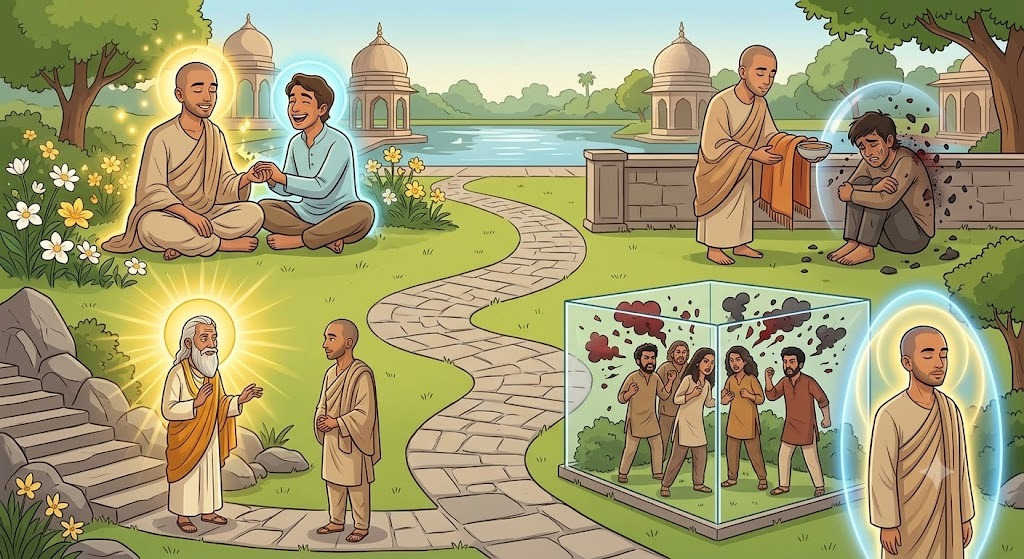
Practice of Spiritual Hygiene & Energy Management

Upeksha is ultimate spiritual boundary tool. It means withdrawing your mental attention completely. You do not hate them or seek revenge. You simply become completely non-reactive to their presence.

Practicing Boundaries in Daily Life

Bringing philosophical discernment into practical life requires clear personal boundaries. You do not need loud arguments or emotional scenes to create distance.

First, always audit the aftermath of every interaction. Notice how you feel after spending time with someone. If you feel centered and clear, that relationship brings Sattva. If you feel drained, doubtful, or anxious, your body is warning you about toxic energy dynamics.

Second, divide your contacts into concentric circles. Keep outer circle for formal courtesy where you share no personal secrets. Keep middle circle for structured social time with safe topics. Reserve your inner circle strictly for few genuine well-wishers who respect your growth and value your quietness.

Third, master art of quiet step-back. The cleanest boundary is subtle consistency. Share less, reply slower, and refuse to enter into arguments. When you stop giving mental fuel, toxic dynamic starves naturally.

Boundaries – Your Shield

Story of the Weaver

We can get the concept through the example of the seasoned weaver living near a bustling village market. Every evening, villagers would bring him tangled hanks of wool, demanding he transform them into smooth cloth on the spot, filling his workshop with their arguments, anxieties, and loud demands until his own hands began to shake and his loom broke. Realizing that chaos outside was destroying his craft within, he built a simple wooden fence around his courtyard, leaving the gate open only to those who approached with calm respect and genuine intent. He did not harbor hatred for the noisy crowd outside, nor did he stop weaving robes to warm the poor, but by deciding who could cross his threshold and who must stay beyond the fence, his mind regained its quiet focus, and his loom produced its finest work yet.

From Spark to Silence: The Fire of Spiritual Growth

Over the last weekend, I sat with a wonderful group of young volunteers at a hall in Benglauru’s tech hub, Electronics City. Amidst the constant hum of traffic and tech talks, a deep question came up. How does a person truly grow from having a simple first spiritual experience into achieving deep inner wisdom? We discussed how this path is not a smooth line, but a series of difficult transformations where you cannot skip any single step. Spiritual growth is a beautiful journey of changing your awareness. It is not a straight line, but a deep change in how you see yourself and the world. Every stage requires a painful breaking of the old self to step into the new. Thanks Mythili for capturing our discussions (I would not like to call the session as my address) and writing this out for me for wider sharing

Anubhuti – First Spark

Every spiritual journey begins with a sudden moment that opens your eyes. It could be a feeling of deep peace while looking at a sunset over the river, or a strange coincidence that feels like a sign from the universe. In this moment, the normal daily life fades away for a second. You experience something that your logical mind cannot explain. This makes you realize that there is a deeper layer to reality than just the material world. You cannot bypass this beginning, because without this initial shake to your system, your mind will never wake up from its deep sleep.

Jignasa – Eager Search

Once you experience this spark, you cannot forget it. Deep curiosity begins to grow inside you. You start reading holy books, exploring philosophy, or learning about yoga and meditation. You look for answers to explain that first unusual experience. This transition is highly painful because your old comfortable beliefs start to shatter. You move from a normal life to a life of active seeking, and the realization that you actually know nothing about reality causes immense mental restlessness.

Sadhana – Daily Practice

Soon you realize that just reading books is like reading a hotel menu without eating food. You need actual practice. You commit yourself to daily habits like mindfulness, chanting mantras, selfless service, or breathwork. You cannot jump straight to peace without doing this hard work. This stage brings intense suffering because you must break your own ego, face old habits, and burn away deep emotional blockages. It feels like a painful death of your old identity.

Abhyasa – Living the Truth

The real test of spirituality does not happen on a meditation mat. It happens when you are stuck in traffic or dealing with a difficult relative. Moving into this stage is another difficult transformation because you have to drop your spiritual pride. You cannot pretend to be holy anymore. Your spiritual practices must mix into your daily life. You become more patient, calm, and loving, but only after completely crushing your old reactive nature.

Jnana – True Wisdom

This is the final stage where all seeking ends. You cannot skip any of the previous struggles to reach here, because wisdom is earned only through that fire of transformation. You no longer need to read maps or follow rules because you have direct realization. You live with an inner understanding that everything in the universe is connected. You see the divine energy in every person. You move from knowing about the truth to actually becoming the truth, and a quiet joy stays with you always.

Seamless & Step-wise Journey from “Where” to “What”

Arjun’s Journey to Light

Let us look at the life of Arjun, a busy clerk in a noisy city. His life changes one evening when he sits by a quiet temple pond.

Suddenly, Arjun feels deep silence inside his heart. World around him stops. This is his first spark. He tries to return to his normal office life, but his heart is restless now. He cannot ignore this touch of divine.

Arjun begins his eager search. He buys heavy books, visits different temples, and asks everyone about god. This transition is painful because his old comfortable ideas about life are destroyed. He feels lost and confused, but he cannot go back.

To find peace, Arjun starts daily practice. He sits for meditation every morning before sunrise. This stage brings real fire. As he sits in silence, all his hidden anger, jealousy, and greed come to surface. Arjun cries many nights because breaking his own ego is highly painful. He wants to run away, but he forces himself to sit on meditation mat day after day.

Now Arjun must live this truth. He goes back to his crowded office. When his boss screams at him, Arjun feels old anger rising. But he remembers his practice. He chooses patience instead of shouting back. This transition hurts his pride, but Arjun slowly learns to crush his ego in daily life.

Finally, Arjun reaches true wisdom. He does not sit in cave. He works in his office and lives with his family, but his heart is always in deep peace. He sees same divine light in his difficult boss, his loving wife, and poor beggar on street. Arjun has crossed every painful step to become wisdom itself.

Love and Forgive – for your own good!!!

Pettah-Inspectors-caught-rotten-potatoes

My son just got back from his exams and there was a nice little story for his language comprehension section. He gave this paper to me (quite unusual and asked me to read the passage – which was a lovely story). It was such a conincidence that the currently active topic appears in the question paper. The theme – why it is better to forgive than nurse hatred within.

He wanted to know what could be the morals… So please keep posting the moral of the story (He can learn 🙂 and he already thanks everyone in advance.

Here is the unadulterated version as it appeared in the question paper.

A kindergarten teacher has decided to let her class play a game. The teacher told each child in the class to bring along a plastic bag containing a few potatoes. Each potato will be given a name of a person that the Child hates, so the number of potatoes that a child will put in his/her plastic bag will depend on the number of people he/she hates.

So when the day came, every child brought some potatoes with the name of the people he/she hated. Some had 2 potatoes; some 3 while some up to 5 potatoes.

The teacher then told the children to carry with them the potatoes in the plastic bag wherever they go (even to the toilet) for 1 week.

Days after days passed by, and the children started to complain due to the unpleasant smell let out by the rotten potatoes. Besides, those having 5 potatoes also had to carry heavier bags.

After 1 week, the children were relieved because the game had finally ended.

The teacher asked: ‘How did you feel while carrying the potatoes with you for 1 week?’ The children let out their frustrations and started complaining of the trouble that they had to go through having to carry the heavy and smelly potatoes wherever they go.

Then the teacher told them the hidden meaning behind the game. The teacher said: ‘This is exactly the situation when you carry your hatred for somebody inside your heart. The stench of hatred will contaminate your heart and you will carry it with you wherever you go. If you cannot tolerate the smell of rotten potatoes for just 1 week, can you imagine what is it like to have the stench of hatred in your heart for your lifetime???’

Apart from some basic story related questions, the last question was “What are the learning from this story?”

Based on listening to  Pujya Gurudev Sri Sri Ravi Shankar during various Art of Living Satsangs and my learnings from the same, My answer to him:

Learnings :

It is better to forgive and love for our own good (rather than carry the stench)

Destiny decides who comes across into our lives and our actions decide who stay on in our lives (Fate vs Heart)

While there sharing the lyrics and meaning of a meaningful Akkamahadevi vachana that was sung during a Satsang with HH Pujya Gurudev Sri Sri Ravi Shankar of The Art of Living

ತನು ಕರಗದವರಲ್ಲಿ ಪುಷ್ಪವನೊಲ್ಲೆಯಯ್ಯಾ ನೀನು
tanu karagadavaralli puShpavanolleyayya neenu
From those whose heart does not melt (with compassion) You don’t accept flowers

ಮನ ಕರಗದವರಲ್ಲಿ ಗಂಧಾಕ್ಷತೆಯನೊಲ್ಲೆಯಯ್ಯಾ ನೀನು
mana karagadavaralli gaMdhAkShateyanollayya neenu
From those whose mind does not heed (to those in difficulty) You will not accept Sandalwood paste and Akshata (Colored rice offered during worship)

ಅರಿವು ಕಣ್ದೆರೆಯದವರಲ್ಲಿ ಆರತಿಯನೊಲ್ಲೆಯಯ್ಯಾ ನೀನು
arivu kaNtereyadavaralli Aratiyanollayya neenu
From those who are not realized souls (about nature of the Lord) You won’t accept Arathi (offering of lighted camphor)

ಪರಿಣಾಮಿಗಳಲ್ಲದವರಲ್ಲಿ ನೈವೇದ್ಯವನೊಲ್ಲೆಯಯ್ಯಾ ನೀನು
pariNAmigaLalladavaralli naivEdyavanollayya neenu
From those who cannot transform (rid society of evils) You will not accept Naivedya (Edible offerings, Food/Fruit etc)

ಭಾವಶುದ್ಧವಿಲ್ಲದವರಲ್ಲಿ ಧೂಪವನೊಲ್ಲೆಯಯ್ಯಾ ನೀನು
bhAvashuddhavilladavaralli dhUpavanollayya neenu
From those whose intents (feelings) are not pure, You will not accept Dhoop/Incense stick

ಹೃದಯ ಕಮಲವಿಲ್ಲದವರಲ್ಲಿ ಇರಲೊಲ್ಲೆಯಯ್ಯಾ ನೀನು
hRudaya kamalavilladavaralli iralollayya neenu
In those who don’t have a lotus heart (love in their inner being) You will not stay
ಎನ್ನಲ್ಲಿ ಏನುಂಟೆಂದು ಎನ್ನ ಕರಸ್ಥಲವನಿಂಬುಗೊಂಡೆ ಹೇಳಾ ಚೆನ್ನಮಲ್ಲಿಕಾರ್ಜುನಾ
ennalli enuMTeMdu karasthaladalli iMbugoMDe hELaa cannamallikArjuna
What did You see oh Lord, that You came to stay Eternally in my folded hands, tell me Oh Lord Channnamallikarjuna

(Akkamahadevi’s Pen-Name Channamallikarjuna)
More about this Saint-Poet of Veershaiva Movement herehttp://en.wikipedia.org/wiki/Akka_Mahadevi